Online communities pilot
Pilot report: r/singularity, vanguard sub-series, 2024Q4 to 2026Q3
Pilot report: r/singularity, vanguard sub-series, 2024Q4 to 2026Q3
Model-coded, no human coder. Updated 2026-10-08: the
figure and the results now come from the majority codes of the
full-sample run (all 390 posts, three models, final codebook). Updated
2026-10-04 with Gemini's trial results (all three models complete on
both trials). Updated 2026-10-03 after John's rulings: first on the
first version of this report, then on the reliability design, which he
revised twice that day. Coding is fully model-based (amendment section
9; log entries of 2026-10-03). Run record:
docs/vanguard/pilot-run-r-singularity-2026-10.md; codebook:
docs/vanguard/codebook.md.
How coding was checked. Three models from different companies each coded all 390 screened posts blind, under the final codebook (rules R2 and R3 adopted 2026-10-03, R1a adopted 2026-10-04):
claude-opus-5-5(Anthropic), six fresh coders, 65 posts each;gemini-3.1-pro-preview, version3.1-pro-preview-01-2026(Google);gpt-6-astra, reasoning effort medium (OpenAI). OpenAI publishes no dated snapshot, so it is pinned by the creation time OpenAI lists for it (1787853604, which is 2026-08-27 UTC).
The final code for each field is the majority vote: the value at
least two models gave
(data/vanguard/r-singularity-pilot-codes-majority-full-final.csv);
where no two agree the field is "unresolved". Models from different
companies can still share blind spots; this is a disclosed limitation.
An earlier check on a 140-post subset, under the codebook before the
rules, is kept under Agreement for the record.
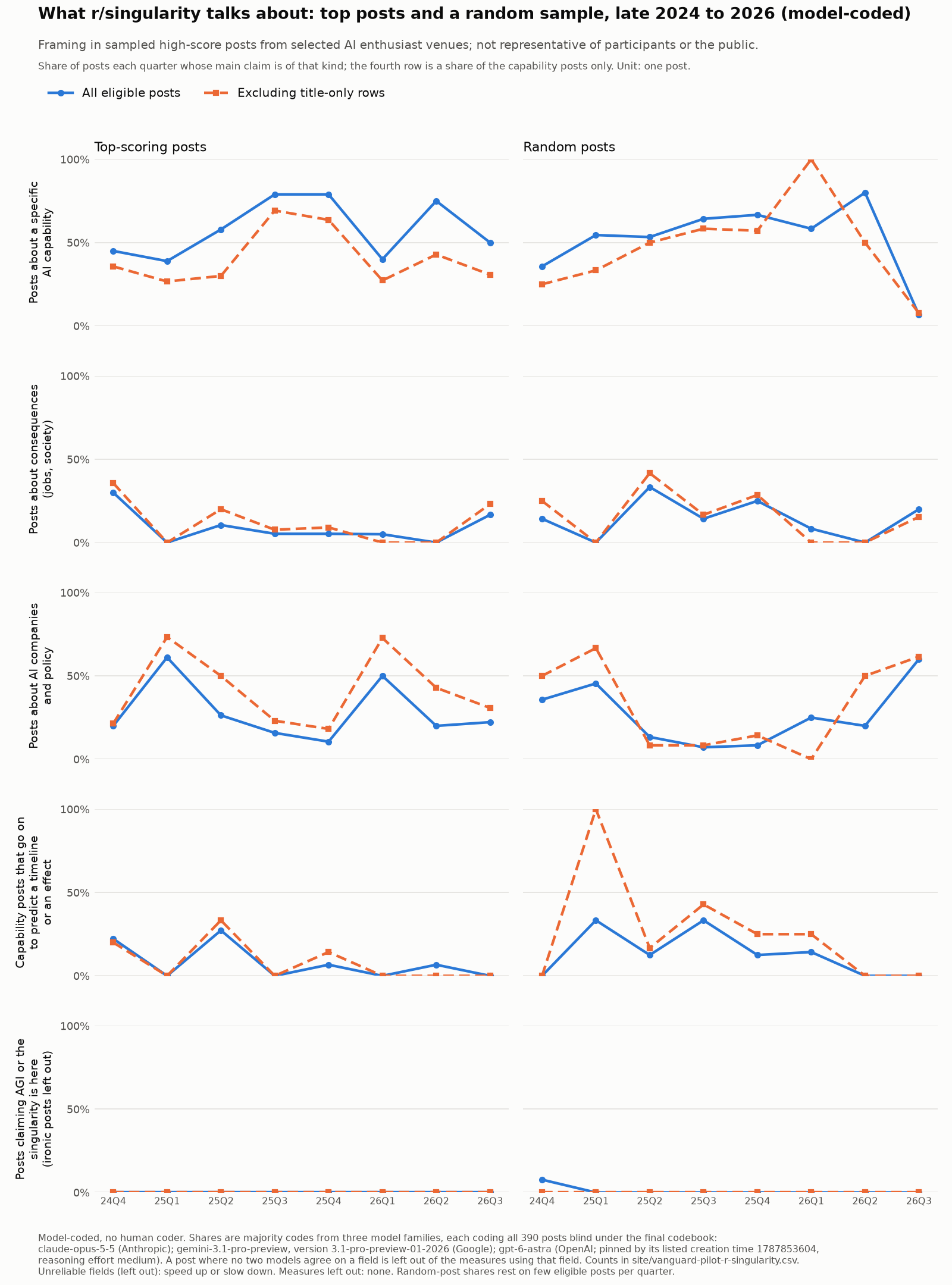
Figure
site/vanguard-pilot-r-singularity.png (counts in
site/vanguard-pilot-r-singularity.csv), labelled
"model-coded" and captioned "Framing in sampled high-score posts from
selected AI enthusiast venues; not representative of participants or the
public."
Results (majority codes, all 390 posts, final codebook)
Written 2026-10-08. The figure is now drawn from the majority codes
(scripts/vanguard_figure.py), not from Claude's first pass.
Three things about how the numbers are counted:
- Main claim only. The majority file holds one row per post: the main claim (the one the title states) and the post-level fields. Secondary claims were never compared across the models, so the claim-kind shares say what the post's main claim is about. A post whose main claim is a capability but which also makes a consequence claim counts as a capability post. Earlier versions of this report counted any claim in the post from Claude's first pass, which is the main reason the consequence shares are lower here (each model finds a consequence claim somewhere in about twice as many posts as have one as the main claim).
- Unresolved fields. Where no two models agree on a
field, the post is left out of every measure that uses that field (it
cannot be put on either side). Per quarter the counts are in the
figure's table (
posts_left_out_unresolved); all quarters together, 3 top posts and 1 random post have no majority on what the main claim is about, and the headline measure, which uses four fields, leaves out 13 top posts and 8 random posts. - Irony. The codebook records irony
(
rhetorical_mode) but does not say whether an ironic post can affirm a headline claim. The figure leaves posts coded ironic out of the headline count (an agent reading, not a ruling; see the run record, 2026-10-08).
Primary measures. Share of eligible posts by what the main claim is about, all quarters together. Denominators differ because of the unresolved posts above; 156 top posts and 104 random posts are counted in all.
| measure | top posts | random posts |
|---|---|---|
| main claim is a specific capability (a model, benchmark, robot or demo) | 89 of 153 (58%) | 52 of 103 (50%) |
| main claim is a consequence (jobs, society, the economy) | 14 of 153 (9%) | 16 of 103 (16%) |
| main claim is industry and governance (AI company and policy drama) | 43 of 153 (28%) | 28 of 103 (27%) |
| capability posts that extrapolate to a timeline or consequence | 7 of 89 (8%) | 8 of 51 (16%) |
| headline claims (poster affirms; ironic posts left out) | 0 of 143 (0%) | 1 of 96 (1%) |
Leaving out posts coded from the title alone (59 of the 156 top posts, 37 of the 104 random posts): capability 40% and 42%; consequence 13% and 20%; industry and governance 41% and 32%; extrapolation 8% and 30%; headline claims 0 and 0.
By quarter, capability main claims range from 39% (2025Q1) to about 80% (2025Q3, 2025Q4) of top posts, and industry-and-governance claims peak in 2025Q1 (11 of 18; DeepSeek, Stargate, the Musk–Altman fight) and 2026Q1 (10 of 20; Anthropic and the Pentagon). Extrapolation from a capability to a timeline or consequence is uncommon throughout: at most 3 of 11 capability posts in any quarter of top posts.
Headline claims, near-absent (poster affirms; any of AGI already achieved, AGI by a stated horizon, self-improvement under way, singularity framing): no top post in the whole window and 1 random post (2024Q4, an AGI forecast with a stated horizon). Three top posts affirm "AGI achieved" or singularity framing by majority but are coded ironic by majority (the titles "AGI 🚀", "AGI achieved" and "Post-Singularity Free Healthcare"), so they are left out; counting them would give 3 of 143 (2%). One more "AGI achieved" top post (2025Q2) has no majority on whether the poster agrees. AGI main claims of any kind are 4% of top posts (6 of 156) and 6% of random posts (6 of 104); self-improvement main claims 0 and 1.
Samples. Top posts: the 230 posts screened in the first pass were coded by all three models; 161 are eligible by majority. The 20-eligible cut-off was re-applied per quarter from the majority codes: rank 26 in 2024Q4, 26 in 2025Q2, 27 in 2025Q3, 30 in 2026Q1 and 28 in 2026Q2, leaving 5 eligible posts below those ranks out. Three quarters fall short of 20: 2025Q1 has 19 eligible among ranks 1 to 29, 2025Q4 has 19 among ranks 1 to 32 and 2026Q3 has 18 among ranks 1 to 26; every screened post counts there, and reaching 20 would need the three models to code further down each quarter's ranked reserve. 156 top posts are counted. Random posts: 160 screened, 104 eligible by majority, all counted. Exclusion reasons are each model's own and are not voted; the majority file records only whether the post counts.
Agreement
Three models, all 390 posts, final codebook (2026-10-07)
This is the check the figure rests on. Cohen's kappa (agreement
corrected for chance) for each pair of models; n is the number of posts
both coders counted. "Whether the post counts" is compared on all 390
posts; the other fields on the posts both models in the pair found
eligible. "No majority" is the share of the 265 posts the majority finds
eligible where all three gave a different answer. Full table:
data/vanguard/three-model-reliability-full-final.csv.
| What is coded | Claude–Gemini | Claude–GPT | Gemini–GPT | No majority | Script's verdict |
|---|---|---|---|---|---|
| Whether the post counts | 0.91 (390) | 0.91 (390) | 0.94 (390) | 0% | reliable |
| What the claim is about | 0.77 (259) | 0.83 (254) | 0.76 (258) | 2% | reliable |
| Timing (already here, forecast, …) | 0.65 (259) | 0.63 (254) | 0.63 (258) | 5% | reliable |
| Whether the poster agrees | 0.75 (259) | 0.63 (254) | 0.56 (258) | 3% | reliable |
| Hedging | 0.73 (259) | 0.66 (254) | 0.54 (258) | 0% | reliable |
| Tone of the post | 0.74 (259) | 0.75 (254) | 0.79 (258) | 0% | reliable |
| Whether the poster wants it faster or slower | 0.46 (259) | 0.59 (254) | 0.45 (258) | 0% | unreliable (every pair below 0.6; ruled unreliable by John, 2026-10-03) |
| Whose claim it is | 0.72 (259) | 0.71 (254) | 0.71 (258) | 1% | reliable |
| Coded from the title alone | 0.99 (259) | 0.99 (254) | 1.00 (258) | 0% | reliable |
| Projects to a time horizon | 0.75 (259) | 0.72 (254) | 0.73 (258) | 1% | reliable |
Under John's test (unresolved on more than 15% of posts, or every pairwise kappa below 0.6), every field passes except whether the poster wants AI sped up or slowed down, which is kept out of figures. The figure's five measures use whether the post counts, what the claim is about, timing, whether the poster agrees, tone (for the irony exclusion), projects to a time horizon and coded from the title alone; all pass, so all five panels are drawn. Gemini and GPT agree less with each other than either does with Claude on whether the poster agrees (0.56) and on hedging (0.54); both fields still pass because the other two pairs clear 0.6.
Earlier check: the 140-post subset, before the rules (2026-10-03)
Kept for the record; superseded by the table above. Cohen's kappa for
each pair of models. "Whether the post counts" is compared on all 140
posts; the other fields on the posts both models in the pair found
eligible (78 to 85). "Unresolved" is the share of the 88 posts the
majority finds eligible where no two models agree. Full table:
data/vanguard/three-model-reliability.csv.
| field | Claude–Gemini | Claude–GPT | Gemini–GPT | unresolved | verdict |
|---|---|---|---|---|---|
| whether the post counts | 0.82 | 0.82 | 0.91 | 0% | reliable |
| what the main claim is about | 0.57 | 0.62 | 0.75 | 6% (5 posts) | reliable |
| forecast or already happened | 0.66 | 0.66 | 0.77 | 5% | reliable |
| whether the poster agrees | 0.38 | 0.36 | 0.69 | 1% | reliable |
| hedging | 0.22 | 0.18 | 0.56 | 2% | unreliable |
| irony | 0.60 (0.595) | 0.57 | 0.58 | 3% | unreliable |
| whether the poster wants AI sped up or slowed down | 0.55 | 0.43 | 0.65 | 0% | reliable |
| whose claim it is | 0.67 | 0.64 | 0.78 | 1% | reliable |
| coded from the title only | 0.97 | 0.97 | 1.00 | 0% | reliable |
| draws a timeline or consequence from a capability | 0.71 | 0.64 | 0.65 | 0% | reliable |
On this subset, under John's test, hedging and irony were unreliable. Both pass on the full sample under the final codebook (table above). No field came close to the 15% unresolved limit.
Claude was the outlier on this subset. Gemini and GPT agreed with each other more than either agreed with Claude on almost every field. Whether the poster agrees passes only because the Gemini–GPT pair reaches 0.69, and what the main claim is about passes because two pairs reach 0.6. The same-family check (two copies of Claude, before the rulings: kappa 0.87 on what the claim is about) badly overstated reliability.
Codebook rules R1 to R3, before and after
Where things stand (2026-10-04). John adopted R2 and
R3 on 2026-10-03 (now in docs/vanguard/codebook.md) and
split R1 into two rules to be trialled separately: R1a for whether the
poster agrees and R1b for whose claim it is. Their results are in the
next section. On 2026-10-04 he adopted R1a, with a sentence on jokes and
reaction titles added, and rejected R1b. The first trial below is now
complete on all 140 posts.
The rules are in
docs/vanguard/proposed-rules-2026-10-03.md:
- R1, posts passed on without comment: these are "passes it on without taking a side" unless the poster adds words endorsing or rejecting the claim, and the claim is attributed to its source.
- R2, company and policy news or capability: the target is decided by the subject of the main claim (a model or system, a company or government, or people and society), not by which company is named.
- R3, hedging: "qualified" only if the words stating the claim contain a hedge word from a set list.
All three models recoded the 140 posts with the three rules added.
Each rule targets a different field, so they were tested together.
Claude and GPT coded all 140 posts on 2026-10-03. Gemini coded 112 that
day, when its daily request limit ran out, and the last 28 on 2026-10-04
under the same frozen codebook
(docs/vanguard/codebook-frozen-2026-10-03-before-rules.md).
Kappa before and after on all 140 posts:
| field | rule | Claude–Gemini | Claude–GPT | Gemini–GPT |
|---|---|---|---|---|
| what the main claim is about | R2 | 0.57 → 0.82 | 0.62 → 0.85 | 0.75 → 0.79 |
| whether the poster agrees | R1 | 0.38 → 0.75 | 0.36 → 0.74 | 0.68 → 0.63 |
| hedging | R3 | 0.21 → 0.77 | 0.18 → 0.53 | 0.56 → 0.56 |
| whose claim it is | (R1 side effect) | 0.66 → 0.69 | 0.64 → 0.81 | 0.78 → 0.57 |
| whether the poster wants AI sped up or slowed down | (none targeted) | 0.55 → 0.52 | 0.43 → 0.65 | 0.65 → 0.47 |
| irony | (none targeted) | 0.60 → 0.71 | 0.57 → 0.75 | 0.58 → 0.74 |
| forecast or already happened | (none targeted) | 0.66 → 0.75 | 0.65 → 0.74 | 0.77 → 0.71 |
With the rules, hedging and irony pass the test. On the first 112 posts (the figures John ruled on) the rows read much the same, with two exceptions: hedging between Gemini and GPT was 0.55 → 0.62 and is now 0.56 → 0.56, and whose claim it is between Gemini and GPT was 0.80 → 0.62 and is now 0.78 → 0.57.
How to read this:
- The Gemini–GPT column is the cleanest test. Between Gemini's and GPT's two runs only the rules changed. The Claude trial codes came from fresh coders, so the Claude pairs mix the rules' effect with the change of coder.
- R2 helps in every pair, including Gemini–GPT (0.75 → 0.79). R3 helps a lot in the Claude pairs but not between Gemini and GPT (0.56 → 0.56 on all 140 posts). Hedging still passes the test through Claude–Gemini (0.77); the fresh-sample check should look at it closely.
- R1 brings Claude into line but slightly lowers Gemini–GPT agreement, both on whether the poster agrees (0.68 → 0.63) and on whose claim it is (0.78 → 0.57). The trial coders found that R1 has no default when a post names no source, and no answer for a model's own output in a screenshot. Refinement for John to consider: when no source is named, attribution = original; a model's output = lab_or_company.
- Optimistic by construction. The rules were written from disagreements on these same posts, so they will look better here than on new posts. Any rule John adopts is checked again on a fresh sample (section 9).
- Other refinements the trial coders raised:
- R3: an "if" that sets a condition is not a hedge.
- R2: a launch or release decision is the company's act, but what the product does is a capability claim. When a title makes both claims, the main claim needs a tie-break.
- R1: "denies" means rejecting that the claim is true. Disliking what is reported goes in development preference.
The trial codes (*-rules-trial.csv) aren't used in any
figure or count.
R1a and R1b, each tried alone (ruled 2026-10-04: R1a adopted with the reactions sentence, R1b rejected)
Run 2026-10-03 (Claude, GPT) and 2026-10-04 (Gemini) on the same 112
posts (data/vanguard/r1-split-trial-posts.csv), with
today's codebook (R2 and R3 adopted) plus one rule each. Each run serves
as the other's comparison, so "without" means the same codebook, day and
models with only the rule under test missing
(vanguard_three_way.py --r1-split). The 90% ranges come
from resampling the posts 2,000 times
(scripts/vanguard_r1_bootstrap.py).
| field | rule | Claude–Gemini | Claude–GPT | Gemini–GPT |
|---|---|---|---|---|
| whether the poster agrees | R1a | 0.45 → 0.78 | 0.50 → 0.74 | 0.53 → 0.65 |
| whose claim it is | R1b | 0.77 → 0.83 | 0.75 → 0.72 | 0.78 → 0.75 |
- R1a decides whether the field is usable. Without it every pair is below 0.6, so whether the poster agrees fails John's test; with it every pair passes. The gain is clear in both Claude pairs (+0.13 to +0.51 and +0.05 to +0.44) and likely between Gemini and GPT (−0.11 to +0.37; R1a higher in 82% of resamples).
- R1b makes no measurable difference (every range spans zero), and the field passes without it.
- What's left: most remaining stance disagreements under R1a are posts whose only words are a reaction or joke ("HOLY SHIT", "This… could be something…"). The original R1 had a sentence for this that the split dropped.
Decision packet (recommendation followed by John's ruling: refine and
adopt R1a; reject R1b):
docs/vanguard/decision-packet-r1a-r1b-2026-10-04.md. The
split-trial codes (*-r1a-trial.csv,
*-r1b-trial.csv) aren't used in any figure or count.
Edge calls still open
- Reposts without comment: settled 2026-10-04 by R1a (stance, including reactions and jokes); attribution follows the field definition.
- "Capability" for the extrapolation field: two
first-pass coders counted AGI and self-improvement claims as capability
claims; the figure measures extrapolation among posts with a
specific_capabilityclaim only. - Drama borderlines: celebrity use of a product (Katy Perry subscribing to Claude), satire about labs, and government action not aimed at an AI company (the DOGE intern post, kept ineligible).
Decisions for John
Rules R1a and R1bruled 2026-10-04: R1a adopted with the reactions sentence, R1b rejected. (R2 and R3 adopted 2026-10-03.)Where the figure's numbers come fromdone 2026-10-08: the full-sample run finished on 2026-10-07 and the figure is drawn from the majority codes (Results above).- Two agent readings to confirm or overrule (made 2026-10-08 while redrawing the figure; run record of that date): posts coded ironic do not count as affirming a headline claim (3 top posts affected); and the claim-kind shares count the main claim only, because secondary claims were never compared across the models.
- The three short quarters. 2025Q1, 2025Q4 and 2026Q3 have 19, 19 and 18 eligible top posts by majority, not 20. Reaching 20 means having all three models code the next few posts down each quarter's ranked reserve (a handful of posts, a few cents each for Gemini and GPT); or the shortfall can stand and be disclosed, as it is now.
Not done
The full-sample run is complete (2026-10-07) and the figure uses it (2026-10-08). Not done: the three short quarters above; the cross-era sample and the comment sample (deferred); and the section 12 preconditions (venue inventory, X decision). No other venue was collected.
Rendered from docs/vanguard/pilot-report-r-singularity-2026-10.md at commit 5cc5451.