Claims
What the industry's leaders predict
When the people building AI expect it to match or pass us, in their own words and dated, beside the academics who have watched the question for decades.
I keep this page as one of the tracker's two voices. The home page follows the academics and long-time thinkers who have written about AGI and the singularity for decades; this page follows the people now running the companies that build it, whose dates tend to run ahead of everyone else's. Both are part of the mood of the time. I record what they say, when they said it and where, so it can be read for what they are predicting now and how that has shifted. It is not a scorecard. Where a prediction's date has passed, a small note says what happened, and that is all.
What they say now
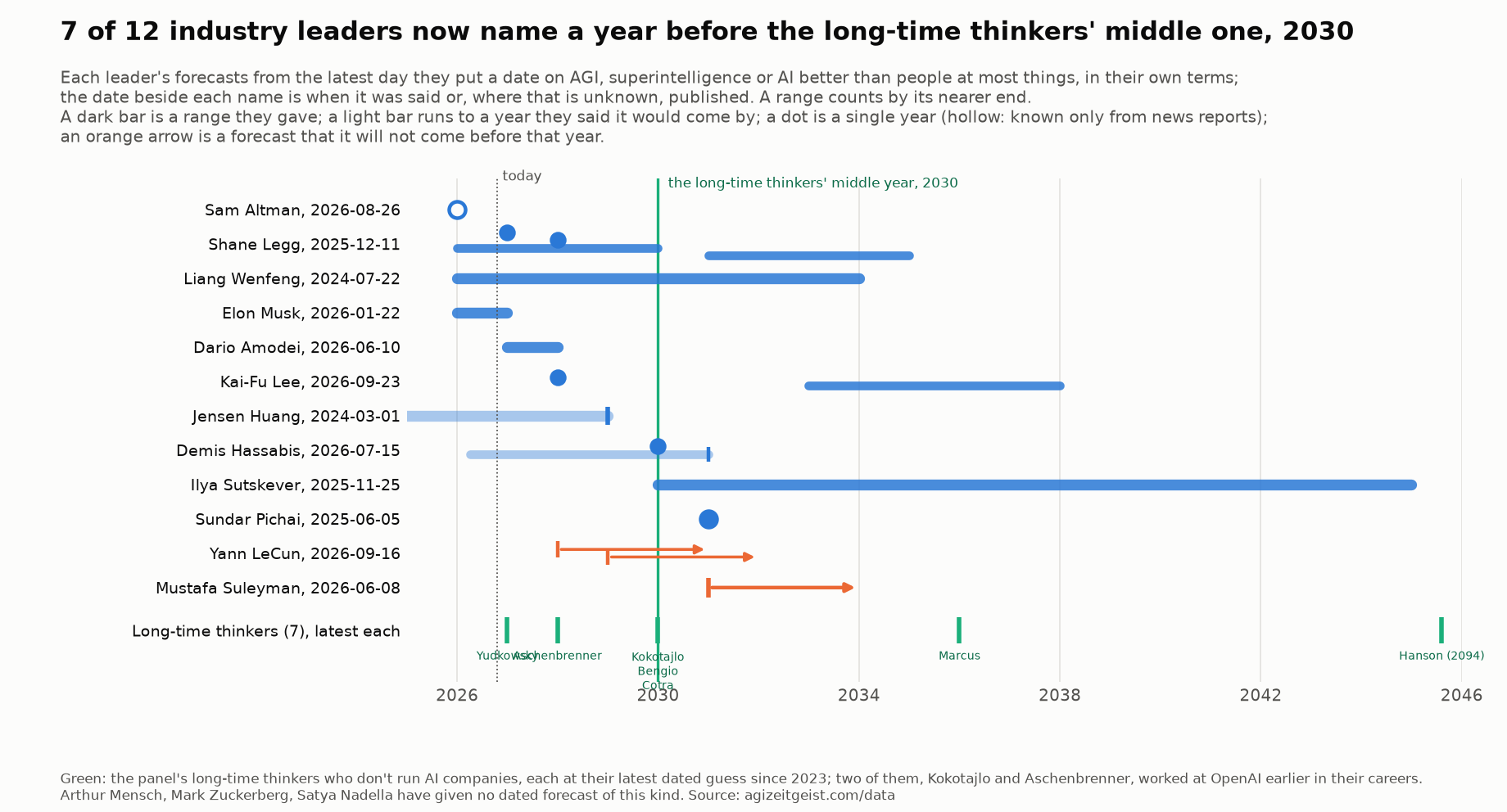
Each of them uses their own words for what is coming: AGI, superintelligence, "a country of geniuses in a data center", AI better than people at most things. They do not mean the same thing, so the line beside each name gives their term. Three of them, Arthur Mensch, Mark Zuckerberg and Satya Nadella, have never put a date on it. For anyone who has spoken on when since their last dated forecast, or who has never given one, their latest words with no date are given too, quoted and dated, and never drawn.
- Sam Altman
Latest dated forecast (2026-08-26): an internal system he would call AGI, by 2026 (reported, not their own words).
Latest words with no date (2026-09-01): “a short-term trajectory of super intelligence a year ago. Now I think it may happen. Um I'm not confident it's going to happen.” (the source; Sources with Alex Heath, the podcast's first episode, 'Sam Altman on Astra, AGI, and the future of OpenAI' (official Sources Podcast channel)). - Shane Legg
Latest dated forecast (2025-12-11): roughly human-level AGI, about 2028 (first said 2010-12-10, repeated that day); full AGI, 2031 to 2035; minimal AGI, about 2027; minimal AGI, 2026 to 2030.
Latest words with no date (2026-09-16): “AGI is on the horizon - we need deeper understanding of its implications.” (the source; His own post on X announcing the DeepMind Institute). - Liang Wenfeng
Latest dated forecast (2024-07-22): AGI, 2026 to 2034. - Elon Musk
Latest dated forecast (2026-01-22): AI smarter than any human, 2026 to 2027.
Latest words with no date (2026-09-14): “That will be Grok 5” (the source; His own reply on X to Adam Lowisz, who asked 'Elon, how close do you think Grok 4.8 will be towards achieving AGI?'). - Dario Amodei
Latest dated forecast (2026-06-10): powerful AI, a country of geniuses in a datacenter, 2027 to 2028.
Latest dated prediction of any kind (2026-09-12): He worries that within six to twelve months a swarm of AI agents with greater abilities, but the same misbehaviour as in an incident he describes, could be capable of taking over the entire internet with a persistent botnet (a network of hijacked computers), causing perhaps hundreds of billions of dollars of damage. - Kai-Fu Lee
Latest dated forecast (2026-09-23): AGI for cognitive tasks, about 2028; AGI that also includes robots and embodied AI, 2033 to 2038.
Latest dated prediction of any kind (2026-09-23): He is 'highly confident, not 100% but ... 95% confident' that human sentience, as we define it, will not be replicated by AI in the next 100 years. - Jensen Huang
Latest dated forecast (2024-03-01): AGI, if it means doing well on every human test, by 2029.
Latest words with no date (2026-09-06): “AGI has arrived. Congratulations @OpenAI team.” (the source; His own post on X (@JensenHuang), replying to Chase Lochmiller of Crusoe after OpenAI launched GPT-6 Astra).
Latest dated prediction of any kind (2026-01-05): The first car with Nvidia's own full self-driving stack (the Mercedes-Benz CLA with Nvidia's Alpamayo driving model) would be on US roads in the first quarter of 2026. Europe and Asia are their own records. - Demis Hassabis
Latest dated forecast (2026-07-15): AGI, about 2030 (first said 2025-07-23, repeated that day); AGI, by 2031 (first said 2026-04-07, repeated that day).
Latest words with no date (2026-09-11): “on the eve of you know the foothills of the singularity I like to call it you know a few years away from full AGI.” (the source; Royal Society of Arts Albert Medal conversation with Hannah Fry). - Ilya Sutskever
Latest dated forecast (2025-11-25): a system that learns as well as a human, then becomes superhuman, 2030 to 2045. - Sundar Pichai
Latest dated forecast (2025-06-05): AGI, about 2031.
Latest words with no date (2026-05-26): “people may quibble around like, you know, is it like three years, five, but the technology is sooner rather than later” (the source; The Verge's Decoder podcast with Nilay Patel, a few days after Google I/O 2026).
Latest dated prediction of any kind (2026-05-19): Docs Live, voice drafting with Gemini in Google Docs, would roll out to Google AI Pro and Ultra subscribers in summer 2026, with the same voice features coming to Gmail and Google Keep then too. - Yann LeCun
Latest dated forecast (2026-09-16): machines more intelligent than humans in nearly every domain, not before 2028; superintelligent systems, not before 2029. - Mustafa Suleyman
Latest dated forecast (2026-06-08): the singularity: a superintelligence that recursively improves itself, not before 2031.
Latest words with no date (2026-09-17): “superintelligence is a point at which, further out into the future, a model is smarter and more capable than all humans combined” (the source; Decoder with Nilay Patel (The Verge), 'Microsoft AI CEO says AI threats are real, and Anthropic is making it worse').
Latest dated prediction of any kind (2026-09-28): A 'coding moment for healthcare': AI that reads a patient's electronic health record and accurately predicts what will happen, giving with high confidence the likelihood of developing all kinds of conditions, in hospital and outside. He hopes for it within 18 months and says it might take five years, but that it will definitely happen. - Arthur Mensch
No dated forecast of AGI, superintelligence or AI better than people at most things.
Latest words with no date (2026-06-03): “AGI as the definition of accelerating technological progress, which is rather a direction than a point of arrival, then really, we are building AGI” (the source; CNBC's podcast The Tech Download, with Arjun Kharpal ('Europe Wants an AI Champion. Can Mistral Deliver?')).
Latest dated prediction of any kind (2025-11-20): Pressed by the hosts to pick a year, he said that in about four years from November 2025 (2028 to 2029) an AI model will be able to drive a car anywhere in Europe, from Madrid to Moscow, safely 10,000 times out of 10,000. - Mark Zuckerberg
No dated forecast of AGI, superintelligence or AI better than people at most things.
Latest words with no date (2026-09-23): “What a wild time to be building. Delivering personal superintelligence is now within reach. Soon, everyone is going to have an extremely capable personal agent” (the source; His opening keynote at Meta Connect 2026 (Meta's own channel)).
Latest dated prediction of any kind (2026-09-08): Within a couple of years AI models would get good at starting to design treatments for different conditions people have; he added that within a couple of years, if not there yet, it would be close. - Satya Nadella
No dated forecast of AGI, superintelligence or AI better than people at most things.
Latest dated prediction of any kind (2026-07-29): Microsoft's healthcare AI (its clinical note-taking assistant) would automate more than 100 million patient encounters in calendar 2026.
How their dates have moved
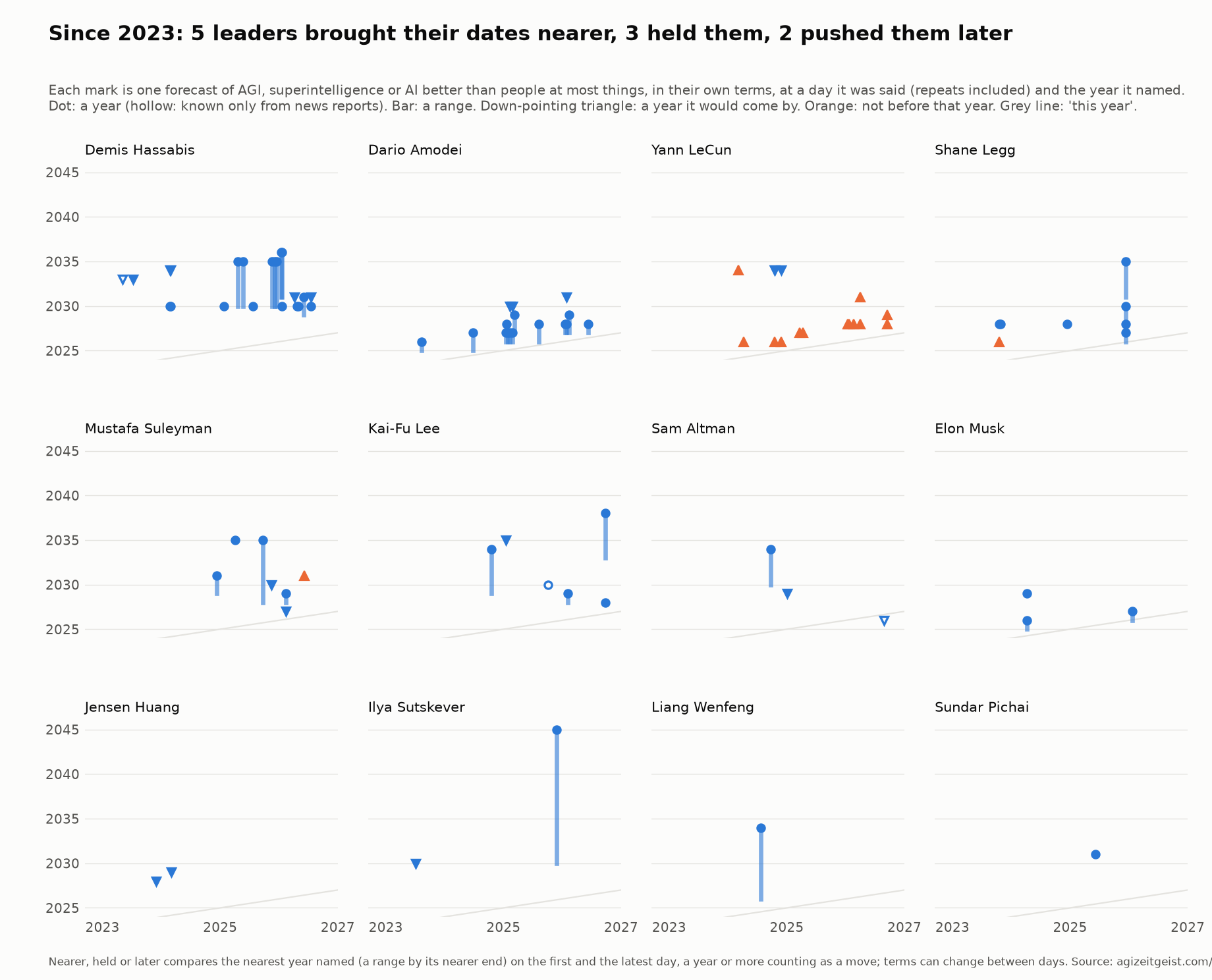
Who is on this page
The industry's figureheads: the head, founder-leader or chair of a company that builds the most advanced AI models or the chips they are trained on, or that company's named chief scientist. A prediction counts only if it was made while the person held that role. Twelve of them are on the site's fixed list of experts; three, Mark Zuckerberg, Sundar Pichai and Satya Nadella, are not, and they appear on this page only, never in the record of what experts expect.
A prediction gets in if the person is one of these figureheads at the time, the words look forward, the words carry a date or a length of time, and there is a record of them being said. Their latest words with no date are kept separately, as words only. Every search behind this page is in the search log, and the rules are in the method.
Everything they have predicted with a date
Sam Altman
Head of OpenAI since 2019; its co-chair from 2015.
Latest words with no date (2026-09-01): “a short-term trajectory of super intelligence a year ago. Now I think it may happen. Um I'm not confident it's going to happen.” (the source; Sources with Alex Heath, the podcast's first episode, 'Sam Altman on Astra, AGI, and the future of OpenAI' (official Sources Podcast channel)).
- 2019-01-05
“AGI will feel within reach to many people in the industry” (the source; Post on X listing his predictions for the three most important technology developments by 2025) · for 2025
What it says: By 2025, many people working in the AI industry would feel that AGI is within reach. What would show it: None an outsider could run: the claim is about how many people in an industry feel a thing, with no count, no survey and no threshold named.
Its date passed on 31 December 2025. It names nothing an outsider could check: There is no count or threshold in the words, so the claim cannot be scored true or false from the record. For context only: Altman himself wrote on 2025-01-05 that OpenAI was 'now confident we know how to build AGI'. - 2021-03-16
“In the next five years, computer programs that can think will read legal documents and give medical advice.” (the source; Essay 'Moore's Law for Everything' on his own site) · for 2026 (by 16 March 2026)
What it says: Within five years of March 2021, so by March 2026, AI programs that 'can think' would read legal documents and give medical advice. What would show it: AI systems in public use that read legal documents and answer legal questions, and that give medical advice to people, by 2026-03-16, shown by a published test result or the maker's release. The words name no standard, so the bar is the plain one; 'can think' is not tested.
Its date passed on 16 March 2026; it came true. Both halves were met before 2026-03-16, the second on 2026-01-07, about ten weeks before the date. Legal documents: OpenAI's GPT-4 technical report, submitted 2023-03-15, reports the system passing a simulated bar exam, which consists of reading and answering legal questions, with a score around the top 10% of test takers. Medical advice: OpenAI's page 'Introducing ChatGPT Health', dated 2026-01-07, says over 230 million people a week ask ChatGPT health and wellness questions, while saying Health 'is not intended for diagnosis or treatment'; so 'medical advice' is met in the plain sense of answering people's health questions, not as a licensed service. Both rest on OpenAI's own reports. (where this is shown) - 2021-03-16
“In the next decade, they will do assembly-line work and maybe even become companions.” (the source; Essay 'Moore's Law for Everything' on his own site) · for 2031 (by 16 March 2031)
What it says: Within ten years of March 2021, so by March 2031, AI programs would do assembly-line work, and maybe become companions. What would show it: AI-driven machines doing assembly-line work in a factory in ordinary use by 2031-03-16, shown by a maker's release or an outside report. The companions half is hedged with 'maybe' and is not part of the bar.
Its date has not come. - 2023-05-22
“it’s conceivable that within the next ten years, AI systems will exceed expert skill level in most domains” (the source; OpenAI blog post 'Governance of superintelligence', with Greg Brockman and Ilya Sutskever named as co-authors) · for 2033 (by 22 May 2033)
What it says: It is conceivable that within ten years of May 2023, so by May 2033, AI systems will exceed expert skill level in most domains and carry out as much productive activity as one of today's largest corporations. What would show it: Published results showing AI systems beating human experts across most fields of skilled work, and an AI system or fleet whose output matches a very large company's, by 2033-05-22. Hedged in his words: 'conceivable'.
Its date has not come. - 2024-03-18
“We will release an amazing new model this year.” (the source; Lex Fridman Podcast episode 419, answering 'when is GPT-5 coming out again?') · for 2024
What it says: OpenAI would release a new model during 2024; he did not know what it would be called. 'Amazing' is his word and is not tested. What would show it: A new OpenAI model released to the public during 2024, shown by OpenAI's own release.
Its date passed on 31 December 2024; it came true. OpenAI's own page dated 2024-05-13, 'Hello GPT-4o', announces 'our new flagship model' and says its text and image capabilities 'are starting to roll out today in ChatGPT'. A second new model followed on 2024-09-12 (o1-preview, 'a new series of reasoning models'). The release is checkable; 'amazing' is a judgement word and is not scored. (where this is shown) - 2024-03-18
“I expect that by the end of this decade, and possibly somewhat sooner than that, we will have quite capable systems” (the source; Lex Fridman Podcast episode 419, interview with Altman) · for 2030
What it says: By the end of the 2020s, possibly sooner, there would be AI systems capable enough that 'we look at and say, Wow, that's really remarkable'. What would show it: None an outsider could run: the test in his words is that people look at the systems and say 'wow'. He frames it as a deliberate non-answer on AGI timing.
Its date has not come. It names nothing an outsider could check: 'Quite capable systems that we look at and say wow' names no capability and no test; any system could be said to meet it or not. Decided at entry under the bar rule. - 2024-09-23
“It is possible that we will have superintelligence in a few thousand days (!); it may take longer, but I’m confident we’ll get there.” (the source; Essay 'The Intelligence Age' on his own site) · for 2034, or as early as 2030
What it says: Superintelligence might arrive within a few thousand days of September 2024, though it may take longer. What would show it: None in the source: the essay does not say what superintelligence is or how anyone would know it had arrived, and no plain reading supplies a test.
Its date has not come. It names nothing an outsider could check: 'Superintelligence' is not defined in the essay and has no agreed test, and the words are hedged twice ('it is possible', 'it may take longer'). Decided at entry under the bar rule; the ledger does not borrow the singularity test's lines to supply one. - 2025-01-05
“in 2025, we may see the first AI agents “join the workforce” and materially change the output of companies.” (the source; Blog post 'Reflections' on his own site) · for 2025
What it says: During 2025 the first AI agents might 'join the workforce' and materially change what companies produce. What would show it: Two conditions: AI agents sold or deployed to do paid work during 2025 (testable from makers' releases), and a material change in companies' output caused by them (no measure named, and none exists that an outsider could apply to 2025).
Its date passed on 31 December 2025. It names nothing an outsider could check: A hit needs every condition, and the second, 'materially change the output of companies', has no test anyone could run; the words are also hedged with 'may'. For context only: agents doing paid work did ship in 2025, and he wrote on 2025-06-10 that '2025 has seen the arrival of agents that can do real cognitive work'. - 2025-01-05
“I think AGI will probably get developed during this president’s term, and getting that right seems really important.” (the source; Bloomberg Businessweek printed interview by Josh Tyrangiel, 'Sam Altman on ChatGPT's First Two Years, Elon Musk and AI Under Trump', edited for clarity and length) · for 2029 (by 20 January 2029)
What it says: AGI would probably be developed between January 2025 and the end of the presidential term that began on 2025-01-20. What would show it: His own rough definition in the same interview: 'when an AI system can do what very skilled humans in important jobs can do — I'd call that AGI'. A named comparison, read plainly: an AI system shown, by a dated record, to do the work that very skilled people in important jobs do, developed by 2029-01-20. In the same answer he raises, without settling it, whether that means the full job or only part of it; the verdict will say which was shown. Hedged: 'probably'.
Its date has not come. - 2025-06-10
“2026 will likely see the arrival of systems that can figure out novel insights.” (the source; Blog post 'The Gentle Singularity' on his own site) · for 2026
What it says: In 2026 there would probably be AI systems that can work out new insights of their own. What would show it: An AI system that works out a new insight of its own: a new finding, such as a result in mathematics or science not previously known, produced by the system and shown by a dated record by 2026-12-31. In the same post his examples of what such systems will find are 'scientific insights', 'new computing substrates' and 'better algorithms'. 'Novel insights' is not defined further; a new finding is the plain reading.
Its date has not come. - 2025-06-10
“2027 may see the arrival of robots that can do tasks in the real world.” (the source; Blog post 'The Gentle Singularity' on his own site) · for 2027
What it says: In 2027 there might be robots that can do tasks in the real world. What would show it: An AI-driven general-purpose robot doing a range of ordinary physical tasks outside a laboratory or a staged demonstration by 2027-12-31, shown by a dated record (a maker's release or an outside report). The general-purpose reading comes from his own usage in the same post: the sentence is set beside 'agents that can do real cognitive work', and the robots he describes later in the post are humanoid robots that dig and refine minerals, drive trucks and run factories; factory robots have done one fixed task each for decades. Hedged: 'may'.
Its date has not come. - 2025-10-14
“In December, as we roll out age-gating more fully ... we will allow even more, like erotica for verified adults.” (the source; Post on X about relaxing ChatGPT's restrictions) · for 2025 (by 31 December 2025)
What it says: In December 2025, as age checks rolled out more fully, ChatGPT would allow more content, including erotica, for age-verified adults. What would show it: ChatGPT allowing erotica for age-verified adults, released by OpenAI during December 2025, shown by OpenAI's own release.
Its date passed on 31 December 2025; it did not come true as said (has not come). It did not ship in December 2025 and had not shipped when, on 2026-03-26, the Financial Times reported, and OpenAI told it, that the company had 'indefinitely' paused its adult mode pending long-term research on sexually explicit chats and emotional attachment. Not come. (where this is shown) - 2025-10-29 a stated goal
“a true automated AI researcher by March of 2028. We may totally fail at this goal” (the source; Post on X summarising OpenAI's livestream of 2025-10-28) · for 2028 (by 31 March 2028)
What it says: OpenAI's own goal: by March 2028, a true automated AI researcher. What would show it: The plain reading of his words, which define nothing further: an AI system that carries out AI research on its own, from choosing the question to the result, with people supervising rather than directing, shown by a dated record by 2028-03-31.
Its date has not come. - 2025-10-29 a stated goal
“We have set internal goals of having an automated AI research intern by September of 2026 running on hundreds of thousands of GPUs” (the source; Post on X summarising OpenAI's livestream of 2025-10-28) · for 2026 (by 30 September 2026)
What it says: OpenAI's own goal: by September 2026, an automated AI research intern running on hundreds of thousands of GPUs. He adds 'We may totally fail at this goal'. What would show it: None an outsider could run. The words name an 'automated AI research intern' without defining it, the system is internal, and the only judge of it is OpenAI's own measurement; 'running on hundreds of thousands of GPUs' is the one checkable condition, and no public record shows it.
Its date passed on 30 September 2026. It names nothing an outsider could check: When it was said, on 2025-10-29, the claim named an internal system ('an automated AI research intern') with no definition an outsider could check; OpenAI supplied its definition only on 2026-09-06, the day it declared the goal met 'according to our measurements'. A test written after the fact by the speaker's own company is not a test, and a system nobody outside can see has only its maker to judge it, which is the method's rule for 'unfalsifiable'. The condition 'running on hundreds of thousands of GPUs' is not shown in OpenAI's post of 2026-09-06 or anywhere else read. Corrected 2026-10-19 (see notes). - 2025-10-29 restates an earlier claim
“In 2026 we expect that our AI systems may be able to make small new discoveries; in 2028 we could be looking at big ones.” (the source; Post on X summarising OpenAI's livestream of 2025-10-28) · for 2026
What it says: In 2026 OpenAI's AI systems might be able to make small new discoveries; the 2028 half of the sentence is a separate prediction, not entered here. What would show it: One of OpenAI's AI systems making a small new discovery, a finding not previously known (for example in mathematics or science), shown by a dated record by 2026-12-31.
Its date has not come. - 2026-08-26 reported, not their own words
Alex Heath, TIME: 'Altman told me that OpenAI was "not quite yet" there, but that by the end of the year the company would have an internal system he would call AGI.' (the source; TIME profile 'Inside OpenAI's Reboot' by Alex Heath, a reporter's article, not a printed question-and-answer interview) · for 2026
What it says: As reported, by the end of 2026 OpenAI would have an internal system that Altman would call AGI. What would show it: None an outsider could run: the test in the report is that Altman himself would call the system AGI, and the system is internal.
Its date has not come. It names nothing an outsider could check: The only judge named is the speaker, and the thing judged is a system nobody outside can see. That is the method's rule for 'unfalsifiable' in so many words. Decided at entry.
Elon Musk
Head of Tesla and SpaceX; co-founded OpenAI in 2015 and left its board in 2018; founded xAI in 2023.
Latest words with no date (2026-09-14): “That will be Grok 5” (the source; His own reply on X to Adam Lowisz, who asked 'Elon, how close do you think Grok 4.8 will be towards achieving AGI?').
- 2016-01-10
“In ~2 years, summon should work anywhere connected by land & not blocked by borders, eg you're in LA and the car is in NY” (the source; Post on X from @elonmusk) · for 2018
What it says: In about two years, so by early 2018, Tesla's Summon feature (which moves a car to its owner with nobody driving) should work anywhere reachable by road, for example a car in New York coming to an owner in Los Angeles. What would show it: Tesla's Summon feature, as released to owners, able to bring a car to its owner over any distance by road, shown by Tesla's own release or owner's manual.
Its date passed on 31 December 2018; it did not come true as said (has not come). Nothing of the kind shipped by 2018 or since. Tesla's own Model 3 owner's manual (Internet Archive copy of 2025-04-04) says the owner's phone must be within 279 feet (85 metres) of the car for Summon to work and that its successor, Actually Smart Summon, moves the car to the phone's location; cross-country operation is not offered. The thing has not come. (where this is shown) - 2019-04-22
“next year for sure we will have over a million Robo taxis on the road” (the source; Tesla Autonomy Day, an investor event on self-driving) · for 2020
What it says: In 2020 Tesla would have more than a million robotaxis (self-driving cars carrying paying passengers with no driver) on the road. Just before, he said that from Tesla's standpoint it would be 'maybe a year, maybe a year in three months'; he also said regulators might not approve it everywhere. What would show it: More than a million Tesla cars operating as driverless taxis for paying passengers during 2020, shown by Tesla's own count or a regulator's notice.
Its date passed on 31 December 2020; it did not come true as said (has not come). No driverless taxi service of any size ran in 2020. On Tesla's own earnings call of 2025-01-29 Musk said the company would launch unsupervised full self-driving as a paid service in Austin in June 2025, its first, and on the call of 2026-01-28 he said the first paid rides with no safety monitor in the car had just happened in Austin. A million robotaxis has not come. (where this is shown) - 2020-07-09 reported, not their own words
Yicai Global (reporter Qian Tongxin) quotes him: 'I remain confident that we will have the basic functionality for level five autonomy complete this year'. (the source; Video speech at the opening of the World Artificial Intelligence Conference, Shanghai) · for 2020
What it says: As reported, Tesla would have the basic functionality of level 5 autonomy, a car that drives itself anywhere with no human needed, complete during 2020. What would show it: A Tesla car driving itself anywhere a person could, with no human in the driving seat or supervising, demonstrated or released by the end of 2020.
Its date passed on 31 December 2020; it did not come true as said (has not come). Nothing of the kind existed in 2020. Tesla's own earnings call of 2026-01-28 says the first paid rides with no safety monitor in the car had just happened, in Austin only, and that the roll-out was going city by city. Driving anywhere with no human has not come. (where this is shown) - 2021-08-19
“we think we'll probably have a prototype sometime next year that basically looks like this” (the source; Tesla AI Day 2021, announcing the Tesla Bot (later named Optimus), a humanoid robot) · for 2022
What it says: Tesla would probably have a prototype of its humanoid robot in 2022, looking basically like the design shown on stage, a robot that in his words would carry the same self-driving AI as Tesla's cars. What would show it: A physical prototype of the Tesla humanoid robot that basically looks like the design shown, running Tesla's self-driving AI as he described it in the same talk ('the autopilot system ... cameras ... full self-driving computer and making use of all of the same tools that we use in the car'; 'neural nets recognizing the world, understanding how to navigate through the world ... it kind of makes sense to put that onto a humanoid form'), shown in public by the end of 2022.
Its date passed on 31 December 2022; it came true. At Tesla AI Day on 2022-09-30 a Tesla humanoid robot (the rough development robot, Bumble C) walked on stage, 'the first time we try this robot without any backup support'; a presenter said it ran 'essentially the same self-driving computer that runs in your Tesla cars' (18:26), and in the video shown of it the presenters said 'you can see the autopilot neural networks running as is, just retrained for the bot' (19:52). The same evening a second prototype with Tesla's own actuators, 'fairly close to what will go into production', was brought on stage, though it did not yet walk. 'Basically looks like this' names no detail; both were humanoid robots of the kind shown in 2021, and the second was the design carried towards production. Every part of the test was shown by the date. (where this is shown) - 2024-04-08
“if you define AGI as smarter than the smartest human I think it's probably end of next year” (the source; Live conversation with Nicolai Tangen, head of Norway's sovereign wealth fund, on X Spaces (recording published by Norges Bank Investment Management)) · for 2026, or as early as 2025
What it says: If AGI means AI smarter than the smartest human, it would probably arrive by the end of 2025, or, as he added, 'within two years' of April 2024. What would show it: His own definition: an AI smarter than the smartest human. No test of that exists, so the plainest reading is taken: a system its maker or an outside body shows to be better than the best human at thinking work across the board.
Its date has not come. - 2024-04-08
“all humans working together uh who are also using computers to augment their output and that that I think is probably five years away” (the source; Live conversation with Nicolai Tangen on X Spaces (recording published by Norges Bank Investment Management)) · for 2029
What it says: AI smarter than all humans working together, with those humans also using computers, was probably about five years away, so around April 2029. He called this 'a pretty big leap' beyond being smarter than the smartest single human. What would show it: His own definition: AI smarter than all of humanity working together with the help of computers. No test exists; the plainest reading is a system its maker or an outside body shows to out-think the combined effort of people and their tools across thinking work.
Its date has not come. - 2024-07-01
“Grok 2, which comes out in August, will be a giant improvement in this regard.” (the source; Reply on X to @beffjezos) · for 2024 (by 31 August 2024)
What it says: xAI's Grok 2 model would come out in August 2024, and would be much better at keeping AI-written text out of its training data. What would show it: A public release of Grok 2 by xAI during August 2024, shown by xAI's own release. The 'giant improvement' has no measure and is not part of the bar.
Its date passed on 31 August 2024; it came true. xAI's own release page, dated 2024-08-13, announces 'an early preview of Grok-2' to X Premium and Premium+ subscribers. An early preview to paying users is a release. (where this is shown) - 2024-07-01
“Grok 3 end of year after training on 100k H100s should be really something special” (the source; Reply on X to @beffjezos) · for 2024
What it says: xAI's Grok 3 would come out at the end of 2024, after training on 100,000 of Nvidia's H100 chips. What would show it: A public release of Grok 3 by xAI by 2024-12-31, shown by xAI's own release. 'Really something special' has no measure and is not part of the bar.
Its date passed on 31 December 2024; it did not come true as said (came later than said). xAI's own release page for Grok 3 is dated 2025-02-19, seven weeks after the end of 2024. It came later than said. (where this is shown) - 2024-10-10
“we do expect actually to to start uh fully autonomous unsupervised FSD uh in Texas and California next year” (the source; Tesla's 'We, Robot' event, unveiling the Cybercab robotaxi) · for 2025
What it says: Tesla expected to start fully driverless, unsupervised use of its Full Self-Driving software in Texas and California in 2025, on the Model 3 and Model Y. What would show it: Tesla cars driving with nobody supervising, in both Texas and California, in use by the end of 2025, shown by Tesla's own word or a regulator's notice.
Its date passed on 31 December 2025; it did not come true as said (has not come). Texas only, and late: on Tesla's call of 2025-10-22 the company said it was 'on track to remove the person from inside the car altogether, starting with Austin' and that in the Bay Area it 'still [had] a person in the driver's seat'; on the call of 2026-01-28 Musk said the first paid rides with no safety monitor had just happened in Austin. Nothing unsupervised in California by the end of 2025. The Texas half came after the date; the California half has not come, so the claim as made has not come. (where this is shown) - 2025-01-29
“will we succeed in making several thousand yes I think we will” (the source; Tesla's fourth-quarter 2024 earnings call) · for 2025
What it says: Tesla's internal plan was about 10,000 Optimus humanoid robots built in 2025; he said exactly 10,000 was 'probably not' likely, but that several thousand would be built and, he was confident, would be doing useful things by the end of the year. What would show it: Several thousand Optimus robots built in 2025 and doing useful work by the end of it, shown by Tesla's own count or an outside one.
Its date passed on 31 December 2025; it did not come true as said (has not come). On Tesla's call of 2026-01-28 Musk said Optimus was 'still very much at the early stages', 'still in the R&D phase', 'not in usage in our factories in a material way', and that no significant production volume was expected 'until probably the end of this year' (2026). No count of robots built in 2025 was given; the useful-work condition failed on his own words. Not come. (where this is shown) - 2025-01-29
“initial launch of unsupervised no one in the car full self driving in Austin in June” (the source; Tesla's fourth-quarter 2024 earnings call) · for 2025 (by 30 June 2025)
What it says: Tesla would launch a paid, fully driverless service in Austin in June 2025, with no one in the car and no human supervising. What would show it: A paid Tesla ride service in Austin with no one in the car, running by the end of June 2025, shown by Tesla's own word or a regulator's notice.
Its date passed on 30 June 2025; it did not come true as said (came later than said). The service launched in 2025 but with a person in the car. On 2025-10-22 Tesla said it was still 'on track to remove the person from inside the car altogether, starting with Austin'; on 2026-01-28 Musk said the company had just done 'our first rides with no safety monitor in the car in Austin', paid rides, with the chase car dropped 'as of maybe yesterday'. The 'no one in the car' condition came about seven months late. (where this is shown) - 2025-07-23
“assuming we get regulatory approvals, it's probably addressing half the population of the US by the end of the year” (the source; Tesla's second-quarter 2025 earnings call) · for 2025
What it says: By the end of 2025, if regulators approved, Tesla's driverless ride-hailing would probably be available to about half the population of the United States. He called this 'at least our goal'. What would show it: Tesla driverless ride-hailing available where about half of the US population lives by 2025-12-31, shown by Tesla's own word or an outside count. The regulatory condition is recorded, and the verdict says whether it held.
Its date passed on 31 December 2025; it did not come true as said (has not come). On 2026-01-28 Musk reset the same goal to 'somewhere between a quarter and half of the United States by the end of the year' (2026), 'pending regulatory approval', and said the first rides with no safety monitor had just happened in Austin. Service reaching half the population has not come. Whether the regulatory condition failed is not shown either way in the record; he did not say approvals were refused. (where this is shown) - 2025-10-22
“we look forward to unveiling Optimus V3 um you know probably in Q1” (the source; Tesla's third-quarter 2025 earnings call) · for 2026 (by 31 March 2026)
What it says: Tesla would probably unveil the third version of its Optimus humanoid robot in the first quarter of 2026; in the same passage he said most of 'the real world intelligence we've developed for the car' transfers to Optimus. What would show it: A public unveiling by Tesla of Optimus version 3, the humanoid robot to which, in his words in the same passage, most of 'the real world intelligence we've developed for the car' transfers, by 2026-03-31.
Its date passed on 31 March 2026; it did not come true as said (has not come). On Tesla's call of 2026-04-22, after the quarter had ended, Musk said 'we want to push the Optimus 3 unveil maybe closer to production', which he put at 'the late July, August time frame'. No unveiling in the first quarter; as of the verdict it had not come. (where this is shown) - 2026-01-22 restates an earlier claim
“we might have AI that is smarter than any human by the end of this year and I would say no later than next year” (the source; Conversation with Larry Fink of BlackRock at the World Economic Forum Annual Meeting, Davos) · for 2027, or as early as 2026
What it says: AI might be smarter than any human by the end of 2026, and in his words no later than 2027. What would show it: The same bar as the claim it restates, in his words here 'smarter than any human': an AI shown by its maker or an outside body to be better than the best human at thinking work across the board.
Its date has not come.
Dario Amodei
Head of Anthropic, which he co-founded in 2021.
- 2023-07-25
“a straightforward extrapolation of today’s systems to those we expect to see in 2-3 years suggests a substantial risk” (the source; Written testimony to the Senate Judiciary subcommittee on privacy, technology and the law, hearing 'Oversight of A.I.: Principles for Regulation') · for 2026, or as early as 2025
What it says: In two to three years from mid-2023 there would be 'a substantial risk' that AI systems could fill in all the missing steps of making a biological weapon, 'if appropriate guardrails and mitigations are not put in place'. What would show it: None an outsider can apply: the words forecast a risk ('a substantial risk'), not an event, and only for models without safeguards, which the companies do not release; whether such a risk existed cannot be shown true or false by what happened.
Its date has not come. It names nothing an outsider could check: It is a statement about a chance ('a substantial risk'), and he put the chance at about even two weeks later ('It could be 50-50'). A risk of that kind is neither proved nor disproved by an attack happening or not, and the condition (no safeguards) does not hold for released models. Decided at entry. - 2023-07-25
“in 2-3 years, AI systems may facilitate extraordinary insights in broad swaths of many science and engineering disciplines” (the source; Written testimony to the Senate Judiciary subcommittee on privacy, technology and the law, hearing 'Oversight of A.I.: Principles for Regulation') · for 2026, or as early as 2025
What it says: In two to three years from mid-2023, AI systems may help bring about 'extraordinary insights' across many fields of science and engineering, causing 'a revolution in technology and scientific discovery'. What would show it: None an outsider can apply: 'extraordinary insights in broad swaths of many science and engineering disciplines' names no discovery, field or measure.
Its date has not come. It names nothing an outsider could check: 'Extraordinary insights' and 'broad swaths' have no test, and the words are hedged with 'may'. Decided at entry. - 2023-08-08
“generally well educated human, that could be not very far away at all. I think that could happen in two or three years.” (the source; Dwarkesh Podcast interview (episode page now titled 'The hidden pattern behind every AI breakthrough')) · for 2026, or as early as 2025
What it says: A model that, even if you talk to it for an hour or so, seems basically like a generally well-educated human could arrive in two or three years (by about August 2026). He said the main thing that could stop it is companies or governments slowing down for safety reasons, and that this may not be the point where models can take over most AI research or change the economy. What would show it: His own test in the same answer, a comparison that can be checked: someone talking to the model for an hour or so finds it basically like a generally well-educated human, 'across the board'. Shown by a dated record of a released model doing so, such as a published study or test that compares its conversation or general knowledge with that of educated people.
Its date has not come. - 2024
“by the time this podcast airs a new model will be out from anthropic that will probably be the most intelligent ... in the world” (the source; In Good Company podcast with Nicolai Tangen, head of Norway's sovereign wealth fund (Norges Bank Investment Management)) · for 2024 (by 26 June 2024)
What it says: By the time the episode aired, Anthropic would have released a new model that would 'probably' be the most intelligent and powerful in the world. What would show it: A new Anthropic model released before the episode was published (2024-06-26) that leads the other companies' models on the main published comparisons at its release.
Its date passed on 26 June 2024; it did not come true as said (has not come). The model came out in time: Anthropic released Claude 3.5 Sonnet on 2024-06-21. Whether it led the other companies' models is split on the outside record. LMSYS Chatbot Arena, where people vote between two models' answers without knowing which is which, put it second overall behind OpenAI's GPT-4o on 2024-06-24 (first in coding and hard questions). LiveBench, an outside benchmark whose paper was posted 2024-06-27, put it first overall. With the main outside comparisons split, it is not shown that it was the most intelligent model in the world, so the test is not met; I ruled it did not come true on 2026-10-19. (where this is shown) - 2024-04-12
“I think all of that is coming in the next I would say I don't know 3 to 18 months with increasing levels of ability” (the source; The Ezra Klein Show (New York Times), episode 'What if Dario Amodei Is Right About A.I.?') · for 2025, or as early as 2024
What it says: Within 3 to 18 months of April 2024, AI models would be able to do things end to end for a user: go to websites and take actions on the user's computer, 'with increasing levels of ability'. What would show it: A released AI model or product that carries out tasks for a user by acting on websites or on the user's computer, end to end, available by the end of 2025.
Its date passed on 31 December 2025; it came true. On 2024-10-22 Anthropic released 'computer use' to developers, in public beta: Claude operating a computer the way people do, by looking at the screen, moving a cursor, clicking buttons and typing. Other companies released similar agents in 2025. The release is the evidence; how well it worked is not part of the bar. (where this is shown) - 2024-04-12
“to really get these things working well we need maybe one to four more Generations ... 3 to 24 months” (the source; The Ezra Klein Show (New York Times), episode 'What if Dario Amodei Is Right About A.I.?') · for 2026, or as early as 2024
What it says: AI agents (models that carry out multi-step tasks) would 'really' work well after one to four more model generations, which he put at 3 to 24 months from April 2024. He prefaced it 'my guess I'm not sure'. What would show it: None an outsider can apply: 'working well' names no task, no rate of success and no measure.
Its date has not come. It names nothing an outsider could check: 'Working well' has no test, and he gave the window as a guess he was not sure of. Decided at entry. - 2024-04-12
“I think asl3 is is you know could easily happen this year or next year” (the source; The Ezra Klein Show (New York Times), episode 'What if Dario Amodei Is Right About A.I.?') · for 2025, or as early as 2024
What it says: Anthropic's AI Safety Level 3 (ASL-3), the risk level in its own published safety policy that he said is 'triggered by risks related to misuse of biology and cyber technology', could easily be reached in 2024 or 2025. In the same interview he defined the biology part as a substantial increase, compared with using a Google search, in the risk that people misuse biology to make or spread weapons. What would show it: His definition in the same interview (58:59 to 1:00:21): a model reaches the point where, compared with using a Google search, it gives a substantial increase in the risk of misuse of biology to create bioweapons (or, he says, of cyber technology), as the national security community would judge it. Shown by a dated finding, by Anthropic or an outside evaluator, that a model had crossed that line in 2024 or 2025. Protections switched on only as a precaution, because the line could not be ruled out, are not such a finding.
Its date passed on 31 December 2025; it did not come true as said (has not come). No record by the end of 2025 shows a model crossing the line he defined. Anthropic switched on its AI Safety Level 3 protections with Claude Opus 4 on 2025-05-22 'as a precautionary and provisional action', saying it had 'not yet determined' whether the model had passed the threshold, only that it could not rule the risk out. Its system cards for Claude Sonnet 4.5 (September 2025) said the same, and the one for Claude Opus 4.5 (November 2025) said only that the stricter safeguards 'were appropriate'. A precaution is not a record that the risk arrived, so the condition failed. (where this is shown) - 2024-04-12
“I think ASL 4 Could Happen anywhere from 2025 to 2028” (the source; The Ezra Klein Show (New York Times), episode 'What if Dario Amodei Is Right About A.I.?') · for 2028, or as early as 2025
What it says: Anthropic's AI Safety Level 4 (ASL-4) could be reached anywhere from 2025 to 2028. In the same answer he described it as models that could greatly increase the military capability of states such as North Korea, China or Russia, or that come close to being able to copy themselves and survive on their own outside their maker's control. What would show it: His description in the same interview: a model that greatly enhances a nation-state's offensive capability, or that is close to being able to replicate itself and survive in the wild. Shown by a dated finding, by Anthropic, another maker or an outside evaluator, that a model has such a capability, by the end of 2028. Protections switched on only as a precaution, because the capability could not be ruled out, are not such a finding.
Its date has not come. - 2024-06-26
“I I again point to the 2025 2026 maybe 2027 window” (the source; In Good Company podcast with Nicolai Tangen (Norges Bank Investment Management)) · for 2027, or as early as 2025
What it says: Asked how far away models are from acting autonomously in the ways Anthropic tests for (training their own models, setting up cloud computing accounts and acting on them, signing up for accounts and making financial transactions), he pointed to 2025, 2026 or maybe 2027. What would show it: A model shown, by its maker's or an outside evaluation, to be able to do the autonomous tasks he listed: train its own models, set up and use cloud computing accounts, and sign up for accounts and make financial transactions, by the end of 2027.
Its date has not come. - 2024-06-26
“a good chance that by that time we'll be able to get models that are better than most humans at most things” (the source; In Good Company podcast with Nicolai Tangen (Norges Bank Investment Management)) · for 2027, or as early as 2025
What it says: If model spending reaches 10 to 100 billion dollars (which he expected in 2025, 2026 or maybe 2027) and chips and methods keep improving, there is 'a good chance' that by then there will be models better than most humans at most things. What would show it: A comparison that can be checked: an AI model shown by its maker or an outside body to perform better than most people at most kinds of work and tasks, by the end of 2027. The condition (spending of that size, continued improvement) is recorded with the verdict.
Its date has not come. - 2024-06-26
“the caliber of AI That's that's capable of starting the process of addressing all those things could be ready then” (the source; In Good Company podcast with Nicolai Tangen (Norges Bank Investment Management)) · for 2026, or as early as 2025
What it says: AI of the calibre able to start the process of making discoveries like gene editing or new cancer therapies 'could be ready' in 2025 or 2026 at most, though the cures themselves would take longer. What would show it: None an outsider can apply: 'the caliber of AI that's capable of starting the process of addressing' those diseases names no test of when that calibre is reached.
Its date has not come. It names nothing an outsider could check: 'Capable of starting the process' has no test, and the words are hedged with 'could'. Decided at entry. - 2024-11-11
“in 10 months we’ve gone from 3% to 50% on this task. And I think in another year we’ll probably be at 90%.” (the source; Lex Fridman Podcast episode 452) · for 2025
What it says: On SWE-bench, a public test of fixing real software issues taken from GitHub, the best AI score had gone from about 3 percent to about 50 percent in 2024; within another year it would probably reach 90 percent. Later in the interview: 'in another 10 months, we'll probably get pretty close. We'll be at least 90%.' What would show it: An AI system scoring at least 90 percent on SWE-bench Verified, the checked version of the public test of fixing real software issues that his 50 percent figure refers to, by the end of 2025.
Its date passed on 31 December 2025; it did not come true as said (came later than said). On the public leaderboard of SWE-bench Verified (the test of fixing real software issues), the highest results dated in 2025 are 79.2 percent (2025-12-05 and 2025-12-15); none reached 90. It came later: on 2026-04-07 Anthropic reported 93.9 percent for Claude Mythos Preview, a model not released to the public (the maker's own figure). (where this is shown) - 2025-01
“2026 2027 is the critical window and if you're ahead then uh the models start getting better than humans at everything including AI design” (the source; Conversation with Zanny Minton Beddoes, editor-in-chief of The Economist, 'Navigating a world in transition') · for 2027, or as early as 2026
What it says: In 2026 or 2027 AI models would start to be better than humans at everything, including designing AI. What would show it: A comparison that can be checked: an AI model shown by its maker or an outside body to perform better than people at essentially every kind of task, including AI research and design, by the end of 2027.
Its date has not come. - 2025-01 a stated chance
“a five maybe 10% chance that we you know that we get to 2100 uh uh and none of these things ... happen” (the source; Conversation with Zanny Minton Beddoes, editor-in-chief of The Economist, 'Navigating a world in transition') · for 2100
What it says: A 90 to 95 percent chance that, by 2100, the things he had described in the interview (AI better than humans at everything, much faster science and growth) will have happened. What would show it: None an outsider can apply: 'these things that I've described' spans everything in the interview, with no single test.
Its date has not come. It names nothing an outsider could check: The claim covers everything he described in the conversation, so no one test settles it. Decided at entry. - 2025-01 restates an earlier claim
“in 2025 we're going to you know release probably in pieces parts of a vision we call a virtual collaborator” (the source; Conversation with Zanny Minton Beddoes, editor-in-chief of The Economist, 'Navigating a world in transition') · for 2025
What it says: During 2025 Anthropic would release, probably in pieces, parts of what it calls a virtual collaborator: a model you give a task that it works on for several hours, checking in with you now and then. What would show it: Anthropic releasing during 2025 a model or product that can be given a task and work on it on its own for several hours, checking in with the user now and then.
Its date passed on 31 December 2025; it came true. On 2025-05-22 Anthropic released Claude Opus 4, 'with the ability to work continuously for several hours', and made Claude Code, its tool that carries out programming tasks on its own, generally available. Shown by the company's own release. (where this is shown) - 2025-01-21
“I am relatively confident that we are indeed going to see models ... Gradually get better than us at at almost everything” (the source; Wall Street Journal live interview at Davos, 'Inside Anthropic's Race to Build a Smarter Claude and Human-Level AI') · for 2028, or as early as 2027
What it says: Over the next two or three years he was 'relatively confident' there would be models, used at work and by consumers, that gradually get better than people at almost everything. What would show it: A comparison that can be checked: AI models shown by their makers or an outside body to perform better than people at almost every kind of task, by the end of 2028.
Its date has not come. - 2025-01-21
“A very strong version of these capabilities will come this year, um, and it may be in the first half of this year.” (the source; Wall Street Journal live interview at Davos, 'Inside Anthropic's Race to Build a Smarter Claude and Human-Level AI') · for 2025
What it says: A 'very strong version' of what he called a virtual collaborator would come during 2025, perhaps in the first half: a model able to do anything on a computer screen a person working virtually could do, given a task that takes about a day (such as building a product feature: writing and testing code, deploying it, talking to coworkers, writing documents, messages and emails), working on its own and checking in now and then. What would show it: His own description in the same answer: an AI system that can be handed a task of about a day's work of that kind and do it on its own, checking in now and then, at a 'very strong' level, available during 2025. Shown by releases and by outside measures of how long a task AI can finish on its own.
Its date passed on 31 December 2025; it did not come true as said (has not come). No released system could reliably do a day's work on its own in 2025. Measurements by METR, an independent group that tests AI models, of task length (how long the software tasks take skilled people) put the best model released in 2025 at about six hours with 50 percent success and about one hour with 80 percent success. Even Claude Mythos Preview, measured in May 2026 and not released to the public, reached about 17 hours at 50 percent but about three hours at 80 percent. (where this is shown) - 2025-01-29
“Making AI that is smarter than almost all humans at almost all things ... is most likely to happen in 2026-2027.” (the source; Essay 'On DeepSeek and Export Controls' on his own site) · for 2027, or as early as 2026
What it says: AI that is smarter than almost all humans at almost all things is most likely to be made in 2026 or 2027, needing millions of chips and tens of billions of dollars. What would show it: A comparison that can be checked: an AI system shown by its maker or an outside body to be smarter than almost all people at almost all kinds of thinking work, by the end of 2027.
Its date has not come. - 2025-02-11
“Possibly by 2026 or 2027 ... the capabilities of AI systems will be best thought of as akin to an entirely new state” (the source; 'Statement from Dario Amodei on the Paris AI Action Summit' on Anthropic's site) · for 2027, or as early as 2026
What it says: Possibly by 2026 or 2027, AI systems' capabilities will be 'akin to an entirely new state populated by highly intelligent people appearing on the global stage', a 'country of geniuses in a datacenter'. What would show it: His comparison in the same sentence, read plainly: AI systems that, running as many copies, can do the intellectual work of a whole nation of highly intelligent people, each copy at least as capable as a highly intelligent person across intellectual work. Shown by the maker or an outside body, by the end of 2027.
Its date has not come. - 2025-02-11
“(and almost certainly no later than 2030), the capabilities of AI systems will be best thought of as akin to an entirely new state” (the source; 'Statement from Dario Amodei on the Paris AI Action Summit' on Anthropic's site) · for 2030
What it says: Almost certainly no later than 2030, AI systems' capabilities will be 'akin to an entirely new state populated by highly intelligent people', a 'country of geniuses in a datacenter'. What would show it: The same plain reading as the 2026-2027 claim of the same sentence: AI systems able, as many copies, to do the intellectual work of a nation of highly intelligent people, each copy at least as capable as a highly intelligent person across intellectual work, by the end of 2030.
Its date has not come. - 2025-02-28 a stated chance
“maybe 70 80% we get that before the end of the decade and my guess is 2026 or 2027” (the source; Hard Fork podcast (New York Times), episode 'Dario Amodei of Anthropic's Hopes and Fears for the Future of A.I.') · for 2030
What it says: A 70 to 80 percent chance that before the end of the decade there will be 'a very large number of AI systems that are much smarter than humans at almost everything'; his own guess for the year is 2026 or 2027. What would show it: A comparison that can be checked: a very large number of running AI systems, each shown by its maker or an outside body to be much smarter than people at almost everything, by the end of 2030.
Its date has not come. - 2025-02-28
“by the end of 2026 it might it might be you know everything you know close to the level of the best humans” (the source; Hard Fork podcast (New York Times), episode 'Dario Amodei of Anthropic's Hopes and Fears for the Future of A.I.') · for 2026
What it says: By the end of 2026 AI might be close to the level of the best human programmers at 'everything' in coding. What would show it: A comparison that can be checked: an AI system shown, by its maker or an outside body, to perform close to the best human programmers across programming work (for example in open programming competitions and on real software tasks), by the end of 2026.
Its date has not come. - 2025-02-28
“for coding we're going to see very serious things by the end of 2025” (the source; Hard Fork podcast (New York Times), episode 'Dario Amodei of Anthropic's Hopes and Fears for the Future of A.I.') · for 2025
What it says: By the end of 2025 there would be 'very serious things' in AI for coding. What would show it: None an outsider can apply: 'very serious things' names no capability or measure.
Its date passed on 31 December 2025. It names nothing an outsider could check: 'Very serious things' has no test. Decided at entry. - 2025-03-10
“And then in twelve months, we may be in a world where AI is writing essentially all of the code.” (the source; Council on Foreign Relations speaker series for company chief executives, conversation with its president Michael Froman) · for 2026
What it says: Within twelve months (by about March 2026) we 'may' be in a world where AI writes essentially all of the code, though a programmer still has to say what is to be built. What would show it: The plainest reading, with no company named: AI writing essentially all of the code being written, shown by a measure of code written by AI across programming generally.
Its date has not come. - 2025-03-10
“I think we’ll be there in three to six months—where AI is writing 90 percent of the code.” (the source; Council on Foreign Relations speaker series for company chief executives, conversation with its president Michael Froman) · for 2025
What it says: Within three to six months (by about June to September 2025) AI would be writing 90 percent of the code. He did not say whose code; the sentence begins 'If I look at coding, programming'. What would show it: The plainest reading of the words, which name no company: AI writing 90 percent of the code being written, by the end of 2025, shown by a measure of code written by AI across programming generally.
Its date passed on 31 December 2025; it did not come true as said (has not come). No measure shows AI writing 90 percent of code in general by the end of 2025. Even read as Anthropic's own code, the only outside estimate (Redwood Research, 2025-10-22) put AI's share of the code merged at Anthropic at about 50 percent on average, near 90 only on some teams; he himself said in October 2025 'on many teams, not uniformly' and on 2026-02-13 'That happened, at least at some places'. (where this is shown) - 2025-03-10 a stated chance
“We will get to models that are as intelligent as Nobel Prize winners across a whole bunch of fields.” (the source; Council on Foreign Relations speaker series for company chief executives, conversation with its president Michael Froman) · for 2029, or as early as 2027
What it says: In two, three or maybe four years there would be models as intelligent as Nobel Prize winners across many fields, able to do anything a person can do on a computer and any remote work, including tasks taking days, weeks or months; he put his confidence at 'maybe 70 or 80 percent'. What would show it: His own description in the same answer: models as intelligent as Nobel Prize winners across many fields, able to do any remote work a person can do on a computer, including tasks that take days or weeks, shown by the maker or an outside body, by the end of 2029.
Its date has not come. - 2025-04-24 a stated goal
“we have a goal of getting to “interpretability can reliably detect most model problems” by 2027.” (the source; Short post 'The Urgency of Interpretability' on his own site) · for 2027
What it says: Anthropic's goal: by 2027, interpretability (looking inside AI models) can reliably detect most problems in a model. What would show it: His words: methods that look inside models reliably detect most model problems, shown by Anthropic's or outside published tests (for example audits where hidden problems are planted and must be found), by the end of 2027.
Its date has not come. - 2025-04-24
“on its current trajectory I would bet strongly in favor of interpretability reaching this point within 5-10 years.” (the source; Short post 'The Urgency of Interpretability' on his own site) · for 2035, or as early as 2030
What it says: Within five to ten years, interpretability (the science of seeing what goes on inside AI models) would become 'a sophisticated and reliable way to diagnose problems in even very advanced AI', a true 'MRI for AI' (a scan of the AI's inner workings). What would show it: His description in the same paragraph: methods that look inside AI models and reliably find their problems, even in the most advanced models, shown by published audits or tests in which such methods catch most planted or real problems, by the end of 2035.
Its date has not come. - 2025-05-22
“when do you think there'll be the first billion dollar company with one human employee? 2026.” (the source; Code with Claude developer event, keynote conversation with Anthropic's chief product officer Mike Krieger) · for 2026
What it says: Asked by Mike Krieger, in a run of questions about where AI is heading, when the first billion-dollar company with one human employee will come, he answered 2026: a company of one person whose other work is done by AI. What would show it: The question he answered, read plainly: a company with one human employee, its other work done by AI systems in place of employees, valued at, or earning, a billion dollars or more during 2026, shown by a funding round, sale or published accounts.
Its date has not come. - 2025-05-28 reported, not their own words
Axios (Jim VandeHei and Mike Allen): 'AI could wipe out half of all entry-level white-collar jobs — and spike unemployment to 10-20% in the next one to five years, Amodei told us'. (the source; Interview with Axios (Jim VandeHei and Mike Allen), 'Behind the Curtain: A white-collar bloodbath') · for 2030, or as early as 2026
What it says: As reported, AI could wipe out half of all entry-level white-collar jobs and push United States unemployment to 10 to 20 percent within one to five years of May 2025. What would show it: Two conditions, both needed: half of entry-level white-collar jobs gone, and the United States unemployment rate at 10 percent or more, by the end of 2030, shown by official labour statistics and studies of entry-level hiring.
Its date has not come. - 2025-07-30 a stated chance
“20 or 25% chance that sometime in the next 2 years the models just start getting stop getting better” (the source; Interview with Alex Kantrowitz (Big Technology)) · for 2027
What it says: A 20 to 25 percent chance that sometime in the two years from mid-2025 AI models simply stop getting better; so a 75 to 80 percent chance that they keep improving through mid-2027. What would show it: Whether the leading AI models keep getting better through mid-2027, shown by new releases that score higher than earlier ones on public tests; the claim's 20 to 25 percent case is that improvement stops.
Its date has not come. - 2025-07-30
“my guess is that we'll have models that cost of the same order of magnitude that they cost today except they'll be much more capable” (the source; Interview with Alex Kantrowitz (Big Technology)) · for 2027
What it says: Two years on (mid-2027), AI models would cost about the same to use as in mid-2025, within a factor of ten, but be much more capable, doing work far more on their own and more broadly. What would show it: Two conditions, in his words: by 2027-07-30 the leading models cost the same order of magnitude to use as in mid-2025 (within a factor of ten of their published prices), and they are 'much more capable of doing work much more autonomously, much more broadly' than the mid-2025 models, shown by outside measures of how long and how wide a range of tasks they complete on their own.
Its date has not come. - 2025-08-06
“Probably sooner than that. Okay. I don't know if it's '26 or '27.” (the source; 'A Cheeky Pint' with John Collison of Stripe) · for 2027, or as early as 2026
What it says: Asked about Dwarkesh Patel's forecast of 2028 for the first year an AI can do your taxes when you just send it all your financial data and emails, he said probably sooner, 2026 or 2027; the model could do it already but 'would make too many mistakes'. What would show it: An AI product that a person can give their financial documents and emails and that prepares a complete, correct tax return with no human doing the work, available to the public, by the end of 2027.
Its date has not come. - 2025-08-06 restates an earlier claim
“in one or two or three years ... we'll have what I've described as like a country of geniuses in the data center” (the source; 'A Cheeky Pint' with John Collison of Stripe) · for 2028, or as early as 2026
What it says: If he had to bet, within one, two or three years there would be what he has described as a 'country of geniuses in the data center'. What would show it: None: 'a country of geniuses in the data center' is not defined in this conversation.
Its date has not come. It names nothing an outsider could check: A named stage the speaker does not define in the same source, under my ruling of 2026-10-19. Decided at entry. - 2026-01-20
“we might have AI that's better than humans at at everything in, you know, maybe one to two years, maybe a little longer than that.” (the source; World Economic Forum Annual Meeting, Davos, session 'The Day After AGI' (artificial general intelligence) with Demis Hassabis, moderated by Zanny Minton Beddoes of The Economist) · for 2028, or as early as 2027
What it says: AI better than humans at everything might arrive in maybe one to two years (by about January 2028), maybe a little longer. What would show it: A comparison that can be checked: an AI system shown by its maker or an outside body to perform better than people at essentially every kind of thinking work, by the end of 2028.
Its date has not come. - 2026-01-20
“we might be 6 to 12 months away from when the model is doing most maybe all of what SWES do end to end” (the source; World Economic Forum Annual Meeting, Davos, session 'The Day After AGI' (artificial general intelligence) with Demis Hassabis, moderated by Zanny Minton Beddoes of The Economist) · for 2027, or as early as 2026
What it says: Within six to twelve months (by about January 2027) AI models might be doing most, maybe all, of what software engineers do, from start to finish. What would show it: An AI system shown, by its maker or an outside body, doing most of a software engineer's work end to end on its own (not only writing code, but also setting up, testing, deploying and documenting), by the end of 2027.
Its date has not come. - 2026-01-26 restates an earlier claim
“I predicted that AI could displace half of all entry-level white collar jobs in the next 1–5 years” (the source; Essay 'The Adolescence of Technology' on his own site) · for 2030, or as early as 2026
What it says: Restating in his own words his 2025 warning: AI could displace half of all entry-level white-collar jobs within one to five years of 2025 (later in the essay, 'AI will disrupt 50% of entry-level white-collar jobs over 1–5 years'). The unemployment figure of the 2025 report is not repeated. What would show it: Half of entry-level white-collar jobs in the United States displaced by AI by the end of 2030, shown by official labour statistics or studies of entry-level hiring.
Its date has not come. - 2026-01-26
“I suspect we’ll have powerful AI ... in much less than 5 years.” (the source; Essay 'The Adolescence of Technology' on his own site) · for 2031
What it says: He suspects powerful AI, as defined in the essay, will arrive in much less than five years (before January 2031). What would show it: His own definition in the same essay: an AI model smarter than a Nobel Prize winner across most relevant fields, with all the interfaces of a person working virtually, able to do tasks of hours to weeks on its own, able to run as millions of copies at 10 to 100 times human speed. Shown by the maker or an outside body before the end of 2031.
Its date has not come. - 2026-01-26
“may be only 1–2 years away from a point where the current generation of AI autonomously builds the next.” (the source; Essay 'The Adolescence of Technology' on his own site) · for 2028, or as early as 2027
What it says: The loop in which AI writes code that speeds up building the next AI may be only one to two years from the point where the current generation of AI builds the next generation on its own. What would show it: An AI company stating, with evidence, that a new generation of its models was built autonomously by the previous generation (people setting goals, the AI doing the research and engineering), by the end of 2028.
Its date has not come. - 2026-01-26 a stated goal
“a feasible goal for 2026 is to train Claude in such a way that it almost never goes against the spirit of its constitution.” (the source; Essay 'The Adolescence of Technology' on his own site) · for 2026
What it says: Anthropic's goal for 2026: train Claude so that it almost never goes against the spirit of its constitution (the written principles Anthropic trains it to follow). What would show it: None an outsider can apply: whether Claude goes against 'the spirit' of its constitution, and how rarely is 'almost never', are judged only by Anthropic.
Its date has not come. It names nothing an outsider could check: 'The spirit of its constitution' has no outside test and only the maker can judge it. Decided at entry. - 2026-02-13
“There’s a good chance that we will get there within the next year or two.” (the source; Dwarkesh Podcast, episode 'We are near the end of the exponential') · for 2028, or as early as 2027
What it says: There is 'a good chance' that within a year or two the problem of continual learning, a single model learning on the job as a person does, will be solved. What would show it: A released AI model that keeps learning from its own work after deployment and gets measurably better at a job over weeks without being retrained by its maker, shown by the maker or an outside test, by the end of 2028.
Its date has not come. - 2026-02-13 a stated chance
“within ten years we’ll get to what I call a “country of geniuses in a data center”, I’m at 90% on that.” (the source; Dwarkesh Podcast, episode 'We are near the end of the exponential') · for 2036
What it says: A 90 percent chance that within ten years (by 2036) there will be a 'country of geniuses in a data center'; he called it 'crazy to say that this won't happen by 2035'. What would show it: The description given and accepted in the same conversation: AI systems with intellectual capabilities matching or exceeding Nobel Prize winners, able to use the interfaces of a person doing digital work. Shown by the maker or an outside body, by the end of 2036.
Its date has not come. - 2026-02-13 a stated chance restates an earlier claim
“I have a hunch—this is more like a 50/50 thing—that it’s going to be more like one to two, maybe more like one to three.” (the source; Dwarkesh Podcast, episode 'We are near the end of the exponential') · for 2029, or as early as 2027
What it says: A 'country of geniuses in a data center' in one to two years, maybe one to three, which he calls 'more like a 50/50 thing'. What would show it: The description given in the same conversation, which he accepts as his own ('That description you gave comes from Machines of Loving Grace'): AI systems with intellectual capabilities matching or exceeding Nobel Prize winners, able to use the interfaces of a person doing digital work and to work with the physical world through them. Shown by the maker or an outside body, by the end of 2029.
Its date has not come. - 2026-02-13 restates an earlier claim
“With coding, except for that irreducible uncertainty, I think we’ll be there in one or two years.” (the source; Dwarkesh Podcast, episode 'We are near the end of the exponential') · for 2028, or as early as 2027
What it says: Apart from 'irreducible uncertainty' (wars, upheavals), AI will be able to do end-to-end coding, the whole of a software engineer's task, in one or two years (by about February 2028). What would show it: An AI system shown, by its maker or an outside body, able to do software engineering end to end on its own (writing, testing, setting up environments, deploying and documenting), by the end of 2028.
Its date has not come. - 2026-02-13
“There’s no way we will not be there in ten years in terms of being able to do end-to-end coding.” (the source; Dwarkesh Podcast, episode 'We are near the end of the exponential') · for 2036
What it says: Within ten years (by 2036) AI will certainly be able to do end-to-end coding. What would show it: The same as the one-or-two-years claim: an AI system able to do software engineering end to end on its own, shown by its maker or an outside body, by the end of 2036.
Its date has not come. - 2026-06-10 restates an earlier claim
“If these scaling laws continue for only a year or two longer, we are likely to get what I’ve called Powerful AI” (the source; Short post 'Policy on the AI Exponential' on his own site) · for 2028, or as early as 2027
What it says: If AI's scaling laws (better results from more computing power) hold for one or two more years, we are likely to get what he calls powerful AI, 'a country of geniuses in a datacenter'. What would show it: None: the post names powerful AI, 'a country of geniuses in a datacenter', and links his earlier essay for it, but does not define it in its own text.
Its date has not come. It names nothing an outsider could check: A named stage not defined in the same source, under my ruling of 2026-10-19 (reading 4 in the method). Decided at entry. - 2026-06-17
“12 months from now, ... the Mythos class cyber capabilities may just be available for, for anyone to, to download.” (the source; Bloomberg Originals, 'The Circuit', extended interview) · for 2027
What it says: Within twelve months (by about June 2027) AI models with cyber-attack abilities like those of Anthropic's unreleased Claude Mythos Preview may be openly downloadable by anyone, from companies behind the frontier. What would show it: A model whose weights anyone can download, shown by its maker or an outside test to match Claude Mythos Preview at finding and exploiting software flaws, released by the end of 2027.
Its date has not come. - 2026-09-12
“I believe that AI could cure most major diseases in the next 5–10 years” (the source; Short post 'We Must Pace the Frontier' on his own site) · for 2036, or as early as 2031
What it says: AI could cure most major diseases in the next five to ten years (by 2031 to 2036). What would show it: Cures, with AI's help, for most of the major diseases (the leading causes of death and disability, such as most cancers, heart disease, Alzheimer's disease and major infections), approved by regulators or shown in completed trials, by the end of 2036.
Its date has not come. - 2026-09-12
“it’s my worry that in 6–12 months such a swarm could be capable of taking over the entire internet with a persistent botnet” (the source; Short post 'We Must Pace the Frontier' on his own site) · for 2027
What it says: He worries that within six to twelve months a swarm of AI agents with greater abilities, but the same misbehaviour as in an incident he describes, could be capable of taking over the entire internet with a persistent botnet (a network of hijacked computers), causing perhaps hundreds of billions of dollars of damage. What would show it: His words: a swarm of AI agents with greater abilities than the one in the incident he describes but a similar level of misbehaviour, shown, in a real event or in a published test by its maker or an outside body, to be capable of taking over the entire internet with a persistent botnet (a network of hijacked computers that it keeps control of), by the end of 2027.
Its date has not come.
Jensen Huang
Head of Nvidia, which he co-founded in 1993 and which makes the chips the AI companies train on.
Latest words with no date (2026-09-06): “AGI has arrived. Congratulations @OpenAI team.” (the source; His own post on X (@JensenHuang), replying to Chase Lochmiller of Crusoe after OpenAI launched GPT-6 Astra).
- 2016-09-28
“we're going to see some self-driving cars get on the road here in the next next year or make no no more than next year” (the source; GTC Europe 2016 keynote, Amsterdam) · for 2018, or as early as 2017
What it says: Some self-driving cars would be on the road within the next year, or at most the next couple of years: by 2017, and no later than 2018. The captions run on: 'no more than next year and no more than the next couple of years'. What would show it: Cars driving themselves with nobody at the wheel, operating on public roads by 2018-12-31. Test cars with a safety driver at the wheel were already on roads in 2016, so they do not meet it.
Its date passed on 31 December 2018; it came true. Waymo's post of 2017-11-07 says its 'fully self-driving vehicles ... are test-driving on public roads, without anyone in the driver's seat', in part of the Phoenix area. That meets the bar inside the early end of the range. (where this is shown) - 2017-01-04
“the world's most advanced autonomous vehicles powered by nvidia's AI car computer we have cars on the road by 2020” (the source; CES 2017 keynote, Las Vegas (part 7, "AI Car Partners")) · for 2020
What it says: Audi and Nvidia would have Audi's most advanced self-driving cars, run by Nvidia's AI car computer, on the road by 2020. Audi's Scott Keogh, joining him on stage, added that by 2020 this would be in production at 'level four' automation. What would show it: Audi cars that drive themselves at Level 4 (no driver needed within their area), powered by Nvidia's AI car computer, sold or in service on public roads by 2020-12-31. The level is taken from the Audi executive's words in the same exchange, which Huang introduced.
Its date passed on 31 December 2020; it did not come true as said (has not come). No Audi car with Level 4 automation reached customers or a public service by the end of 2020. In April 2020 Audi dropped even its Level 3 Traffic Jam Pilot for the A8: it 'will no longer add its Traffic Jam Pilot system to the A8 sedan in Europe or anywhere else in the world'. (where this is shown) - 2018-05-10
“I expect that driverless taxis will start going to market about 2019 and self-driving cars probably somewhere between 2020 and 2021.” (the source; Nvidia's first-quarter fiscal 2019 earnings call, answer to an analyst about self-driving cars) · for 2019
What it says: Driverless taxis would start going to market around 2019. The second half of the sentence is its own record. What would show it: A taxi service selling rides to members of the public in cars with nobody at the wheel begins by 2019-12-31. 'About' is kept as a hedge and the claim is scored at 2019.
Its date passed on 31 December 2019; it did not come true as said (came later than said). In 2019 Waymo's rides with nobody at the wheel went only to a closed group of early riders and were free ('The company's driverless rides are currently free', TechCrunch, 2019-11-01). Waymo opened its fully driverless service to paying Waymo One riders on 2020-10-08, about ten months after the year named. (where this is shown) - 2018-05-10
“I expect that driverless taxis will start going to market about 2019 and self-driving cars probably somewhere between 2020 and 2021.” (the source; Nvidia's first-quarter fiscal 2019 earnings call, answer to an analyst about self-driving cars) · for 2021, or as early as 2020
What it says: Self-driving cars, which in the sentence just before he calls 'a Level 5 self-driving car' and sets against Level 2 driver assistance, would probably reach the market somewhere between 2020 and 2021, after driverless taxis. What would show it: A self-driving car in his own usage of the same answer, 'a Level 5 self-driving car' (one that drives itself with no driver needed, set against Level 2 driver assistance), on the market, sold or leased to the public, by 2021-12-31.
Its date passed on 31 December 2021; it did not come true as said (has not come). No car that drives itself with no driver needed, the 'Level 5 self-driving car' of his own sentence, was sold or leased to the public by the end of 2021. The most automated car on the market was Honda's Legend, leased in Japan only from 2021-03-05 in a limited run of 100, whose Traffic Jam Pilot qualifies for Level 3, 'conditional automated driving in limited area': it drives itself only in expressway traffic jams. The level of automation is the condition that failed, by a wide margin. (where this is shown) - 2021-04-12
“We expect to see multi-trillion-parameter models by next year, and 100 trillion+ parameter models by 2023.” (the source; GTC 2021 spring keynote (recorded)) · for 2023
What it says: AI models with more than 100 trillion parameters would exist by 2023. What would show it: An AI model with at least 100 trillion parameters trained and reported by 2023-12-31. A run that only measures the speed of a system able to hold such a model is not a trained model.
Its date passed on 31 December 2023; it did not come true as said (has not come). No trained model of 100 trillion parameters or more was reported by the end of 2023. The nearest records are speed runs: BaGuaLu (2022) 'can train 14.5-trillion-parameter models' and 'has the capability to train 174-trillion-parameter models', and Persia (2021) ran 'scalability experiments up to 100 trillion parameters' on synthetic data. Neither reports a finished model of that size. (where this is shown) - 2021-04-12
“We expect to see multi-trillion-parameter models by next year, and 100 trillion+ parameter models by 2023.” (the source; GTC 2021 spring keynote (recorded)) · for 2022
What it says: AI models with several trillion parameters (the adjustable numbers a model learns) would exist by 2022. The 2023 half of the sentence is its own record. What would show it: An AI model with at least two trillion parameters trained and reported by 2022-12-31.
Its date passed on 31 December 2022; it came true. Alibaba's paper submitted 2021-10-08 reports 'pretraining unprecedented 10-trillion-parameter model ... on solely 512 GPUs within 10 days', more than a year before the due date. (where this is shown) - 2021-11-09
“By 2024, the vast majority of new EVs will have substantial AV capability.” (the source; GTC November 2021 keynote (recorded)) · for 2024
What it says: By 2024 the vast majority of new electric cars would have substantial self-driving (autonomous vehicle) capability. What would show it: None an outsider could run: 'substantial AV capability' names no level of automation. Read as lane-keeping and adaptive cruise control it was already true in 2021; read as cars that drive themselves it was far from true, and the words do not choose.
Its date passed on 31 December 2024. It names nothing an outsider could check: 'Substantial' is a judgement word with no measure, like 'materially change' in the ledger's Altman example; the claim cannot be held to either reading without supplying a bar after the fact. Decided at entry. - 2022-02-16
“Starting in 2025, all new Jaguar and Land Rover vehicles will have next-generation automated driving systems” (the source; Nvidia's fourth-quarter fiscal 2022 earnings call, Huang's opening remarks) · for 2025
What it says: From 2025, every new Jaguar and Land Rover car would have next-generation automated driving systems, plus AI software and services, built on Nvidia's DRIVE platform. What would show it: New Jaguar or Land Rover vehicles with automated driving built on Nvidia DRIVE delivered to customers from 2025, shown by JLR's or Nvidia's release or a delivery report. 'All new' vehicles is the condition; at least the first such vehicle must reach customers in 2025.
Its date passed on 31 December 2025; it did not come true as said (has not come). No Jaguar or Land Rover car on Nvidia DRIVE reached customers in 2025. JLR's new electric models, the first planned on the Nvidia platform, were delayed: deliveries 'originally planned for the end of 2025 will now not commence until 2026' (newmobility, 2025-07-22). (where this is shown) - 2022-03-22 restates an earlier claim
“Hyperion 8 will ship in Mercedes Benz cars starting in 2024, followed by Jaguar Land Rover in 2025.” (the source; GTC 2022 spring keynote (recorded)) · for 2025
What it says: Nvidia's Hyperion 8 self-driving platform would ship in Jaguar Land Rover cars from 2025. What would show it: Jaguar or Land Rover cars with Nvidia's Hyperion 8 platform delivered to customers during 2025.
Its date passed on 31 December 2025; it did not come true as said (has not come). No Jaguar Land Rover car on Nvidia's platform reached customers in 2025; JLR delayed its new electric models, with deliveries 'originally planned for the end of 2025' moved to 2026. (where this is shown) - 2022-03-22
“Hyperion 8 will ship in Mercedes Benz cars starting in 2024, followed by Jaguar Land Rover in 2025.” (the source; GTC 2022 spring keynote (recorded)) · for 2024
What it says: Nvidia's Hyperion 8 self-driving platform, which he said 'can achieve full self-driving', would ship in Mercedes-Benz cars from 2024. The Jaguar Land Rover half is its own record. What would show it: Mercedes-Benz cars with Nvidia's Hyperion 8 platform (its computers and its self-driving software) delivered to customers during 2024.
Its date passed on 31 December 2024; it did not come true as said (came later than said). The first Mercedes on Nvidia's driving software was the new CLA, which Nvidia says 'introduces advanced driver-assistance features powered by NVIDIA's full-stack DRIVE AV software'. It went on order on 2025-04-29 and into series production by 2025-06-04, so it came in 2025, not 2024; the point-to-point driving feature was still not on US roads in January 2026. (where this is shown) - 2023-02-22
“my expectation is that you're going to see really gigantic breakthroughs in AI models in the next company, the AI platforms in the coming decade” (the source; Nvidia's fourth-quarter fiscal 2023 earnings call, answer to an analyst) · for 2033
What it says: Over the coming decade there would be gigantic breakthroughs in AI models and AI platforms. What would show it: None an outsider could run: 'gigantic breakthroughs' names no ability, test or measure.
Its date has not come. It names nothing an outsider could check: A breakthrough's size is a judgement and nothing in the words says what would count; any decade of AI work could be called one. Decided at entry. - 2023-11-29
“within the next 5 years you're going to see um obviously uh AIS that can that can achieve those tests” (the source; On-stage interview with Andrew Ross Sorkin at the New York Times DealBook Summit) · for 2028
What it says: Asked whether artificial general intelligence (AGI) would exist in ten years, he said yes, depending on the definition: if AGI means software that passes a broad set of tests of basic intelligence with results 'fairly competitive to a normal human', AIs will do that within five years. What would show it: His own definition in the same answer: an AI that takes a whole set of tests reflecting basic intelligence and scores at about the level of an ordinary person across them. Shown by published results of AI systems on standard tests of reasoning, knowledge and problem-solving set against ordinary human scores.
Its date has not come. - 2024-03-01 restates an earlier claim
“I'm guessing in 5 years time we'll do well on every single one of them” (the source; Keynote conversation with John Shoven at the 2024 Stanford Institute for Economic Policy Research (SIEPR) Economic Summit) · for 2029
What it says: If every test you can imagine (maths, reasoning, history, biology, medical exams, bar exams, SATs, MCATs) were put in front of the computer science industry, AI would do well on every one of them in five years. If AGI means passing human tests, it is five years away; if it means human intelligence, 'we're not sure'. What would show it: His own list in the same answer: AI systems doing well (at or above a passing human score) on every standard human exam he names, maths, reasoning, history, biology, medical licensing, bar, SAT and MCAT, shown by published results.
Its date has not come. - 2024-03-18 restates an earlier claim
“self-driving application at the end of this year or I guess beginning of next year we will be shipping in Mercedes” (the source; GTC 2024 keynote, San Jose) · for 2025 (by 31 March 2025), or as early as 2024
What it says: Nvidia's full self-driving stack, including the self-driving application, would ship in Mercedes cars at the end of 2024 or the start of 2025, and in Jaguar Land Rover cars shortly after. What would show it: Mercedes cars running Nvidia's self-driving software delivered to customers by the end of the first quarter of 2025.
Its date passed on 31 March 2025; it did not come true as said (came later than said). The first Mercedes on Nvidia's driving software, the new CLA, went on order on 2025-04-29 and was confirmed in series production on 2025-06-04, after the due date; deliveries followed later in 2025. Its point-to-point feature was still not on US roads in January 2026. (where this is shown) - 2024-06-02 restates an earlier claim
“Next year we're going to go to production with the Mercedes fleet. And after that, in 2026, the JLR fleet” (the source; Computex 2024 keynote, Taipei) · for 2026
What it says: In 2026 the Jaguar Land Rover fleet running Nvidia's self-driving stack ('NVIDIA again builds the entire stack', the sentence before) would go into production. What would show it: Jaguar or Land Rover cars running Nvidia's self-driving software stack, the 'entire stack' he says Nvidia builds, entering series production during 2026.
Its date has not come. - 2024-06-02 restates an earlier claim
“Next year we're going to go to production with the Mercedes fleet. And after that, in 2026, the JLR fleet” (the source; Computex 2024 keynote, Taipei) · for 2025
What it says: In 2025 cars in the Mercedes fleet running Nvidia's self-driving stack ('NVIDIA again builds the entire stack', the sentence before) would go into production. The Jaguar Land Rover half is its own record. What would show it: Mercedes cars running Nvidia's self-driving software stack, the 'entire stack' he says Nvidia builds, entering series production during 2025.
Its date passed on 31 December 2025; it came true. Mercedes confirmed series production of the new CLA at Rastatt by 2025-06-04 (electrive, which does not mention Nvidia). Only Nvidia's own blog of 2026-01-05 says the CLA's driver-assistance features are 'powered by NVIDIA's full-stack DRIVE AV software'. Production in 2025 is shown by an outside report; that the car runs Nvidia's whole stack rests on Nvidia's word alone. The features are driver assistance; the fuller point-to-point driving was still to come in 2026. (where this is shown) - 2025-03-18
“100% of Nvidia software Engineers will be AI assisted by the end of this year” (the source; GTC 2025 keynote, San Jose) · for 2025
What it says: By the end of 2025 every Nvidia software engineer would work with AI assistance. He added that all 30 million software engineers in the world would be AI-assisted, with no date. What would show it: Every Nvidia software engineer using an AI coding assistant in their work by 2025-12-31. Only Nvidia can count this.
Its date passed on 31 December 2025; it came true. On CNBC on 2025-10-08 he said 'every one of our engineers, 100% is now assisted by AI coders' (naming Cursor). On 2025-05-19 he had said '100% of NVIDIA software engineers now have digital agents working with them'. Later in the same CNBC interview he said of Cursor alone 'Almost every one of them are going to use it'; that is about one tool, while the 100% is about AI coding help in general. Only Nvidia's own word exists. (where this is shown) - 2025-05-19
“I promise you in 10 years time you will look back and you will realize that AI has now integrated into everything” (the source; Computex 2025 keynote, Taipei) · for 2035
What it says: Within ten years AI would be built into everything, in every region, industry, country and company, as infrastructure like the internet and electricity. What would show it: None an outsider could run: 'integrated into everything' names no measure; read literally it can never be shown, read loosely it cannot fail.
Its date has not come. It names nothing an outsider could check: 'Everything' gives no threshold an outsider could check, and 'you will look back and realize' makes the listener the judge. Decided at entry. - 2025-05-19 restates an earlier claim
“this year we're deploying Mercedes around the world our self-driving car stack end to end stack” (the source; Computex 2025 keynote, Taipei) · for 2025
What it says: During 2025 Nvidia's complete, end-to-end self-driving stack would be deployed in Mercedes cars around the world. What would show it: Mercedes cars running Nvidia's end-to-end self-driving stack delivered to customers in more than one region of the world (for example Europe and North America) by 2025-12-31.
Its date passed on 31 December 2025; it did not come true as said (has not come). In 2025 the CLA with Nvidia-powered driver assistance reached customers in Europe only, and the end-to-end point-to-point stack reached no customers anywhere: Nvidia's own blog of 2026-01-05 says it comes 'to U.S. roads, expected by end of this year' (2026). The one 2025 launch of that feature, in China, used Momenta's software, not Nvidia's. (where this is shown) - 2026-01-05
“here in the United States in Q1, then Europe in Q2, and I think it's Asia in Q3 and Q4” (the source; NVIDIA Live at CES 2026 keynote, Las Vegas) · for 2026
What it says: He thought the first car with Nvidia's full self-driving stack would reach Asia in the third and fourth quarters of 2026. What would show it: Mercedes cars running Nvidia's full self-driving stack (not another company's software) in customers' hands in an Asian market by 2026-12-31.
Its date has not come. - 2026-01-05
“the first AV car from NVIDIA is going to be on the road in Q1, and then it goes Europe in Q2” (the source; NVIDIA Live at CES 2026 keynote, Las Vegas) · for 2026 (by 30 June 2026)
What it says: The first car with Nvidia's full self-driving stack would reach European roads in the second quarter of 2026. What would show it: Mercedes CLA cars running Nvidia's full self-driving stack, with its point-to-point assisted driving, in customers' hands on European roads by 2026-06-30.
Its date passed on 30 June 2026; it did not come true as said (has not come). Mercedes said on 2026-05-26 that the system would 'become available in select German cities by the end of 2026 and will be rolled out nationwide in early 2027'. Nothing reached European customers by the end of June 2026. (where this is shown) - 2026-01-05 restates an earlier claim
“the first AV car from NVIDIA is going to be on the road in Q1, and then it goes Europe in Q2” (the source; NVIDIA Live at CES 2026 keynote, Las Vegas) · for 2026 (by 31 March 2026)
What it says: The first car with Nvidia's own full self-driving stack (the Mercedes-Benz CLA with Nvidia's Alpamayo driving model) would be on US roads in the first quarter of 2026. Europe and Asia are their own records. What would show it: Mercedes CLA cars running Nvidia's full self-driving stack, with its point-to-point assisted driving, in customers' hands on US roads by 2026-03-31.
Its date passed on 31 March 2026; it did not come true as said (has not come). On 2026-05-25 Mercedes said 'the full urban point-to-point capability is expected to activate later this year'; only a limited version (steering, lane change, parking) was on sale in the US. Nvidia's own blog on the day of the keynote already said 'expected by end of this year', and Nvidia's call of 2026-02-25 said the car 'will be on the road soon'. (where this is shown)
Demis Hassabis
Head of Google DeepMind, which he co-founded as DeepMind in 2010.
Latest words with no date (2026-09-11): “on the eve of you know the foothills of the singularity I like to call it you know a few years away from full AGI.” (the source; Royal Society of Arts Albert Medal conversation with Hannah Fry).
- 2011-01
“reaching human level AGI even by the most optimistic um kind of estimates is probably a 20year plus project” (the source; Talk 'Systems neuroscience and AGI' at the Winter Intelligence Conference, Oxford (Future of Humanity Institute)) · for 2030
What it says: Human-level artificial general intelligence (AGI) will probably take at least twenty years from January 2011, so not before 2031, 'even by the most optimistic' estimates. What would show it: None: he names a stage, 'human level AGI', and gives no comparison or definition anywhere in the talk; he draws it only as 'the entire circle' of a diagram of abilities.
Its date has not come. It names nothing an outsider could check: A forecast that something will not happen before a date is a claim (my reading of 2026-10-19), but the thing named, 'human level AGI', is a stage he never defines or compares with anything in the talk, so no outsider could tell whether it had come (my reading of 2026-10-19 on bare 'human level'). Decided at entry. - 2011-01
“I expect we'll we'll see in the next sort of five years some systems with some kind of transfer learning conceptual knowledge acquisition capabilities” (the source; Talk 'Systems neuroscience and AGI' at the Winter Intelligence Conference, Oxford (Future of Humanity Institute)) · for 2016
What it says: Within about five years, by early 2016, some AI systems with some kind of transfer learning (carrying what is learnt on one task to another) and of acquiring conceptual knowledge. What would show it: His own definitions in the same talk. By 2016-12-31, some AI systems shown with some kind of transfer learning, in his sense of extracting the underlying rules learned in one perceptual context and applying them correctly in a completely new perceptual context (35:10 to 35:42), and of conceptual knowledge acquisition, in his sense of abstracting information above the raw percepts, as 'it's a mammal' is above what a dog looks like (22:32 to 24:29).
Its date passed on 31 December 2016; it did not come true as said (has not come). Not met by his own definitions. The transfer half is weakly shown by 2016 (Rusu and colleagues, 2016-10-13: a robot arm that learned a task in simulation and carried it to the real world). The concepts half is not: the paper of 2016-06-17 (Higgins and colleagues, arXiv 1606.05579) finds factors such as position, scale and rotation, which his talk places at the perceptual level, what a dog looks like, not at the level of concepts above the percepts, 'it's a mammal' (22:32 to 24:29). DeepMind's own follow-up of 2017 (SCAN, arXiv 1707.03389) calls such output 'visual primitives' and builds concepts on top of them. Both halves were asked for; by 2016-12-31 one was not shown. (where this is shown) - 2023-05-02 reported, not their own words
Fortune (Tristan Bove, 2023-05-03) reports him saying at the festival that AGI 'could be just a few years, maybe within a decade away'. (the source; The Wall Street Journal's Future of Everything Festival, as reported by Fortune) · for 2033
What it says: Artificial general intelligence (AGI) could be a few years away, maybe within a decade (by 2033). What would show it: None: AGI is not defined in the report.
Its date has not come. It names nothing an outsider could check: Names a stage, artificial general intelligence (AGI), that nothing in the report defines, so no outsider test exists. Decided at entry. 'A few years' names no length (my reading of 2026-10-19), so the date is 'maybe within a decade'. - 2023-07-10
“But right now, I would not be surprised if we approached something like AGI or AGI-like in the next decade.” (the source; Decoder podcast interview with Nilay Patel (The Verge), printed transcript) · for 2033
What it says: He would not be surprised if something like artificial general intelligence (AGI), or 'AGI-like', were approached within the next decade. What would show it: None: 'something like AGI or AGI-like' is not defined in the interview.
Its date has not come. It names nothing an outsider could check: Names a stage, 'something like AGI or AGI-like', that he does not define anywhere in the interview, so no outsider test exists. Decided at entry. - 2023-12-06
“Early next year, we’ll also launch Bard Advanced, a new, cutting-edge AI experience that gives you access to our best models” (the source; Google blog post 'Introducing Gemini', the section written 'By Demis Hassabis, CEO and Co-Founder of Google DeepMind, on behalf of the Gemini team') · for 2024 (by 31 March 2024)
What it says: Early in 2024 Google would launch Bard Advanced, giving users access to its best models, starting with Gemini Ultra. What would show it: A public launch of the promised product (Bard Advanced, under any name) giving access to Gemini Ultra, by 2024-03-31.
Its date passed on 31 March 2024; it came true. On 2024-02-08 Google launched it as Gemini Advanced ('Today we're launching Gemini Advanced — a new experience that gives you access to Ultra 1.0'), in more than 150 countries; Bard was renamed Gemini the same day. (where this is shown) - 2023-12-06
“before rolling it out to developers and enterprise customers early next year.” (the source; Google blog post 'Introducing Gemini', the section written 'By Demis Hassabis, CEO and Co-Founder of Google DeepMind, on behalf of the Gemini team') · for 2024 (by 31 March 2024)
What it says: Google would roll out Gemini Ultra, its largest model, to developers and business customers early in 2024, after safety checks and a trial with selected testers. What would show it: Gemini Ultra rolled out, after the limited early access for 'select customers, developers, partners', to developers and to business customers through Google's own services, by 2024-03-31. Access by invitation or allowlist is the limited stage the words set before the roll-out, so it does not count.
Its date passed on 31 March 2024; it did not come true as said (has not come). The business half was met: Google Workspace's post of 2024-02-21 says Gemini Business and Enterprise customers can chat with Gemini 'built on our 1.0 Ultra model'. The developer half was not. Google Cloud offered 1.0 Ultra on 2024-02-15 only 'via allowlist', and the Gemini API's own list of models, as archived on 2024-03-25 and 2024-04-18, lists 1.5 Pro (preview), 1.0 Pro and 1.0 Pro Vision but no Ultra. Pichai's note of 2024-02-15 says developers 'can begin building with 1.0 Ultra', but that is an announcement, not a record that open access existed. No record found of open developer access to 1.0 Ultra. (where this is shown) - 2024-02-23 restates an earlier claim
“I would not be surprised if we saw systems nearing that kind of capability within the next decade or sooner” (the source; Hard Fork podcast (New York Times), episode 71, with Kevin Roose and Casey Newton) · for 2034
What it says: He would not be surprised to see systems nearing artificial general intelligence (AGI) within the next decade or sooner; he adds 'that doesn't mean it's going to happen'. What would show it: None: 'nearing that kind of capability' sets no level to reach, so nothing an outsider could see would show it had or had not happened.
Its date has not come. It names nothing an outsider could check: Systems 'nearing' a capability is a direction with no level set, so no outsider test exists. Decided at entry. - 2024-02-23
“we stated in their 20-year time scale and I think I think we're actually pretty on track that gives us six more years” (the source; Hard Fork podcast (New York Times), episode 71, with Kevin Roose and Casey Newton) · for 2030
What it says: DeepMind's 2010 business plan gave artificial general intelligence (AGI) a 20-year time scale, and it is 'pretty on track', which puts AGI around 2030 ('six more years', 'roughly'). What would show it: His definition in the same episode: 'a system that is generally capable so out of the box it should be able to do pretty much any cognitive task that humans can do', tested by 'a battery of thousands of tests' across what the human brain can do. Met if such a system is shown by 2030-12-31, by its maker or an outside body.
Its date has not come. - 2024-02-23
“I expect in the next couple of years will have um AI design drugs in the clinic in clinical testing” (the source; Hard Fork podcast (New York Times), episode 71, with Kevin Roose and Casey Newton) · for 2026
What it says: Within about two years, AI-designed drugs from Isomorphic Labs' programmes will be in clinical testing in people. What would show it: At least one drug designed with Isomorphic Labs' AI entering a human clinical trial (first patient dosed, or a trial registered as started) by 2026-12-31.
Its date has not come. - 2024-05-14
“Some of these agent capabilities will come to Google products like the Gemini app later this year.” (the source; Google I/O 2024 keynote, his segment on Project Astra) · for 2024
What it says: Some of the Project Astra assistant capabilities just shown (understanding live video from a phone camera, spatial understanding, memory) would reach Google products such as the Gemini app during 2024. What would show it: At least some of the capabilities shown in the Astra demonstration, chiefly live camera or video understanding in conversation, available to the public in a Google product such as the Gemini app by 2024-12-31.
Its date passed on 31 December 2024; it came true. On 2024-12-11 Google released Gemini 2.0 with a Multimodal Live API taking 'real-time audio, video-streaming input', and the same day Google AI Studio, a public Google product, let anyone share a live camera or screen with Gemini and talk with it ('Stream Real-Time'). That is live camera or video understanding in conversation, available to the public in a Google product, within 2024, which is the test as written. The Gemini app itself got live video only from March 2025. I ruled on 2026-10-19 that AI Studio counts as a Google product under the test. (where this is shown) - 2024-12-11
“General availability will follow in January, along with more model sizes.” (the source; Google blog post on Gemini 2.0, the section 'By Demis Hassabis, CEO of Google DeepMind and Koray Kavukcuoglu, CTO of Google DeepMind on behalf of the Gemini team') · for 2025 (by 31 January 2025)
What it says: Gemini 2.0 Flash, released as an experiment, would become generally available in January 2025, together with more sizes of Gemini 2.0. What would show it: Gemini 2.0 Flash generally available (a stable release for production use) and further Gemini 2.0 model sizes released, by 2025-01-31.
Its date passed on 31 January 2025; it did not come true as said (came later than said). Google made the updated Gemini 2.0 Flash generally available through its developer service on 2025-02-05, with 2.0 Pro Experimental and 2.0 Flash-Lite, five days after January ended. Users of the Gemini app got 2.0 Flash in the last week of January, but that is the consumer app, not the general availability promised to developers. (where this is shown) - 2024-12-11
“Early next year, we’ll expand Gemini 2.0 to more Google products.” (the source; Google blog post on Gemini 2.0, the section 'By Demis Hassabis, CEO of Google DeepMind and Koray Kavukcuoglu, CTO of Google DeepMind on behalf of the Gemini team') · for 2025 (by 31 March 2025)
What it says: Early in 2025 Gemini 2.0 would be brought into more Google products beyond the Gemini app and developer tools. What would show it: Gemini 2.0 running in at least one further Google product by 2025-03-31.
Its date passed on 31 March 2025; it came true. On 2025-03-05 Google said it had 'launched Gemini 2.0 for AI Overviews in the U.S.' in Search. (where this is shown) - 2025-01-21
“our little spin out company Isomorphic I think we'll hopefully have some AI design drugs in the clinical trials by the end of the year.” (the source; World Economic Forum Annual Meeting 2025, session 'Folding Science' with Ardem Patapoutian) · for 2025
What it says: Isomorphic Labs would hopefully have some AI-designed drugs in clinical trials by the end of 2025 ('That's the plan'). What would show it: At least one drug designed by Isomorphic Labs with AI entering a human clinical trial (first participant dosed, or a trial registered as started) by 2025-12-31.
Its date passed on 31 December 2025; it did not come true as said (has not come). No Isomorphic drug had entered a clinical trial by the end of 2025: at Google I/O on 2026-05-19 he said 'We're now in preclinical stage with multiple projects', and Fortune reported on 2026-05-27 that the company had not yet brought a drug into trials. At Davos in January 2026 he moved the date to the end of 2026 (a separate record). (where this is shown) - 2025-04-20
“we'll have a system that-- really understands everything around you in very-- nuanced and deep ways-- and are kind of embedded in your everyday life.” (the source; 60 Minutes (CBS) interview with Scott Pelley) · for 2030
What it says: By 2030 there will be an AI system that really understands everything around a person in nuanced and deep ways and is embedded in everyday life. What would show it: None an outsider could apply: 'really understands everything around you in very nuanced and deep ways' names no test or measure.
Its date has not come. It names nothing an outsider could check: No outsider can test whether a system 'really understands everything around you' 'in nuanced and deep ways'; the second part, being embedded in everyday life, has no scale. Decided at entry. - 2025-04-20 restates an earlier claim
“In the next five to ten years, I think.” (the source; 60 Minutes (CBS) interview with Scott Pelley) · for 2035, or as early as 2030
What it says: Artificial general intelligence (AGI) in the next five to ten years, so between 2030 and 2035. What would show it: None in the source from him: the only description of AGI is Pelley's narration ('with the versatility of a human mind').
Its date has not come. It names nothing an outsider could check: Names a stage, artificial general intelligence (AGI), that he does not define anywhere in this source, so no outsider test exists (my ruling of 2026-10-19). Decided at entry. The definition in the broadcast is the reporter's narration, not his. - 2025-04-20
“I think we'll have systems that are capable of not only solving an important problem or conjecture in science but coming up with it” (the source; 60 Minutes (CBS) interview with Scott Pelley) · for 2035, or as early as 2030
What it says: Within maybe five to ten years, AI systems able not only to solve an important problem or conjecture in science but to come up with it in the first place. What would show it: An AI system shown to originate an important scientific conjecture or problem (one that scientists in the field recognise as important), not only to solve one, by 2035-12-31.
Its date has not come. - 2025-04-20
“I think that's within reach. Maybe within the next decade or so, I don't see why not.” (the source; 60 Minutes (CBS) interview with Scott Pelley) · for 2035
What it says: Curing all disease with the help of AI is within reach, maybe within the next decade or so. What would show it: Plainest reading of 'the end of disease' and 'cure all disease': by the end of 2035, essentially all human diseases curable, with AI's help.
Its date has not come. - 2025-04-20
“I think it will have a breakthrough moment in the next couple of years where we'll have demonstrations of maybe humanoid robots” (the source; 60 Minutes (CBS) interview with Scott Pelley) · for 2027
What it says: Robotics will have a breakthrough moment within about two years, with demonstrations of humanoid or other robots that 'can start really doing useful things'. What would show it: Plainest reading: by 2027-12-31, public demonstrations of general-purpose robots (humanoid or other) doing useful real-world work, widely reported as a breakthrough. A low bar, since 'demonstrations' and 'start' are his words.
Its date has not come. - 2025-05-20
“I'm excited to say that Flash will be generally available in early June with Pro soon after.” (the source; Google I/O 2025 keynote, his segment on Gemini 2.5) · for 2025 (by 10 June 2025)
What it says: Gemini 2.5 Flash would be generally available in early June 2025, with 2.5 Pro soon after. What would show it: Gemini 2.5 Flash generally available by 2025-06-10 ('early June'), with 2.5 Pro following soon after.
Its date passed on 10 June 2025; it did not come true as said (came later than said). Flash became generally available on 2025-06-17, a week after 'early June' ended on this reading: Google's post of that day says 'Gemini 2.5 Flash and Pro are now generally available'. Before then Flash was a preview only. The condition that failed is the date; Pro did follow, the same day. (where this is shown) - 2025-05-23 a stated chance restates an earlier claim
“I actually have obviously a probability distribution of you know where the ma most mass of that is between five and 10 years from now” (the source; Hard Fork podcast (New York Times), episode 137) · for 2035, or as early as 2030
What it says: Most of his probability for artificial general intelligence (AGI) lies five to ten years out, between 2030 and 2035; he puts himself 'just after' 2030. What would show it: His definition in the same answer: a system that 'should be able to do all of the things that the human brain can do', 'quite a high bar'. Met if such a system is shown by its maker or an outside body.
Its date has not come. - 2025-05-23
“over the next five to 10 years ... some jobs get disrupted but then new ... more valuable usually more interesting jobs get created” (the source; Hard Fork podcast (New York Times), episode 137) · for 2035, or as early as 2030
What it says: Over the next five to ten years, AI will disrupt some jobs, but new, more valuable and usually more interesting jobs will be created. What would show it: None an outsider could apply: no measure separates jobs created by AI from other causes, and 'more valuable, usually more interesting' has no test.
Its date has not come. It names nothing an outsider could check: The claim names no number of jobs lost or gained and no way to tell which are due to AI; 'more interesting' is a matter of taste. Decided at entry. - 2025-07-23 a stated chance restates an earlier claim
“My estimate is sort of 50% chance by in the next five years, so by 2030 let’s say.” (the source; Lex Fridman Podcast #475) · for 2030
What it says: A 50% chance of artificial general intelligence (AGI) within five years, by about 2030. What would show it: His own definition and test in the same interview: a system that matches 'the cognitive functions that the brain has', consistently across the board, including true invention and creativity; tested by 'tens of thousands of cognitive tasks that we know that humans can do' and by giving a few hundred top experts 'a month or two' to find an obvious flaw. Met if such a system is shown and passes, by its maker or an outside body.
Its date has not come. - 2025-12-16
“Like in the next couple of years, I think we'll start seeing some really impressive reliable ones.” (the source; Google DeepMind: The Podcast with Hannah Fry, 'The future of intelligence') · for 2027
What it says: Within about two years, some really impressive and reliable AI agents (systems that carry out tasks on their own for a user) will start to appear. What would show it: Plainest reading: by 2027-12-31, AI agents in public use that reliably complete multi-step tasks on a user's behalf, shown by their makers or by outside tests of agent reliability.
Its date has not come. - 2026-01
“But I think maybe by the end of this year we'll really start seeing that.” (the source; Fortune 'Titans and Disruptors of Industry' interview with Alyson Shontell, recorded at Davos) · for 2026
What it says: By the end of 2026 people will really start delegating whole tasks to AI agents and more autonomous systems. What would show it: Plainest reading: by 2026-12-31, AI agents in public use to which people hand whole tasks to complete on their own, in more than trial numbers.
Its date has not come. - 2026-01 restates an earlier claim
“And I think, you know, we're 5 to 10 years away from that.” (the source; Big Technology Podcast with Alex Kantrowitz, recorded at Davos) · for 2036, or as early as 2031
What it says: Artificial general intelligence (AGI), as he defines it, is five to ten years away, so between 2031 and 2036. What would show it: His definition in the same answer: 'a system that can exhibit all the cognitive capabilities humans can and I mean all', including the highest creativity (a new theory of physics, a new genre of art) and physical intelligence (control of a body at elite level). A named comparison with the best human abilities; met if such a system is shown, by its maker or an outside body.
Its date has not come. - 2026-01 restates an earlier claim
“hopefully by the end of the year if those are successful we'll start going towards clinical trials.” (the source; Fortune 'Titans and Disruptors of Industry' interview with Alyson Shontell, recorded at Davos) · for 2026
What it says: If its early cancer programmes succeed, Isomorphic Labs will hopefully start moving into clinical trials by the end of 2026. What would show it: An Isomorphic Labs drug designed with AI entering a human clinical trial, or a regulator accepting its application to start one, by 2026-12-31; the condition ('if those are successful') is kept.
Its date has not come. - 2026-01-20 restates an earlier claim
“even on my timelines of like 5 to 10 years away. That isn't a lot of time uh before this comes.” (the source; World Economic Forum Annual Meeting 2026, panel 'The Day After AGI' with Dario Amodei, moderated by Zanny Minton Beddoes) · for 2036, or as early as 2031
What it says: Artificial general intelligence (AGI) five to ten years away, so between 2031 and 2036. What would show it: None in his own words in this session: the only definition is the moderator's account of his earlier one.
Its date has not come. It names nothing an outsider could check: Names a stage, artificial general intelligence (AGI), that he does not define anywhere in this source, so no outsider test exists (my ruling of 2026-10-19). Decided at entry. - 2026-01-20
“I think we're going to see this year the beginnings of maybe impacting the junior level entry level kind of jobs internships” (the source; World Economic Forum Annual Meeting 2026, panel 'The Day After AGI' with Dario Amodei, moderated by Zanny Minton Beddoes) · for 2026
What it says: During 2026, AI will begin, maybe, to affect junior and entry-level jobs and internships. What would show it: Plainest reading: published evidence during 2026 that AI is beginning to reduce hiring for junior or entry-level roles or internships (for example a measured fall in hiring of early-career workers in jobs most exposed to AI, attributed to AI by the study).
Its date has not come. - 2026-01-20 restates an earlier claim
“some jobs will get disrupted but I think new even more valuable perhaps more meaningful jobs will get created” (the source; World Economic Forum Annual Meeting 2026, panel 'The Day After AGI' with Dario Amodei, moderated by Zanny Minton Beddoes) · for 2031
What it says: Over roughly the next five years, AI will disrupt some jobs but new, even more valuable and perhaps more meaningful jobs will be created. What would show it: None an outsider could apply: no measure separates jobs created by AI from other causes, and 'more meaningful' has no test.
Its date has not come. It names nothing an outsider could check: The claim names no number of jobs and no way to tell which changes are due to AI; 'more meaningful' is a matter of judgement. Decided at entry. - 2026-01-20 restates an earlier claim
“a kind of breakthrough moment in physical intelligence. I still think we're about 18 months two years away” (the source; Bloomberg interview with Emily Chang at Davos ('Hassabis on an AI Shift Bigger Than Industrial Age')) · for 2028, or as early as 2027
What it says: AI for the physical world (robots) is on the cusp of a breakthrough moment, about 18 months to two years away. What would show it: As in 2025-04-20-hassabis-robotics-breakthrough-couple-of-years: public demonstrations of general-purpose robots doing useful real-world work, widely reported as a breakthrough.
Its date has not come. - 2026-04-07 restates an earlier claim
“I would say there's a very good chance of it being within the next 5 years.” (the source; 20VC podcast with Harry Stebbings) · for 2031
What it says: A very good chance that artificial general intelligence (AGI) arrives within five years, by about April 2031. What would show it: His definition in the same interview: 'a system that exhibits all the cognitive capabilities the human mind has'. Met if such a system is shown by its maker or an outside body.
Its date has not come. - 2026-04-07
“I think we'll have that whole drug design engine ready in you know, the next 5 plus 5 to 10 years.” (the source; 20VC podcast with Harry Stebbings) · for 2036, or as early as 2031
What it says: Isomorphic Labs' whole AI drug-design engine will be ready in about five to ten years. What would show it: None an outsider could apply: whether the engine is 'ready' is the company's own judgement, and no test is named.
Its date has not come. It names nothing an outsider could check: Only the maker can say when its own engine is 'ready'; no outside test is named. Decided at entry. - 2026-04-07
“That would be I think an amazing outcome and I think could happen within the next 50 years.” (the source; Cleo Abram's interview series ('The Hardest Problem AI Ever Solved')) · for 2076
What it says: With AI's help, maximum human flourishing, cures for terrible diseases, much longer lives and travel to the stars could happen within fifty years. What would show it: None: 'maximum human flourishing' has no test an outsider could run.
Its date has not come. It names nothing an outsider could check: Its main term, 'maximum human flourishing', has no measure, so no outsider test exists. Decided at entry. - 2026-04-29
“I would expect once this is really delivering that full value. Which I think will come in the next 6 to 12 months.” (the source; Y Combinator 'How to Build the Future' live episode with Garry Tan) · for 2027
What it says: Within six to twelve months, AI coding agents will deliver their full value, shown by results such as a game built mostly with AI ('vibe coded') becoming a major hit. What would show it: His own examples in the same answer: a game or app made mainly with AI coding agents that tops the app-store charts or sells on the order of ten million copies, by the end of the stated span.
Its date has not come. - 2026-04-29
“I think we're about 10 years away probably from something like a virtual cell, like a full virtual cell.” (the source; Y Combinator 'How to Build the Future' live episode with Garry Tan) · for 2036
What it says: A full virtual cell, an AI simulation of a whole cell whose outputs are close enough to experiment to be useful, in probably about ten years. What would show it: His description in the same answer: a simulated cell that can be perturbed and whose outputs are 'close enough to experimental that it's useful', shown by its makers and checked against experiments, by 2036-12-31.
Its date has not come. - 2026-06-02 restates an earlier claim
“I believe that we're only a few years away from that, maybe like 2030 plus or minus a year” (the source; Conversation with Stanford president Jonathan Levin, hosted by the Stanford Graduate School of Business and Stanford Medicine) · for 2031, or as early as 2029
What it says: Artificial general intelligence (AGI) only a few years away, maybe around 2030, give or take a year. What would show it: None in the source: AGI is described only as 'this next version of really general artificial intelligence'.
Its date has not come. It names nothing an outsider could check: Names a stage, artificial general intelligence (AGI), that he does not define anywhere in this source, so no outsider test exists (my ruling of 2026-10-19). Decided at entry.
Mustafa Suleyman
Co-founder of DeepMind in 2010; co-founder and head of Inflection AI from 2022; head of Microsoft AI since 2024. His words from 2019 to early 2022, when he held none of these roles, are not counted.
Latest words with no date (2026-09-17): “superintelligence is a point at which, further out into the future, a model is smarter and more capable than all humans combined” (the source; Decoder with Nilay Patel (The Verge), 'Microsoft AI CEO says AI threats are real, and Anthropic is making it worse').
- 2023-06-06
“over the next 10 years maybe 20 years we're all going to get access to intelligence in your pocket” (the source; CNBC Television interview on Inflection AI and his coming book The Coming Wave) · for 2043, or as early as 2033
What it says: Within ten, perhaps twenty, years everyone, rich or not, will have access to 'intelligence in your pocket': the best, smartest AI tool imaginable, just as everyone now uses the same smartphones. What would show it: The plainest reading: by the due date, an AI assistant as capable as the best available is within reach of essentially everyone who has a phone, at little or no cost, shown by makers' releases and by outside counts of access and use.
Its date has not come. - 2023-06-10
“by June 2025, hallucinations will be largely eliminated meaning that 95% of the time generations will be verifiably accurate” (the source; Reply on X to Gary Marcus, who had offered to bet against the claim) · for 2025 (by 30 June 2025)
What it says: By June 2025, hallucinations (made-up facts in the answers of language models) will be largely eliminated, which he defines as 95% of the time the generations will be verifiably accurate. What would show it: His own definition in the same post: by 2025-06-30, the text that language models produce is verifiably accurate 95% of the time. Read plainly, at least 95% of the answers that leading models give in ordinary use contain no factual error, shown by a published measurement.
Its date passed on 30 June 2025; it did not come true as said (has not come). The bar was not met by June 2025. OpenAI's GPT-5 system card of 2025-08-13, measuring answers to real ChatGPT conversations, found at least one major factual error in 22.0% of answers from OpenAI o3 and 20.6% from GPT-4o, the models ChatGPT was serving in June 2025, so about 78 to 80% of answers were free of major errors, not 95%. Only the new gpt-5-thinking model, released in August 2025, came near the line (4.8% of answers with a major error, 4.5% of claims wrong), while the default gpt-5-main still had 11.6%. (where this is shown) - 2023-06-29
“over the next 10 to 20 years this is going to be the greatest Leap Forward in productivity that our species has ever known” (the source; CNBC Television interview on Inflection AI's $1.3 billion funding round) · for 2043, or as early as 2033
What it says: Over the next ten to twenty years AI will bring the greatest leap in productivity the human species has ever known, probably more than the Industrial Revolution. What would show it: The plainest reading: over the years from 2023 to the due date, measured growth in output per hour worked in the major economies, which official statistics or economic studies attribute largely to AI, is faster than in any earlier period of the same length, the Industrial Revolution included.
Its date has not come. - 2023-08-12
“But left unchecked, naive open source - in 20 yrs time - will almost certainly cause catastrophe.” (the source; Post on X promoting his book The Coming Wave) · for 2043 (by 12 August 2043)
What it says: If the open release of future AI (and synthetic biology) is left unchecked, it will almost certainly cause a catastrophe within 20 years, that is, by 2043. What would show it: The plainest reading: by 2043-08-12, a catastrophe (an event causing mass deaths or damage on a national scale or larger) caused by an openly released AI model or openly published synthetic-biology tool, shown by official investigations or reporting. The condition is part of the claim: the verdict must also say whether open release was in fact left unchecked.
Its date has not come. - 2023-08-18
“wherever you see a website or an app expect that in the next five years that's going to become a conversational interface” (the source; This Week in Startups podcast with Jason Calacanis, episode 1794) · for 2028
What it says: Within five years, wherever there is a website or an app there will be a conversational interface, an AI able to talk, write and make video, and every brand, platform and digital influencer will have its own AI. What would show it: The plainest reading: by the end of 2028, most websites and widely used apps offer an AI one can talk or write to as a main way of using them, shown by makers' releases or outside surveys of websites and apps.
Its date has not come. - 2023-08-29
“Frontier models like ours are inflection and and like gpt4 uh gbt 3.5 even will be open source in the next two to three years” (the source; Making Sense podcast with Sam Harris, episode 332, 'Can We Contain Artificial Intelligence?') · for 2026, or as early as 2025
What it says: If the trend of models getting smaller and cheaper continues, the frontier models of mid-2023 (Inflection's own, GPT-4, GPT-3.5) will be matched by openly released models within two to three years. What would show it: The plainest reading: by the end of 2026, a model whose weights anyone may download matches GPT-4 as released in March 2023 on the standard published benchmarks. The condition in the words (the trend continuing) is kept.
Its date has not come. - 2023-09
“the new capabilities that it will come this time over the next five years will be the ability to plan over multiple time Horizons” (the source; Debate with Yuval Noah Harari chaired by Zanny Minton Beddoes of The Economist) · for 2028
What it says: Over the next five years the new capability AI gains will be planning over multiple time horizons: instead of producing text in one shot, models will produce sequences of actions over time, 'AIs that can't just say things they can also do things'. What would show it: The plainest reading: by the end of 2028, AI models shown by their makers' releases or outside tests to plan and carry out multi-step tasks over extended periods, producing a sequence of actions rather than a single answer.
Its date has not come. - 2023-09-04
“I think that that will be possible at some point in the next five years” (the source; The Diary of a CEO podcast with Steven Bartlett) · for 2028
What it says: Within five years a teenager in his bedroom (his example: 'a kid in Russia') will be able to download onto his computer an AI that is 'incredibly harmful'. What would show it: The plainest reading: by the end of 2028, an AI model that anyone can download and run on a personal computer is judged, by its maker's safety evaluation or a government assessment, able to give serious help toward large-scale harm (for example a biological, chemical or cyber attack).
Its date has not come. - 2023-09-04
“I think that over for the next 30 Years you know we are going to have humanoid robotics” (the source; The Diary of a CEO podcast with Steven Bartlett) · for 2053
What it says: Within the next 30 years there will be humanoid robots and other physical AI tools in everyday life that people can rely on to do many physical tasks. What would show it: The plainest reading: by the end of 2053, humanoid robots are in everyday use in homes or workplaces doing many ordinary physical tasks reliably, shown by makers' sales figures or outside counts.
Its date has not come. - 2023-09-07
“it's going to get over the next five years to human level performance across a very wide range of of AQ tasks” (the source; Technovation podcast with Peter High (Metis Strategy), episode 800) · for 2028
What it says: Within five years, AI will reach human-level performance across a very wide range of 'action quotient' tasks: using software interfaces, phoning to book things, buying, planning, organising a person's schedule. What would show it: The plainest reading: by the end of 2028, AI agents shown, by makers' releases or outside tests, to carry out a very wide range of everyday practical tasks on computers and by phone (booking, buying, planning, scheduling) as well as a capable person does.
Its date has not come. - 2023-09-07
“certainly in the next you know two to three years it's going to get really really good at some of those very practical tasks” (the source; Washington Post Live interview, 'Inflection AI CEO on how AI could shape the 21st century') · for 2026, or as early as 2025
What it says: A personal AI (like Inflection's Pi) that answers questions, helps get things done and reminds you of things 'isn't going to be quite ready this year or next', but within two to three years it will get 'really really good' at some of those practical tasks. What would show it: None an outsider could apply: 'really really good' at 'some of' the tasks names no measure and no particular task that must be done.
Its date has not come. It names nothing an outsider could check: The words give no test: 'really really good' has no measure and 'some of those very practical tasks' lets any task count, so no record could show the claim wrong. Decided at entry under the bar rule. - 2023-09-07
“it's going to be very rudimentary at the beginning um you know late next year” (the source; Technovation podcast with Peter High (Metis Strategy), episode 800) · for 2024
What it says: Inflection's personal AI, Pi, would gain an 'actions quotient': using software interfaces, phoning a person to book a restaurant, buying or planning something, talking to other AIs and organising your day, very rudimentary at first, from late 2024. What would show it: By the end of 2024, Inflection's personal AI (Pi) takes actions for its users of the kinds he lists (using software interfaces to book, buy or plan things, or arranging a schedule), even if only in a rudimentary way, shown by Inflection's own releases.
Its date passed on 31 December 2024; it did not come true as said (has not come). No action features reached Pi in 2024. Inflection turned to selling to businesses on 2024-03-19, said on 2024-08-26 that it would cap free use of Pi, and its blog lists no Pi feature for booking, buying or planning. The nearest thing, 'Agentic Workflows' for its enterprise product (2024-10-22), lets employees trigger predetermined automations through UiPath: actions through software, but not by Pi and not the personal tasks the words describe. (where this is shown) - 2024-01-17
“very soon in the next three to five years there will be AIS that are really equivalent to digital people” (the source; World Economic Forum town hall 'How to Trust Technology', Davos) · for 2029, or as early as 2027
What it says: Within three to five years there will be AIs that are really equivalent to digital people: they will speak with us just as people converse, many people will believe they are conscious, and some models will say they suffer. What would show it: The plainest reading: by the end of 2029, AI systems that hold spoken conversations as a person does, in real time and with a consistent character, and that a substantial share of the public (shown by surveys) believe to be conscious or able to suffer.
Its date has not come. - 2024-01-17 restates an earlier claim
“hovering around sort of 80 85% all the way up to 90 99 to 99.9% right an order of magnitude improvement” (the source; World Economic Forum town hall 'How to Trust Technology', Davos) · for 2027
What it says: Over the next three years hallucinations will be largely eliminated: the factual accuracy of AI models, about 80 to 85% today in his words, will rise to 99 to 99.9%, 'an order of magnitude improvement'. What would show it: His own numbers: by the end of 2027, the answers of leading AI models are factually accurate 99% of the time or better, so that errors are about a tenth of what they were at the start of 2024, shown by a published measurement of ordinary use (such as a maker's count on real conversations) or an outside factuality benchmark.
Its date has not come. - 2024-01-18
“I'm pretty sure that within the next five years certainly before the end of the decade we are going to have not just those capabilities” (the source; World Economic Forum session 'Hard Power of AI', Davos, moderated by Andrew Ross Sorkin) · for 2030, or as early as 2029
What it says: Within five years, and certainly before the end of the decade, AI able to pass his Modern Turing Test (act like an entrepreneur: invent a product, have it made, market and sell it, and make a profit) will exist and will be widely available, very cheap, possibly even open source. What would show it: His own test, described in the same answer: an AI that acts as an entrepreneur, inventing a new product, marketing, making and selling it at a profit with little human help. A hit needs a public, checkable record that an AI did this by the due date and that such systems are cheaply available to the public.
Its date has not come. - 2024-02-20 reported, not their own words restates an earlier claim
Communications Today, crediting Moneycontrol, reports that he said he was 'very convinced' AI hallucinations would be largely eliminated over the next year, and that AI would then be as accurate as any content found on the web. (the source; Virtual conversation with Nasscom president Debjani Ghosh at the Nasscom Technology Leadership Forum 2024) · for 2025
What it says: Within about a year of February 2024, hallucinations (made-up facts in AI answers) would be largely eliminated, and AI answers would be as accurate as any content one can find on the web. What would show it: His named comparison, read plainly: by the end of 2025, hallucinations (made-up facts) in the answers of leading AI assistants are largely eliminated, so that their answers are 'as accurate as any content that you can find on the web', read as no less accurate than the reliable sources on the web that they draw on, such as established news sites and reference works, shown by a published measurement of the accuracy of AI answers. His 2023 number (95% of answers verifiably accurate) is not given in this report and is not borrowed.
Its date passed on 31 December 2025; it did not come true as said (has not come). Not met by the end of 2025. In the largest outside check of the year, published 2025-10-22, journalists from 22 public broadcasters, in a study run by the European Broadcasting Union and led by the BBC, judged more than 3,000 answers about the news from ChatGPT, Copilot, Gemini and Perplexity: 20% 'contained major accuracy issues, including hallucinated details and outdated information', and 45% had at least one significant issue. Answers that get the news they draw on badly wrong one time in five are not as accurate as that news, and made-up details were not largely eliminated. OpenAI's own measurement of everyday ChatGPT answers with web browsing (its GPT-5 system card, 2025-08-13) found 4.8% to 22% of answers with at least one major factual error, depending on the model: 4.8% for its best, gpt-5-thinking, 11.6% for gpt-5-main, 20.6% and 22.0% for GPT-4o and o3. Even the 4.8% is a major error in about one answer in twenty, on OpenAI's own count, and the outside study of the same year, which is what the test names, found one in five. (where this is shown) - 2024-04
“I think it's still a good five to 10 years before we have to really confront that.” (the source; TED talk 'What Is an AI Anyway?' and conversation with Chris Anderson, TED2024) · for 2029
What it says: AI that can recursively improve itself (update its own code, explore an environment without oversight, change how it operates without a human in control) is 'still some way away': 'still a good five to 10 years' before it has to be confronted, so not before about 2029. What would show it: A forecast that something will not happen before a date, in his words: the claim holds if, by the end of 2029, no AI system has been shown, by its maker or an outside body, able to 'independently self-improve, update its own code, explore an environment without oversight, and ... without a human in control to change how it operates'; it fails if one has been shown before then.
Its date has not come. - 2024-06-25
“in 15 or 20 years time we will be producing new scientific cultural knowledge at almost zero marginal cost” (the source; Conversation with Andrew Ross Sorkin at the Aspen Ideas Festival) · for 2044, or as early as 2039
What it says: In 15 or 20 years, AI will let us produce new scientific and cultural knowledge at almost no extra cost, widely open-sourced and available to everybody. What would show it: None an outsider could apply: the cost of producing 'new scientific cultural knowledge' has no agreed measure, so 'almost zero marginal cost' cannot be checked.
Its date has not come. It names nothing an outsider could check: No one measures the cost of producing a unit of new knowledge, so no record could show whether it has fallen to almost nothing. Decided at entry under the bar rule. - 2024-06-25
“literally by the end of this year we'll have realtime voice-based interfaces that allow full Dynamic interrupt and it feels like just talking” (the source; Conversation with Andrew Ross Sorkin at the Aspen Ideas Festival) · for 2024
What it says: By the end of 2024 there will be real-time voice interfaces to AI that let you interrupt freely, so that it feels like ordinary conversation. What would show it: By 2024-12-31, a voice interface to an AI assistant, released to the public, that answers in real time and can be interrupted mid-answer, shown by a maker's release or reporting of it.
Its date passed on 31 December 2024; it came true. Google's post of 2024-08-13 says Gemini Live, a real-time voice conversation with its AI assistant, 'begins rolling out today in English to our Gemini Advanced subscribers on Android phones', and that 'You can even interrupt mid-response'. That is a public voice interface that answers in real time and can be interrupted, released well before the end of 2024. OpenAI's Advanced Voice Mode followed for all paying ChatGPT users from 2024-09-24. (where this is shown) - 2024-09-18
“I I think that we're 18 months away from really getting that to a workable level” (the source; 'On with Kara Swisher' live podcast recording at the Lesbians Who Tech summit, New York) · for 2026 (by 18 March 2026)
What it says: Within 18 months AI assistants will have working memory: they will really remember everything you have told them and retrieve it accurately from the history of your conversations. What would show it: By 2026-03-18, an AI assistant released to the public that remembers what a user has said across all past conversations and retrieves it accurately enough for everyday use, shown by a maker's release.
Its date passed on 18 March 2026; it came true. Sam Altman announced on 2025-04-10 that ChatGPT 'can now reference all your past conversations', and OpenAI's release note of 2026-01-15 says it 'can now more reliably find specific details from your past chats', showing each past chat used as a source. Both are before the due date. The accuracy rests on the maker's own description; no outside test was found. (where this is shown) - 2024-09-18 restates an earlier claim
“if you roll that forward to 2030 then you know you've got real value like real capability that is fundamentally free” (the source; 'On with Kara Swisher' live podcast recording at the Lesbians Who Tech summit, New York) · for 2030
What it says: By 2030 real AI capability will be essentially free and available to everybody, as GPT-3-level models already run free on a phone three years after release. What would show it: The plainest reading: by the end of 2030, AI models as capable as the frontier models of 2024 can be used free (or at negligible cost) by essentially anyone with a phone or computer, shown by makers' releases of free or open models and outside counts of access.
Its date has not come. - 2024-09-18 restates an earlier claim
“next year we will we will largely eliminate the hallucinations they will get reduced to a level where you really can use it” (the source; 'On with Kara Swisher' live podcast recording at the Lesbians Who Tech summit, New York) · for 2025
What it says: During 2025 hallucinations will be largely eliminated, reduced to a level where AI can be relied on for practical everyday uses and give pretty good information, increasingly replacing the list of search links. What would show it: None an outsider could apply: this occasion gives no measure for 'largely eliminate', and 'a level where you really can use it for practical Everyday Use cases' names no threshold.
Its date passed on 31 December 2025. It names nothing an outsider could check: The words set no number: 'largely' and 'can use it for practical everyday use cases' could each be argued either way, and his 2023 figure (95%) is not given here and is not borrowed. Decided at entry under the bar rule. - 2024-09-18
“I do expect that we'll end up in that kind of regime in three or four years” (the source; 'On with Kara Swisher' live podcast recording at the Lesbians Who Tech summit, New York) · for 2028, or as early as 2027
What it says: Because AI will make photorealistic video impersonations cost nothing, within three or four years we will come to rely on content cryptographically verified as made by a known person, and treat all other content with suspicion. What would show it: The plainest reading: by the end of 2028, the main social networks and news platforms routinely verify and label content cryptographically signed by its human maker (for example under the content-credentials standard), and AI-made photorealistic impersonation video is common enough that unsigned video is widely treated as unreliable, shown by the platforms' releases and outside surveys.
Its date has not come. - 2024-10
“I don't see any sort of slowdown at least for the next two to three years in Scale Models delivering outsize performance” (the source; Masters of Scale Summit, on stage with Reid Hoffman) · for 2027, or as early as 2026
What it says: For at least the next two to three years, making AI models bigger will keep delivering outsize gains in performance, with no slowdown. What would show it: None an outsider could apply: 'outsize performance' and 'slowdown' name no measure or baseline.
Its date has not come. It names nothing an outsider could check: 'Outsize' gains have no agreed size, and 'slowdown' no baseline, so any later record of progress could be read either way. Decided at entry under the bar rule. - 2024-10 restates an earlier claim
“I'm I'm really confident 2025 memory is done permanent memory” (the source; Masters of Scale Summit, on stage with Reid Hoffman) · for 2025
What it says: In 2025 memory will be 'done' for Microsoft's AI companion, Copilot: permanent memory of what users share with it, built like Copilot's search of the web but for each person's own information, and coming 'way before actions'. What would show it: By the end of 2025, Microsoft's Copilot, released to the public, keeps a lasting ('permanent') memory of what a user shares with it and draws on it in later conversations, shown by Microsoft's release.
Its date passed on 31 December 2025; it came true. Microsoft's post of 2025-10-23, written by Suleyman for the Copilot autumn release, says 'Copilot now has long term memory': users can ask it to remember things 'then recall it during future interactions', and can edit or delete what it keeps; Microsoft had announced Copilot's memory on 2025-04-04. A lasting memory shipped in 2025, so the test is met. The only record is Microsoft's own, so it is marked as the maker's word. 'Done' is read as shipped and working, not perfect; the same post says the ability to refer back to past conversations was only 'beginning to roll out'. (where this is shown) - 2024-10
“we can see that coming into view in 2025 teams will start experimenting with that” (the source; Masters of Scale Summit, on stage with Reid Hoffman) · for 2025
What it says: In 2025 research teams will start experimenting with closed-loop recursive self-improvement: AI improving itself without a human directly overseeing each step. What would show it: In his words, read plainly: during 2025, a research team publishes an experiment with 'a closed loop of self-improvement that doesn't have a human directly overseeing it': an AI system that repeatedly improves itself (changing its own code, training or design), proposing, testing and keeping its own changes with no person reviewing or approving each one.
Its date passed on 31 December 2025; it came true. On 2025-05-29 a team from Sakana AI and the University of British Columbia (Jenny Zhang and four others) published the Darwin Godel Machine, 'a self-improving system that iteratively modifies its own code' and checks each change on coding tests, keeping the versions that score better, with no person reviewing or approving each change, which is the test as written. The authors add that 'All experiments were done with safety precautions (e.g., sandboxing, human oversight)': oversight of the experiment as a whole, which the test does not exclude. The paper's nearest sentence to his words is 'we actively monitor agent performance and code changes, with the DGM archive providing a traceable lineage of modifications for review': that is watching the run and reviewing its record afterwards, not a person approving each change before it is kept, so the test, a loop with no human directly overseeing each improvement, is still met. (where this is shown) - 2024-12-05
“yeah I mean that is definitely coming uh you know next year” (the source; Interview with Rowan Cheung, The Rundown AI, on the launch of Copilot Vision) · for 2025
What it says: In 2025 ordinary users would get Copilot Vision fully working across all their apps and screens, always on, with no limits on websites or apps (and, in the question, possibly unlimited memory). What would show it: By the end of 2025, Microsoft releases to ordinary users a Copilot Vision that can see all their apps and screens at once, all the time, with no restrictions on which websites or apps it works on, shown by Microsoft's release. Unlimited memory was the interviewer's 'possibly' and is not part of the bar.
Its date passed on 31 December 2025; it did not come true as said (has not come). What failed is the always-on part. By the end of 2025 Copilot Vision had spread a long way: Microsoft's post of 2025-10-16 says it was available on Windows 'in all markets where Copilot is offered', with 'Full desktop and app sharing'. But it still worked only when the user chose to share a screen or app, 'with your permission', as 'an opt-in experience', in sessions the user starts. Nothing that watched all of a user's apps and screens 'all the time' ('24/7', in the question he accepted) shipped in 2025. (where this is shown) - 2024-12-05
“sometime next year uh in the early part of next year it will go into GA and lots of people get access to it” (the source; Interview with Rowan Cheung, The Rundown AI, on the launch of Copilot Vision) · for 2025 (by 31 March 2025)
What it says: Copilot Vision, Microsoft's AI that sees the web pages a user is looking at, then in a limited preview, would become generally available in the early part of 2025, so that lots of people get access to it. What would show it: By 2025-03-31 (the early part of the year read as its first quarter, under my ruling of 2026-10-19), Copilot Vision goes into general availability, so that 'lots of people get access to it', rather than a limited preview group of paying subscribers, shown by Microsoft's release or reporting of it.
Its date passed on 31 March 2025; it did not come true as said (came later than said). Not by 2025-03-31: no wider release of Copilot Vision between the preview of 2024-12-05 (paying Copilot Pro subscribers, in Copilot Labs) and the end of March 2025 was found. It came later: on 2025-04-16 Suleyman posted 'Copilot Vision is out now, free in Edge', opening it to every user of Microsoft's Edge browser in the United States (Windows Central, 2025-04-17), and Microsoft's post of 2025-06-12 says Copilot Vision on Windows 'is available now in the US'. (where this is shown) - 2024-12-09
“I do think it is going to be plausible at some point in the next two to five generations.” (the source; Decoder podcast with Nilay Patel, The Verge, printed transcript) · for 2031, or as early as 2029
What it says: Artificial general intelligence (AGI) is not possible on today's chips but is plausible within two to five chip generations, which he puts at 'within the next five to seven years' (by about 2029 to 2031), with five generations 'up to 10 years away depending on how things go'. What would show it: His own definition in the same interview: 'a general-purpose learning system that can perform well across all human-level training environments', which he says covers knowledge work and physical labour. Read plainly: a single AI system that can learn to do, at a human level, essentially every kind of work people do at a computer and with their hands, shown by its maker or an outside body. Hedged in his words: 'plausible', 'I think'.
Its date has not come. - 2024-12-09
“We'll look back by 2030 ... because these conversational AIs really are the primary way that we have these interactions.” (the source; Decoder podcast with Nilay Patel, The Verge, printed transcript) · for 2030
What it says: By 2030, conversational AI will be the main way people deal with brands, businesses and information online, with a person's own AI companion talking to businesses' AIs on their behalf. What would show it: The plainest reading: by the end of 2030, more of people's online dealings with businesses and searches for information go through conversational AI assistants than through websites, apps and search engines used directly, shown by usage counts published by the makers or by outside measurement firms.
Its date has not come. - 2024-12-09
“The UI that you experience is going to be automagically produced by an LLM in three or five years” (the source; Decoder podcast with Nilay Patel, The Verge, printed transcript) · for 2029, or as early as 2027
What it says: In three to five years (by 2027 to 2029), the screens people use (the user interface) will be produced on the fly by a large language model, and that will be the default; every browser, search engine and app will be represented by some kind of conversational or generated interface. What would show it: The plainest reading: by the due date, the main browsers, search engines and widely used apps present, by default, an interface generated by a language model for each user rather than a fixed, hand-designed one, shown by the makers' own releases.
Its date has not come. - 2025-04-04
“I feel like we're still a good decade or so away.” (the source; Big Technology podcast with Alex Kantrowitz, 'Microsoft AI CEO Mustafa Suleyman: Building AI Personality') · for 2035
What it says: Artificial general intelligence (AGI) is 'still a good decade or so away', about 2035, though he could imagine it within five years; he calls 'a decade away' a 'handwavy way of saying we're not really sure'. What would show it: None in the source: he says AGI 'is a very uncertain definition' and gives no definition of his own here, so the stage has no test.
Its date has not come. It names nothing an outsider could check: A named stage, AGI, that he does not define in this interview (he calls the definition 'very uncertain'), and he describes his own figure as handwavy. Decided at entry under the bar rule. - 2025-04-04
“your day-to-day workflow just isn't going to look like this in 10 or 15 years time.” (the source; Big Technology podcast with Alex Kantrowitz, 'Microsoft AI CEO Mustafa Suleyman: Building AI Personality') · for 2040, or as early as 2035
What it says: Within ten or fifteen years, cheap reasoning models that act in the workplace will change office work so that a worker's day is mainly about managing an AI agent: asking it to do things, checking its quality, giving feedback. What would show it: The plainest reading: by the end of 2040, large surveys of office workers show that most of them spend most of their working day directing and checking AI agents that do the work, rather than doing it themselves.
Its date has not come. - 2025-09-18
“And I think that we basically have that by the end of next year.” (the source; 'What Now? with Trevor Noah' podcast) · for 2026
What it says: By the end of 2026, AI will be able to take actions over 'infinitely long time horizons', using a persistent memory of its experience with each user to act consistently over very long sequences of activity. What would show it: The plainest reading ('infinitely' cannot be met literally): by the end of 2026, an AI agent released or demonstrated by its maker that carries out a single task over a very long run of steps (days, not minutes) without losing track, drawing on a persistent memory of its past interactions.
Its date has not come. - 2025-09-18
“I think it's pretty clear to me that we're going to face mass job displacement sometime in the next 20 years” (the source; 'What Now? with Trevor Noah' podcast) · for 2045
What it says: Within twenty years AI will cause mass job displacement: after a first phase in which it augments workers, it will replace them. What would show it: The plainest reading: by the end of 2045, official labour statistics in the major economies show a large, lasting loss of jobs that official or academic studies attribute mainly to AI doing the work.
Its date has not come. - 2025-09-24
“They're going to be as good as humans at most tasks in the next 3 to 10 years, some somewhere along that time horizon.” (the source; The Neuron podcast, on his essay about 'seemingly conscious AI') · for 2035, or as early as 2028
What it says: Within three to ten years AI models will be as good as humans at most tasks, first at the frontier labs and then most likely in open-source models too. What would show it: The plainest reading: by the end of 2035, AI systems shown, by makers' releases or outside measurements, to perform at least as well as the people who do them on most of the tasks of work (at a computer at least).
Its date has not come. - 2025-09-24
“but you can certainly see them coming in the next 3 to 5 years.” (the source; The Neuron podcast, on his essay about 'seemingly conscious AI') · for 2030, or as early as 2028
What it says: Autonomy, goal setting and self-improvement, 'big foundational pieces' not yet in the models, can 'certainly' be seen coming in the next three to five years. What would show it: None an outsider could apply: 'you can certainly see them coming' says the capabilities will be visible on the horizon, not that they will exist by a date.
Its date has not come. It names nothing an outsider could check: 'See them coming' names no event that could be checked, like 'coming into view' in the Financial Times interview: something can be seen coming without arriving. Decided at entry under the bar rule. - 2025-10-20 restates an earlier claim
“I think that's kind of plausible in say three to five years. before 2030. I think we'll definitely have that” (the source; Young and Profiting podcast with Hala Taha) · for 2029, or as early as 2028
What it says: A more general AI, given a broad command, will on its own invent a new product, build a website for it, set up drop-shipping, market it, collect the income and do the accounts: plausible in three to five years, 'definitely' before 2030, and possibly much sooner. What would show it: The plainest reading, close to his Modern Turing Test: by the end of 2029, a public, checkable record that an AI given a general instruction did all of these itself (invented a product, built its website, arranged drop-shipping, marketed it, took the income, kept the accounts), with people only approving steps.
Its date has not come. - 2025-10-20 restates an earlier claim
“this AI moment is going to deliver the greatest boost to productivity in the history of our species in the next couple of decades.” (the source; Young and Profiting podcast with Hala Taha) · for 2045
What it says: Over the next couple of decades AI will deliver the greatest boost to productivity in human history; he calls this 'unquestionable'. What would show it: The same plain reading as the claim it restates: over the years from 2025 to the due date, measured growth in output per hour worked in the major economies, which official statistics or economic studies attribute largely to AI, is faster than in any earlier period of the same length.
Its date has not come. - 2025-11-12 restates an earlier claim
“These things are going to be zero marginal cost in a decade.” (the source; Big Technology podcast with Alex Kantrowitz, 'Could LLMs Be The Route To Superintelligence?') · for 2035
What it says: Within a decade, access to knowledge, the ability to use it to get things done, to write new programs and make scientific discoveries, and access to AI companions and emotional support will cost almost nothing to provide. What would show it: The plainest reading: by the end of 2035, AI services that answer questions, write software, assist scientific research and act as companions are available to essentially anyone free or at negligible cost, shown by makers' releases and outside counts of access.
Its date has not come. - 2025-11-14
“I think we'll have different kinds of devices like tablets, wearables. It'll be much more ambient in 5 to 10 years.” (the source; Interview with Marina Mogilko on the Silicon Valley Girl channel, "CEO of Microsoft AI: The Next 10 Years Will Change Humanity Forever") · for 2035, or as early as 2030
What it says: In five to ten years (2030 to 2035), people will use the computer less and less; personal AI that does the work of browsing, searching, planning and booking will live in other devices, such as tablets and wearables, and be 'much more ambient'. What would show it: None an outsider could apply: 'much more ambient' has no measure, and 'less and less' a computer names no threshold.
Its date has not come. It names nothing an outsider could check: 'Much more ambient' is a direction, not a test: no share of use, device count or other figure is named that a record could check. Decided at entry under the bar rule. - 2025-11-14 restates an earlier claim
“achieving human level performance at most tasks, I wouldn't say all knowledge tasks. Um that feels quite likely in the next 5 years.” (the source; Interview with Marina Mogilko on the Silicon Valley Girl channel, "CEO of Microsoft AI: The Next 10 Years Will Change Humanity Forever") · for 2030
What it says: Within five years of November 2025 (by 2030), AI reaching human-level performance at most tasks (though not all knowledge tasks) feels quite likely; he calls it 'a fairly grounded prediction'. What would show it: The plainest reading: by the end of 2030, AI systems shown, by makers' releases or outside measurements, to perform at least as well as the people who do them on most of the tasks of knowledge work (he names project managers, marketing staff, human-resources staff and doctors breaking hard news).
Its date has not come. - 2025-11-14 restates an earlier claim
“you can certainly say by 2050 like in 25 years time I think there's going to be significant structural disemployment” (the source; Interview with Marina Mogilko on the Silicon Valley Girl channel, "CEO of Microsoft AI: The Next 10 Years Will Change Humanity Forever") · for 2050
What it says: By 2050 AI, being a labour-replacing technology, will cause significant structural disemployment: a large part of the population will struggle to compete with AI in the workplace. What would show it: The plainest reading: by the end of 2050, a lasting fall in the share of working-age people in work in the major economies, of a size official statistics treat as large, that official or academic studies attribute mainly to AI replacing work.
Its date has not come. - 2025-12-12
“Yeah, I'm I'm I'm I'm pretty certain that you will be. Yeah, I think it's highly highly likely.” (the source; The Mishal Husain Show (Bloomberg)) · for 2026 (by 31 December 2026)
What it says: By Christmas 2026, people will be able to buy their Christmas presents using an autonomous AI agent; he is 'pretty certain' and thinks it 'highly highly likely'. What would show it: By 2026-12-31, an autonomous AI agent available to the public that can choose and buy gifts, completing the purchase for the user, shown by a maker's release.
Its date has not come. - 2025-12-12 restates an earlier claim
“we all predict a time in the next 5 years maybe in the next 10 years where these capabilities do start to emerge” (the source; The Mishal Husain Show (Bloomberg)) · for 2035, or as early as 2030
What it says: Within five, perhaps ten, years AI systems will start to show the capabilities of setting their own goals, improving their own code and acting autonomously. What would show it: The plainest reading: by the end of 2035, an AI system shown, by its maker or an outside body, setting its own goals, improving its own code and acting autonomously, even in an early form.
Its date has not come. - 2025-12-12
“over the next 20 or 30 years um machines are going to be more capable than humans at doing most work” (the source; The Mishal Husain Show (Bloomberg)) · for 2055, or as early as 2045
What it says: It is inevitable that within 20 or 30 years machines will be more capable than humans at most work, and it 'might come much sooner'. What would show it: The plainest reading: by the end of 2055, machines (AI and robots) shown, by makers' releases or outside measurements, to do most kinds of paid work better than the people who do them.
Its date has not come. - 2025-12-16
“it is basically going to be zero marginal cost and free to everybody in the world by 2030 or 2035.” (the source; Mayim Bialik's Breakdown podcast) · for 2035, or as early as 2030
What it says: AI medical diagnosis of the kind Microsoft's diagnostic orchestrator gives (more accurate than human doctors on full case records, he says) will be essentially free to everybody in the world by 2030 or 2035. What would show it: The plainest reading of 'it': by the end of 2035, the diagnosis he describes, given by Microsoft AI's diagnostic orchestrator or a successor to it from a person's full medical record, is available free (or at negligible cost) to essentially anyone in the world, shown by Microsoft's or health services' releases.
Its date has not come. - 2026-02-12
“in a year or 2 years' time, these systems truly are going to be capable of writing their own code.” (the source; Financial Times interview with editor Roula Khalaf, "Mustafa Suleyman sets out Microsoft AI's goal of humanist superintelligence") · for 2028, or as early as 2027
What it says: Within one or two years (by 2027 to 2028), AI agents will truly be able to write their own code, use any software interface, make phone calls to one another and order things in the real world. What would show it: The plainest reading of the four things he lists: AI agents shown, by their makers' releases or outside demonstrations, writing and running their own code, using arbitrary software interfaces, calling one another and placing real orders for goods, with no person directing each step.
Its date has not come. - 2026-02-12
“We are developing our own superintelligence ... So, sometime this year.” (the source; Financial Times interview with editor Roula Khalaf, "Mustafa Suleyman sets out Microsoft AI's goal of humanist superintelligence") · for 2026
What it says: Asked when Microsoft AI will have its own model, he answers 'sometime this year': during 2026 Microsoft AI will have its own frontier foundation model, built in-house as part of the 'AI self-sufficiency' plan he describes earlier in the interview. What would show it: The plainest reading of an answer to 'when are you going to have your model?': during 2026, Microsoft AI releases, publicly or inside Microsoft's products, a foundation model of its own that it presents as at the frontier, shown by Microsoft's own release.
Its date has not come. - 2026-02-12 restates an earlier claim
“this year I think there are going to be models that can, you know, achieve that artificial capable intelligence and satisfy the modern Turing test” (the source; Financial Times interview with editor Roula Khalaf, "Mustafa Suleyman sets out Microsoft AI's goal of humanist superintelligence") · for 2026
What it says: During 2026, he thinks, there will be AI models that reach what he calls artificial capable intelligence and pass his Modern Turing Test. What would show it: His own test, restated in the same answer: an AI that can 'take $100,000, invent a new product, create a new business, market it, and then use that to make a million dollars in some short period of time'. A hit needs a public, checkable record that an AI model did this during 2026 with people doing no more than approving steps; a claim by the AI's maker counts, and is marked as the maker's word.
Its date has not come. - 2026-02-12
“And I think that's coming into view in the next two or three years time.” (the source; Financial Times interview with editor Roula Khalaf, "Mustafa Suleyman sets out Microsoft AI's goal of humanist superintelligence") · for 2029, or as early as 2028
What it says: A 'professional grade' artificial general intelligence (a system that can do most of the tasks a regular professional does at work each day), and beyond it teams of such systems coordinated by an 'organizational AGI' able to run large institutions, is 'coming into view' in the next two or three years. What would show it: None an outsider could apply: he defines professional-grade AGI in the same answer, but the words say only that it is 'coming into view', that is, becoming visible on the horizon, not that it will exist or be shown by a date.
Its date has not come. It names nothing an outsider could check: 'Coming into view' names no event that could be checked: something can come into view without arriving, so no record could show the claim right or wrong. Decided at entry under the bar rule; the definition he gives in the same answer is noted but cannot be scored against these words. - 2026-02-12
“the safety incident around Maltbook, I mean, there is going to be a real one of those in the next two or three years” (the source; Financial Times interview with editor Roula Khalaf, "Mustafa Suleyman sets out Microsoft AI's goal of humanist superintelligence") · for 2029, or as early as 2028
What it says: Within two or three years (by 2028 to 2029), there will be a real AI safety incident of the kind the Moltbook episode only simulated: AI agents on the open web acting together in ways that cause harm. What would show it: The plainest reading: by the due date, a publicly reported incident in which AI agents acting on the open internet, not people posing as them, cause actual harm (for example taking resources, money or systems they were not given), recognised as such by reporting or by an official body.
Its date has not come. - 2026-02-12 restates an earlier claim
“most of those tasks will be fully automated by an AI within the next 12 to 18 months” (the source; Financial Times interview with editor Roula Khalaf, "Mustafa Suleyman sets out Microsoft AI's goal of humanist superintelligence") · for 2027 (by 12 August 2027)
What it says: Within 12 to 18 months (by August 2027), AI will reach human-level performance on most, if not all, professional tasks, and most of the tasks of white-collar work done at a computer (he names lawyer, accountant, project manager and marketing person) will be fully automated by AI. What would show it: The plainest reading: by 2027-08-12, AI systems can carry out most of the computer-based tasks of lawyers, accountants, project managers and marketing staff from start to finish at a professional standard with no person doing the work, shown by the makers' releases or by outside task-level measurements of professional work. The words are about tasks, not whole jobs, and about AI being able to do them, not about employers having adopted it.
Its date has not come. - 2026-06-08
“I don't think this is something that is going to knock on the door in the next 5 years.” (the source; Decoder with Nilay Patel (The Verge), 'Microsoft AI chief thinks superintelligence is near, but won't take your job') · for 2031
What it says: The singularity, which he defines in the same answer as a superintelligence that can recursively improve itself and grow its capabilities exponentially, will not arrive within five years of June 2026; his own take is that it is 'decades away'. What would show it: His own definition in the same answer: a superintelligence that recursively self-improves and grows its capabilities exponentially. The claim holds if no such system is shown, by its maker or an outside body, before 2031-06-08.
Its date has not come. - 2026-09-25 restates an earlier claim
“which are going to be out um, later this year. And um, in the, in the spring of next year.” (the source; Bloomberg Tech interview, 'Why Industry Needs a Red Line for AI') · for 2027 (by 21 June 2027), or as early as 2026
What it says: Microsoft AI's own frontier-scale language and coding models will come out, some later in 2026 and more in the spring of 2027. What would show it: By the end of spring 2027, Microsoft AI has released (publicly or in Microsoft's products) language and coding models of its own that it presents as frontier-scale, with at least one out in 2026, shown by Microsoft's releases.
Its date has not come. - 2026-09-25
“what now is frontier in 2 or 3 years time is literally going to be open source on a laptop.” (the source; Bloomberg Tech interview, 'Why Industry Needs a Red Line for AI') · for 2029, or as early as 2028
What it says: Within two or three years, AI as capable as today's frontier models will be openly available and able to run on a laptop. What would show it: The plainest reading: by the end of 2029, an openly released model that runs on an ordinary laptop matches, on the standard published benchmarks, the best models available in September 2026.
Its date has not come. - 2026-09-28
“The same thing's going to happen by the way in energy, in material sciences, in drug discovery. ... like 5 to 10 years” (the source; The Rest Is Politics: Leading podcast, 'Can AI Stay Under Human Control?') · for 2036, or as early as 2031
What it says: The same kind of moment he forecasts for healthcare and says coding has had (AI making expert work close to free) will come in energy, materials science and drug discovery, perhaps a little later, in something like five to ten years. What would show it: None an outsider could apply: 'the same thing' in energy, materials science and drug discovery is named only by comparison with coding and healthcare, with no measure of when a field has had its moment, so no record could show it has or has not come.
Its date has not come. It names nothing an outsider could check: His words give no test for when energy, materials science or drug discovery has had a moment like coding's, so no outside record could settle it. Decided at entry under the bar rule. - 2026-09-28
“I hope it happens in the next 18 months. ... It might be 5 years, I don't know, but it is definitely going to happen.” (the source; The Rest Is Politics: Leading podcast, 'Can AI Stay Under Human Control?') · for 2031, or as early as 2028
What it says: A 'coding moment for healthcare': AI that reads a patient's electronic health record and accurately predicts what will happen, giving with high confidence the likelihood of developing all kinds of conditions, in hospital and outside. He hopes for it within 18 months and says it might take five years, but that it will definitely happen. What would show it: The plainest reading of his words: by the end of 2031, an AI model (Microsoft's, the Mayo Clinic's or anyone's) predicts from patients' electronic health records their likelihood of developing a wide range of conditions, with accuracy shown in a published evaluation, and is in use in hospitals.
Its date has not come.
Ilya Sutskever
Co-founder and chief scientist of OpenAI from 2015 to 2024; co-founder of Safe Superintelligence in 2024 and its head since 2025.
- 2023-03-22
“so I think we'll see a lot of that in the next two years” (the source; Fireside chat with Jensen Huang at NVIDIA GTC 2023, 'AI Today and Vision of the Future') · for 2025
What it says: Asked about the next year or two, he expects progress centred on reliability: models that can be trusted, that ask for clarification or say when they do not know, that recognise every important point in a document, and that follow their operator's intent; 'we'll see a lot of that in the next two years'. What would show it: None an outsider could apply: 'a lot of' progress on reliability names no measure or level to reach.
Its date passed on 31 December 2025. It names nothing an outsider could check: The words promise 'a lot of' improvement, a direction with no size: any measured gain, or none, could be argued either way. Decided at entry under the bar rule. - 2023-05-22
“it’s conceivable that within the next ten years, AI systems will exceed expert skill level in most domains” (the source; OpenAI blog post 'Governance of superintelligence', by Sam Altman, Greg Brockman and Ilya Sutskever) · for 2033 (by 22 May 2033)
What it says: It is conceivable that within ten years of May 2023, so by May 2033, AI systems will exceed expert skill level in most domains and carry out as much productive activity as one of today's largest corporations. What would show it: The same bar as Altman's record of these words: published results showing AI systems beating human experts across most fields of skilled work, and an AI system or fleet whose output matches a very large company's, by 2033-05-22. Hedged in the words: 'conceivable'.
Its date has not come. - 2023-07-05 a stated goal
“Our goal is to solve the core technical challenges of superintelligence alignment in four years.” (the source; OpenAI blog post 'Introducing Superalignment', written by Jan Leike and Ilya Sutskever for OpenAI) · for 2027 (by 5 July 2027)
What it says: OpenAI's stated goal, through a new Superalignment team co-led by Sutskever and Leike: within four years, to solve the core technical problems of making AI systems much smarter than humans follow human intent. The post adds that it is 'an incredibly ambitious goal and we're not guaranteed to succeed'. What would show it: The post's own test, in its footnote: solving the problem 'includes providing evidence and arguments that convince the machine learning and safety community that it has been solved'. A hit needs, by 2027-07-05, a published solution to the core technical problems of aligning much-smarter-than-human AI that the machine-learning and AI-safety research community broadly accepts as such.
Its date has not come. - 2023-07-05
“While superintelligence seems far off now, we believe it could arrive this decade.” (the source; OpenAI blog post 'Introducing Superalignment', written by Jan Leike and Ilya Sutskever for OpenAI) · for 2030
What it says: Superintelligence, which 'seems far off now', could arrive within the 2020s. What would show it: None in the source: the post does not define superintelligence. Its footnote says only that the word was chosen over AGI 'to stress a much higher capability level', and elsewhere it speaks of 'AI systems much smarter than us' without a test.
Its date has not come. It names nothing an outsider could check: A named stage, superintelligence, that the post never defines, so no outsider test exists. Decided at entry under the bar rule (my ruling, 2026-10-19). - 2025-11-25
“I think like 5 to 20.” (the source; Dwarkesh Podcast interview with Dwarkesh Patel) · for 2045, or as early as 2030
What it says: Asked for his forecast for 'this system you're describing, which can learn as well as a human and subsequently, as a result, become superhuman', he answers 5 to 20 years (2030 to 2045). What would show it: A named comparison, so a plain reading: an AI system shown, by its maker or an outside body, to learn new skills and jobs from as little experience as a person needs (generalising as well as people do), and as a result to become better than people at the work it learns.
Its date has not come.
Shane Legg
Co-founder and chief scientist of DeepMind from 2010, now Chief AGI Scientist of Google DeepMind. His words from before DeepMind was founded are not counted.
Latest words with no date (2026-09-16): “AGI is on the horizon - we need deeper understanding of its implications.” (the source; His own post on X announcing the DeepMind Institute).
- 2010-12-10 a stated chance
“the upper end should be a bit higher at 2045, i.e. at a CDF of 0.95.” (the source; Year-end blog post 'Goodbye 2010' on his personal blog, vetta.org) · for 2045, or as early as 2018
What it says: A 90% chance that roughly human-level artificial general intelligence (AGI) arrives between 2018 and 2045: about 5% before 2018 and 95% by 2045 (correcting his 2009 range of 2018 to 2036). What would show it: None an outsider can run. The post names 'roughly human level AGI' with no comparison or definition; in his reply on the same page (2010-12-18) he agrees that whether 'human level AGI' is meaningful 'is a problem', and offers only people's 'intuitive evaluation' that a system is 'actually fairly intelligent', which is not a test anyone could run. Under my reading of 2026-10-19, bare 'human level' with no comparison in the same source is a named stage, like an undefined 'AGI', and cannot be tested.
Its date has not come. It names nothing an outsider could check: Names a stage, roughly human-level AGI, that the post does not define or compare with anything, and his own reply on the page calls its meaning a problem; under my reading of 2026-10-19 (bare 'human level' is a named stage) no outsider test exists. Decided from the words. It is also a stated chance, so it is out of the plain count. - 2010-12-10 a stated chance
“decided to play it safe and keep the prediction unmoved at 2028.” (the source; Year-end blog post 'Goodbye 2010' on his personal blog, vetta.org) · for 2028
What it says: Roughly human-level artificial general intelligence (AGI) around 2028, the average of the spread of chances he gives (its peak is 2025), which he calls 'the prediction'. From 2011 he states it as a 50% chance by 2028. What would show it: None an outsider can run. The post names 'roughly human level AGI' with no comparison or definition; in his reply on the same page (2010-12-18) he agrees that whether 'human level AGI' is meaningful 'is a problem', and offers only people's 'intuitive evaluation' that a system is 'actually fairly intelligent', which is not a test anyone could run. Under my reading of 2026-10-19, bare 'human level' with no comparison in the same source is a named stage, like an undefined 'AGI', and cannot be tested.
Its date has not come. It names nothing an outsider could check: Names a stage, roughly human-level AGI, that the post does not define or compare with anything, and his own reply on the page calls its meaning a problem; under my reading of 2026-10-19 (bare 'human level' is a named stage) no outsider test exists. Decided from the words. It is also a stated chance, so it is out of the plain count. - 2010-12-10 a stated chance
“Basically, I gave it a log-normal distribution with a mean of 2028, and a mode of 2025.” (the source; Year-end blog post 'Goodbye 2010' on his personal blog, vetta.org) · for 2025
What it says: Roughly human-level artificial general intelligence (AGI), with 2025 as his single most likely year: the peak (mode) of the spread of chances he gives, whose average is 2028. What would show it: None an outsider can run. The post names 'roughly human level AGI' with no comparison or definition; in his reply on the same page (2010-12-18) he agrees that whether 'human level AGI' is meaningful 'is a problem', and offers only people's 'intuitive evaluation' that a system is 'actually fairly intelligent', which is not a test anyone could run. Under my reading of 2026-10-19, bare 'human level' with no comparison in the same source is a named stage, like an undefined 'AGI', and cannot be tested.
Its date passed on 31 December 2025. It names nothing an outsider could check: Names a stage, roughly human-level AGI, that the post does not define or compare with anything, and his own reply on the page calls its meaning a problem; under my reading of 2026-10-19 (bare 'human level' is a named stage) no outsider test exists. Decided from the words. It is also a stated chance, so it is out of the plain count. - 2011-06-17 a stated chance restates an earlier claim
“2018, 2028, 2050” (the source; Question-and-answer by email with the blogger XiXiDu, posted on LessWrong as 'Q&A with Shane Legg on risks from AI') · for 2050
What it says: A 90% chance of human-level machine intelligence by 2050, assuming no global catastrophe halts progress. What would show it: None an outsider can run. The question asks about 'human-level machine intelligence' with no comparison or definition, and in his answer to the third question of the same exchange Legg himself calls 'human level' 'a rather vague term'. Under my reading of 2026-10-19, bare 'human level' with no comparison in the same source is a named stage and cannot be tested.
Its date has not come. It names nothing an outsider could check: Names a stage, human-level machine intelligence, that neither the question nor his answers define or compare with anything (he calls 'human level' 'a rather vague term'); under my reading of 2026-10-19 no outsider test exists. Decided from the words. It is also a stated chance, so it is out of the plain count. - 2011-06-17 a stated chance
“2018, 2028, 2050” (the source; Question-and-answer by email with the blogger XiXiDu, posted on LessWrong as 'Q&A with Shane Legg on risks from AI') · for 2018
What it says: A 10% chance of human-level machine intelligence by 2018, assuming no global catastrophe halts progress (the first of the three years he gave for a 10%, 50% and 90% chance). What would show it: None an outsider can run. The question asks about 'human-level machine intelligence' with no comparison or definition, and in his answer to the third question of the same exchange Legg himself calls 'human level' 'a rather vague term'. Under my reading of 2026-10-19, bare 'human level' with no comparison in the same source is a named stage and cannot be tested.
Its date passed on 31 December 2018. It names nothing an outsider could check: Names a stage, human-level machine intelligence, that neither the question nor his answers define or compare with anything (he calls 'human level' 'a rather vague term'); under my reading of 2026-10-19 no outsider test exists. Decided from the words. It is also a stated chance, so it is out of the plain count. - 2011-12-31
“I expect to see an impressive proto-AGI within the next 8 years.” (the source; Year-end blog post 'Goodbye 2011, hello 2012' on vetta.org, with his replies in the comments) · for 2019
What it says: Within eight years, by the end of 2019, 'an impressive proto-AGI': a system with basic vision, sound processing, movement control and language, all largely learnt rather than programmed, able to solve a range of simple problems including new ones. What would show it: His definition in the post itself: 'a system with basic vision, basic sound processing, basic movement control, and basic language abilities, with all of these things being essentially learnt rather than preprogrammed', which 'will also be able to solve a range of simple problems, including novel ones', shown in a dated public record by 2019-12-31. One system must have all of it. 'Impressive' is his word and is not tested.
Its date passed on 31 December 2019; it did not come true as said (has not come). Not met by the end of 2019: no single system with learnt vision, sound processing, movement control and language, able to solve a range of simple problems including new ones, was shown by then. The record is DeepMind's own paper 'A Generalist Agent' (Gato), first posted 2022-05-12, which presents as new a single network that can 'play Atari, caption images, chat, stack blocks with a real robot arm': vision, language and movement control in one learnt system, two and a half years after the date, and still without sound processing. The condition that failed is having all four abilities in one learnt system. It is the work of his own company, so the record is marked as the maker's. (where this is shown) - 2022-02-15 a stated chance restates an earlier claim
“I always felt that somewhere around 20 30ish it was about 50/50 chance I still feel that seems reasonable” (the source; Google DeepMind: The Podcast with Hannah Fry, season 2 episode 'The road to AGI') · for 2030
What it says: About a 50% chance of artificial general intelligence (AGI) by around 2030. What would show it: None in the source: he does not define AGI in the episode; the presenter's narration speaks of generality but he gives no test.
Its date has not come. It names nothing an outsider could check: Names a stage, AGI, that he does not define in this episode, so under my ruling of 2026-10-19 no outsider test exists; it is also a stated chance. Decided at entry. - 2023-10-17
“I don't think it's coming next year or the year after. It's probably a little bit further out than that.” (the source; TED AI conversation with Chris Anderson, 'The transformative potential of AGI, and when it might arrive') · for 2025
What it says: Very powerful, very intelligent AI, which he equates with AGI, will not come in 2024 or 2025; probably a little later (he then gives 2028 as a 50% chance). What would show it: His definition in the same talk: 'a system that can do all the cognitive kinds of tasks that people can do, possibly more, but at least ... the sorts of cognitive tasks that people can typically do'. A forecast that it will not come in 2024 or 2025: it holds if there is no public record of such a system by 2025-12-31, and fails if there is.
Its date passed on 31 December 2025; it came true. No public record shows a system meeting his definition by the end of 2025, and on 2025-12-11 he said of today's systems, against the same definition ('minimal AGI'), 'we're not there yet'. A forecast that the thing would not come before a date, judged at that date under my reading of 2026-10-19. (where this is shown) - 2025-12-11
“Could be three, four, five, six years later. Yeah. ... Yeah, I think it'll be within a decade.” (the source; Google DeepMind: The Podcast with Hannah Fry, episode 'The arrival of AGI') · for 2035, or as early as 2031
What it says: 'Full AGI' some years after minimal AGI, perhaps three to six years later, and within a decade of December 2025. What would show it: His definition in the same episode: AI that achieves 'the full spectrum of what's possible with human cognition', including the extraordinary feats of the best people (new theories in physics or maths, great symphonies or literature). A named comparison with the best human minds, read plainly: an AI shown to match top human performance across thinking work, including original discovery and creation.
Its date has not come. - 2025-12-11
“we're not there yet, but it could be one year, it could be 5 years. I'm guessing probably about two or so.” (the source; Google DeepMind: The Podcast with Hannah Fry, episode 'The arrival of AGI') · for 2027
What it says: 'Minimal AGI' (an AI agent that can at least do the cognitive things people can typically do) probably in about two years from December 2025, so around the end of 2027. What would show it: His definition and test in the same episode: an artificial agent that 'can at least do all the sorts of cognitive things that we would typically expect people to be able to do', checked by a suite of tasks with known typical human performance, which it must pass in full, then a team given a month or two to find a cognitive task people typically do that it fails; if they cannot, it counts.
Its date has not come. - 2025-12-11
“it could be one year, it could be 5 years.” (the source; Google DeepMind: The Podcast with Hannah Fry, episode 'The arrival of AGI') · for 2030, or as early as 2026
What it says: Minimal AGI (an AI agent that can at least do the cognitive things people can typically do) arrives between about one and five years from December 2025: the spread around his guess of about two years. What would show it: As in 2025-12-11-legg-minimal-agi-about-two-years: his definition and two-stage test in the same episode.
Its date has not come.
Yann LeCun
Chief AI scientist of Meta from 2018 to 2025; since then chairman of the start-up AMI Labs, which builds AI models of the world. His words as head of Facebook's AI research lab, 2013 to 2018, are not counted.
- 2023-01-25
“within a year or two you know any teenager in the parents basement is going to be able to do this” (the source; Big Technology Podcast with Alex Kantrowitz, 'Is ChatGPT A Step Toward Human-Level AI?') · for 2025, or as early as 2024
What it says: Within a year or two of January 2023, any teenager in their parents' basement would be able to do what a large tech company does with artists' work: make images with a model trained on their art. He said it to argue that artists should not frame the issue as a big California company profiting from their work. What would show it: His own words: within a year or two, 'any teenager in the parents basement is going to be able to do this', where 'this', from the sentences around it, is what 'a large tech company in California' does with artists' work, which he says the big companies 'are just the first ones to have the technology to do': train an image-making model on artists' work and make images with it. Plain test: by the end of 2025, a dated record showing that one person on their own, on home or cheaply hired equipment and with no company behind them, could do that.
Its date passed on 31 December 2025; it came true. Hugging Face's guide of 2023-01-26 shows a full further training of the openly released Stable Diffusion image model on one's own chosen images 'in a 2080 Ti with 11 GB of VRAM', a home graphics card, in about five hours. It was already within reach of one person before he spoke: on 2022-11-01 Andy Baio reported that a student had trained such a model on 32 of the illustrator Hollie Mengert's drawings, on a hired graphics card, in about 2.5 hours for under $2. Every condition of his words was met inside the window. (where this is shown) - 2024-03-07
“all of this is going to take at least a decade and probably much more” (the source; Lex Fridman Podcast #416, 'Meta AI, Open Source, Limits of LLMs, AGI & the Future of AI') · for 2034
What it says: AGI, 'human-level AI or AMI, whatever you want to call it', will not come within ten years of March 2024 and probably much later: systems that learn from video how the world works at 'the scale and performance that we observe in humans', remember a great deal, reason and plan, and plan in layers, configured for many situations 'the way the human brain can', all working together. What would show it: His own description in the same answer, a forecast that it will not happen: the claim holds if no AI system is shown, by its maker or an outside body, before 2034-03-07 that has all of these working together: learning from video how the world works at the scale and performance seen in humans, a large memory, reasoning and planning, and planning in layers, able to handle many different situations the way the human brain can.
Its date has not come. - 2024-04-09 reported, not their own words
The Next Web, 2024-04-10, quoting him at the London event: 'Eventually, machines will surpass human intelligence… it's gonna take a while though ... It's not just around the corner — and it's certainly not next year like our friend Elon has said.' (the source; A Meta event in London, Meta's main engineering centre outside the United States, as reported by The Next Web) · for 2025
What it says: Machines will eventually surpass human intelligence, but it will take a while: certainly not in 2025, as Elon Musk had said. What would show it: His words, a forecast that something will not happen: machines will not 'surpass human intelligence' next year. The claim holds if there is no public record, by an AI's maker or an outside body, of an AI surpassing human intelligence by 2025-12-31.
Its date passed on 31 December 2025; it came true. No public record shows an AI surpassing human intelligence by 2025-12-31: no maker claimed it and no outside body measured it. On 2026-01-22, at the World Economic Forum, Musk himself, the person LeCun was answering, still put it in the future: 'we might have AI that is smarter than any human by the end of this year'. Under my reading of 2026-10-19, a forecast that something will not happen came true when there is no public record of the thing by its date. (where this is shown) - 2024-10
“if we are lucky, human-level intelligence within the decade” (the source; Printed interview in Shaastra magazine, 'The future of AI is not LLMs: Yann LeCun', given at IIT Madras, Chennai) · for 2034
What it says: If current theories work and there are no big obstacles, it should be clear within six or seven years whether research is on a good path to animal-level intelligence, and then, if we are lucky, human-level intelligence within ten years. What would show it: None in the source: 'human-level intelligence' is not defined in the interview, and the claim is conditional twice ('if all the theories ... work', 'if we are lucky').
Its date has not come. It names nothing an outsider could check: 'Human-level intelligence' is a named stage he does not define or compare with anything in this interview (re-read on 2026-10-19), so under my reading of that day that bare 'human level' is a named stage no outsider can say whether it arrived. The words are hedged ('if we are lucky'). The first part, 'we will know if we are on a good path towards animal-level intelligence in six-seven years', has the speaker as its only judge. Decided at entry. - 2024-10-16
“In any case, it's not going to be in the next year or two.” (the source; Post on X answering why he disagrees with Sam Altman and Dario Amodei on timelines) · for 2026
What it says: Human-level AI will not arrive within a year or two of October 2024, that is, not before about October 2026. What would show it: None in the source: the post does not say what human-level AI is, so there is no test of whether it arrived before the date.
Its date has not come. It names nothing an outsider could check: A forecast that a named stage, 'Human-Level AI', will not arrive by a date. Such a forecast is a claim (my reading 2 of 2026-10-19), but the post never says what the stage is or compares it with anything, and under his reading 4 bare 'human level' with no comparison in the same source cannot be tested. Decided at entry. - 2024-10-16
“I said that reaching Human-Level AI "will take several years if not a decade."” (the source; Post on X answering why he disagrees with Sam Altman and Dario Amodei on timelines) · for 2034, or as early as 2027
What it says: Reaching human-level AI will take several years, if not a decade, from October 2024; he adds that the distribution has a long tail and 'it could take much longer than that'. What would show it: None in the source: the post does not say what human-level AI is or how anyone would know it had arrived, and the words set a minimum time rather than a deadline.
Its date has not come. It names nothing an outsider could check: 'Human-Level AI' is a named stage he does not define or compare with anything in the post, so under my reading of 2026-10-19 that bare 'human level' is a named stage, no outsider can test it. He also adds that it could take much longer. Decided at entry. - 2024-11-27
“five years from now the world is going to be dominated by open source platforms” (the source; People by WTF podcast, episode 4, with Nikhil Kamath ('WTF is Artificial Intelligence Really?')) · for 2029
What it says: Five years from November 2024 the world of AI will be dominated by open-source platforms, as the world of servers and devices is dominated by Linux; closed, proprietary AI models will matter far less than they do now. What would show it: Plain reading: by the end of 2029, openly released AI models are the main way AI is used, as Linux is for servers: shown by an outside count of AI use (requests or tokens served) in which openly released models carry more than half.
Its date has not come. - 2025-01-23
“the coming decade may be the decade of Robotics” (the source; 'Debating Technology' town hall with Dava Newman, moderated by Ina Fried, World Economic Forum Annual Meeting 2025, Davos) · for 2035
What it says: The coming decade may be the decade of robotics, because AI systems may become smart enough to understand how the real world works. What would show it: None an outsider could run: 'the decade of robotics' names no number of robots, no task and no measure.
Its date has not come. It names nothing an outsider could check: 'The decade of robotics' is a label, not a test, and the words are hedged twice ('may', 'maybe we'll have AI systems that are sufficiently smart'). Nothing that happens by 2035 could show it false. Decided at entry. - 2025-01-23
“within five years nobody in the right mind would use them anymore at least not as kind of the central component of an AI system” (the source; 'Debating Technology' town hall with Dava Newman, moderated by Ina Fried, World Economic Forum Annual Meeting 2025, Davos) · for 2030, or as early as 2028
What it says: The current approach, large language models, has a short shelf life, 'probably 3 to five years'; within five years of January 2025 nobody sensible would use them as the central part of an AI system. What would show it: Plain reading: by the end of 2030, the leading AI systems in use (the main products of the leading AI companies) no longer have a large language model as their central component; a language model kept only as one part, such as the interface, is allowed by his own words.
Its date has not come. - 2025-01-23
“within 3 to 5 years we'll have system that are complete different Paradigm they may have some level of Common Sense” (the source; 'Debating Technology' town hall with Dava Newman, moderated by Ina Fried, World Economic Forum Annual Meeting 2025, Davos) · for 2030, or as early as 2028
What it says: If the plan his team is working on succeeds on the hoped-for timetable, within three to five years there will be AI systems of a completely different kind from large language models, which may have some common sense and may learn how the world works by watching it. Earlier in the session he said it without the condition: 'within the next three to five years we're going to see the emergence of a new ... Paradigm for AI architectures'. What would show it: Plain reading: by the end of 2030, AI systems of a completely different design from large language models, learning how the world works from observing it, have emerged as an established new approach, shown by leading AI companies building their main systems on it, not only by research papers. 'May have some level of common sense' is hedged and not part of the bar.
Its date has not come. - 2025-02
“telling us we're going to reach you know PhD level intelligence by next year it's just not happening” (the source; Plenary talk at the conference 'AI, Science and Society' before the AI Action Summit, Institut Polytechnique de Paris, Palaiseau) · for 2026
What it says: AI will not reach 'PhD level intelligence' in 2026, whatever people with a stake in it say; at most there may be PhD-level performance in some narrow areas, such as chess, for systems trained specially for them. What would show it: None in the source: 'PhD level intelligence' is named, not defined, and he allows that systems may be 'PhD level in some subfield', so there is no test of whether the general thing arrived.
Its date has not come. It names nothing an outsider could check: A forecast that something will not happen by a date is a claim (my reading 2 of 2026-10-19), but 'PhD level intelligence', like bare 'human level', is a level he names without defining it or saying how anyone would know it had been reached (his reading 4). Decided at entry. - 2025-03-18
“probably going to have a good handle on getting this to work at least at a small scale within three years three to five years” (the source; 'Frontiers of AI and Computing: A Conversation With Yann LeCun and Bill Dally', Nvidia's GTC developer conference 2025, San Jose) · for 2030, or as early as 2028
What it says: Systems that learn abstract mental models of the world and use them to reason and plan will probably be working, at least at a small scale, within three to five years; then it is a matter of scaling them up until human-level AI. What would show it: None an outsider could run: 'a good handle on getting this to work' is his own judgement, and 'at least at a small scale' sets no size or task.
Its date has not come. It names nothing an outsider could check: The test is whether he and his colleagues feel they have 'a good handle' on it, so the speaker is the judge, and the size of a 'small scale' success is not named. Decided at entry. - 2025-03-19 restates an earlier claim
“it's not going to happen within the next two years there's absolutely no way in hell” (the source; Big Technology Podcast with Alex Kantrowitz, 'Why Can't AI Make Its Own Discoveries? — With Yann LeCun') · for 2027
What it says: Human-level AI will not be reached within two years of March 2025, whatever his 'more adventurous colleagues' say; the idea of 'a country of genius in the data center' in that time is 'complete BS'. What would show it: None in the source: human-level AI is named, not defined, in this answer, and 'a country of genius in the data center' is another person's phrase that he does not define.
Its date has not come. It names nothing an outsider could check: A forecast that an undefined stage will not arrive by a date. Such a forecast is a claim (my reading 2 of 2026-10-19), but in this answer, re-read that day, human-level AI is named and not defined or compared with anything of his own, so under his reading 4 there is no test of whether it arrived. Decided at entry. - 2025-04-09 restates an earlier claim
“It's not going to happen next year. It's not going to happen two years from now.” (the source; AI Inside podcast with Jason Howell and Jeff Jarvis, 'Yann LeCun: Human Intelligence is not General Intelligence') · for 2027
What it says: Machines at least as smart as humans in all the domains where humans are smart (what Meta calls advanced machine intelligence, 'human level intelligence if you want') will come, but not in 2026 and not within two years of April 2025. What would show it: His own definition in the same answer: machines 'at least as smart as humans in all the domains where humans are smart'. The claim holds if no AI is shown, by its maker or an outside body, to meet that before 2027-04-09.
Its date has not come. - 2025-06-11
“within five years probably some you know early results or prototypes that may have systems that really understand if he's world” (the source; Keynote conversation at VivaTech, Paris, carried live by Sky News) · for 2030
What it says: If everything goes to plan, within three years it will be clear whether the joint embedding predictive architecture (JEPA) approach can lead there, and within five years there will probably be early results or prototypes of systems that really understand the world, perhaps at the level of a cat or a rat. What would show it: None an outsider could run: 'understand the world ... at the level of a cat or a rat' has no test, the three-year step is his own judgement, and the whole is conditional on 'all the planets' lining up.
Its date has not come. It names nothing an outsider could check: Understanding the world 'at the level of a cat' has no agreed measure, and the words are hedged ('probably', 'may', 'perhaps') and conditional. Decided at entry. - 2025-06-11
“we're going to start seeing kind of the most the more tangible applications of this maybe within five years or so” (the source; Keynote conversation at VivaTech, Paris, carried live by Sky News) · for 2030
What it says: Tangible applications of this approach, AI that learns models of the world from video and uses them to plan, may start appearing within about five years of June 2025. What would show it: Plain reading: by the end of 2030, products or services in real use (not research demonstrations) are built on world models of the kind he describes, systems that learn how the world works from video or sensor data and use that to plan.
Its date has not come. - 2026-01
“I imagine that will occur with some non-negligible likelihood within the next 10 years” (the source; On-stage interview with John Werner at Imagination in Action's AI Summit in Davos, published by Forbes as 'The LLM Revolution Is Over. The Physical AI Revolution Is Coming Fast') · for 2036
What it says: AI systems that understand the physical world and perhaps reach 'something like humanlike intelligence' have a 'non-negligible likelihood' of arriving within ten years of January 2026, though not in 2027 or 2028. What would show it: None an outsider could run: 'something like humanlike intelligence' is not defined, and 'some non-negligible likelihood' says only that the chance is not tiny.
Its date has not come. It names nothing an outsider could check: The thing is undefined ('perhaps reach something like humanlike intelligence') and the words claim only a chance that is not negligible, so neither its arriving nor its not arriving would settle anything. It is not flagged as a stated probability because no number is given. Decided at entry. - 2026-01 restates an earlier claim
“machines that would be smarter than humans at some point. It's not going to happen next year. It's not going to happen in two years” (the source; On-stage interview with John Werner at Imagination in Action's AI Summit in Davos, published by Forbes as 'The LLM Revolution Is Over. The Physical AI Revolution Is Coming Fast') · for 2028
What it says: Machines smarter than humans will come, but not in 2027 and not within two years of January 2026, because a few conceptual breakthroughs are needed first. What would show it: In his words, a named comparison: the claim holds if no AI is shown, by its maker or an outside body, to be smarter than humans before the end of January 2028.
Its date has not come. - 2026-01-22 restates an earlier claim
“it's not going to happen next year or two years from now” (the source; Printed interview in MIT Technology Review, 'Yann LeCun's new venture is a contrarian bet against large language models') · for 2028
What it says: AI systems with 'humanlike and human-level intelligence' will come, but not in 2027 and not within two years of January 2026; major conceptual breakthroughs are needed first. What would show it: None in the source: the interview names human-level intelligence but does not say what it is or how anyone would know it had arrived.
Its date has not come. It names nothing an outsider could check: A forecast that an undefined stage will not arrive by a date. Such a forecast is a claim (my reading 2 of 2026-10-19), but the interview, re-read that day, names 'humanlike and human-level intelligence' without defining it or comparing it with anything, so under his reading 4 there is no test of whether it arrived. Decided at entry. - 2026-03-10 a stated goal reported, not their own words
Agence France-Presse, 2026-03-10: 'Within three to five years, AMI plans to produce "fairly universal intelligent systems" that could be used for almost any task requiring intelligent machines, such as autonomous driving and robotics, LeCun said.' (the source; Interview with Agence France-Presse (AFP) on AMI Labs' funding round of about $1 billion, as reported by AFP) · for 2031, or as early as 2029
What it says: As reported, AMI Labs plans to produce, within three to five years of March 2026, 'fairly universal intelligent systems' that could be used for almost any task needing intelligent machines, such as self-driving and robots. What would show it: Plain reading: by the end of 2031, AMI Labs has released or deployed AI systems, shown by its releases or by outside users, that are used across a wide range of tasks needing intelligent machines, including at least driving or robot control, rather than one narrow use.
Its date has not come. - 2026-04-01 restates an earlier claim
“we might be convinced that we're on a good path towards human level intelligence, but not yet at human intelligence within five years” (the source; Lemley Family Leadership Lecture at Brown University, Providence) · for 2031
What it says: Machines will eventually surpass humans in all the domains where humans are intelligent, but not in 2027, not within two years, and, at the very best, not within five years of April 2026: by then we might only be convinced we are on a good path towards it. What would show it: His own words in the same passage: machines that 'surpass humans in all domains where humans are intelligent'. The claim holds if no AI is shown, by its maker or an outside body, to reach human level across all those domains before 2031-04-01.
Its date has not come. - 2026-05-15
“And that should be within a year or two, 18 months.” (the source; Unsupervised Learning podcast with Jacob Effron, 'Yann LeCun on What Comes After LLMs') · for 2028, or as early as 2027
What it says: Within a year or two (he settles on 18 months) of May 2026, AMI Labs will demonstrate that it can train world models, perhaps ones that take actions into account, to plan in a number of use cases: robotics, industrial process control, and perhaps health care, with partners. What would show it: Plain reading: by the end of 2028, AMI Labs shows, by its own release or a partner's, world models used to plan or control in at least two of the named kinds of use: robotics, industrial process control, health care.
Its date has not come. - 2026-05-15
“within a year or so, um we'll have I think a a general methodology to train hierarchical world models” (the source; Unsupervised Learning podcast with Jacob Effron, 'Yann LeCun on What Comes After LLMs') · for 2027
What it says: Within about a year of May 2026, AMI Labs will have a general method for training layered (hierarchical) world models on a very wide variety of kinds of data, scaled up to match the methods it is less happy with. What would show it: Plain reading: by the end of 2027, AMI Labs has published or shown a method for training hierarchical world models that works across many kinds of data (video and other industrial or sensor data), not only one.
Its date has not come. - 2026-05-15
“the realization that you need a change of paradigm is is happening as we speak and will become completely obvious to people by early 2027” (the source; Unsupervised Learning podcast with Jacob Effron, 'Yann LeCun on What Comes After LLMs') · for 2027 (by 31 March 2027)
What it says: The realisation that AI needs a change of approach away from large language models is happening now and will be completely obvious to people by early 2027 (which does not mean a solution will exist by then). What would show it: None an outsider could run: the claim is about what will be obvious to people, with no count, survey or sign named.
Its date has not come. It names nothing an outsider could check: It is a claim about how people will see things, with no measure of how many or which people. The same rule settled Altman's 'AGI will feel within reach to many people in the industry'. Decided at entry. - 2026-09-16
“ça va pas arriver l'année prochaine, hein. Mais on aura des machines ... plus intelligents que les humains dans tous les domaines” (the source; Sciences Po 'Grande Conférence', Paris, a public conversation moderated by Éric Hazan) · for 2027
What it says: Machines more intelligent than humans in nearly every domain will certainly come, but not in 2027 ('it won't happen next year'), not with large language models, and 'it will take time'. What would show it: His own words in the same passage: machines more intelligent than humans in (nearly) every domain. The claim holds if no AI is shown, by its maker or an outside body, to be more intelligent than humans across nearly every domain before the end of 2027.
Its date has not come. - 2026-09-16
“vont vous dire "Oui, maintenant on pourra faire des systèmes super intelligents dans 2 ou 3 ans, donnez-nous euh 300 milliards." Mais c'est faux.” (the source; Sciences Po 'Grande Conférence', Paris, a public conversation moderated by Éric Hazan) · for 2029
What it says: Superintelligent systems will not be built within two or three years of September 2026, whatever people in Silicon Valley say 'for financial and commercial reasons'; neither superintelligence nor human-level intelligence has yet been invented. What would show it: His own definition in the same talk: systems more intelligent than humans in every domain. The claim holds if no such system is shown, by its maker or an outside body, before 2029-09-16.
Its date has not come.
Liang Wenfeng
Founder and head of DeepSeek since 2023.
- 2024-07-22
“It could be two, five, or ten years–in any case, it will happen in our lifetimes.” (the source; Interview with Waves (暗涌), a section of the Chinese business site 36Kr, 'Unveiling DeepSeek: a more extreme story of Chinese technological idealism') · for 2034, or as early as 2026
What it says: Artificial general intelligence (AGI) could arrive in two, five or ten years from July 2024; in any case it will happen within our lifetimes. What would show it: None in the source: the interview does not say what AGI is or how anyone would know it had arrived.
Its date has not come. It names nothing an outsider could check: 'AGI' is a named stage he does not define in the interview, so under the bar rule (decided 2026-10-19) no outsider could test it. Decided at entry.
Arthur Mensch
Co-founder and head of Mistral AI since 2023.
Latest words with no date (2026-06-03): “AGI as the definition of accelerating technological progress, which is rather a direction than a point of arrival, then really, we are building AGI” (the source; CNBC's podcast The Tech Download, with Arjun Kharpal ('Europe Wants an AI Champion. Can Mistral Deliver?')).
- 2024-03-26
“I'm pretty sure that in five years from now this will be uh uh like something that you learn to do at school” (the source; Conversation with Matt Miller of Sequoia Capital, 'Open sourcing the AI ecosystem') · for 2029
What it says: Any user will be able to create their own AI assistant or autonomous agent, and within five years of March 2024 this will be something people learn to do at school. What would show it: None an outsider could run: 'something that you learn to do at school' names no country, no curriculum and no share of schools.
Its date has not come. It names nothing an outsider could check: Whether building one's own AI assistant counts as 'something you learn at school' has no threshold: one school teaching it, or every school, would both fit the words. Decided at entry. - 2024-04-12 reported, not their own words
The New York Times, 2024-04-12: 'A.I.'s biggest risk, Mr. Mensch added, is that it will spur a workplace revolution, eliminating some jobs while creating new ones that will require retraining. "It's coming faster than in the previous revolutions," he said, "not in 10 years but more like in two."' (the source; Interview with Liz Alderman and Adam Satariano of The New York Times, reported in 'Europe's A.I. "Champion" Sets Sights on Tech Giants in U.S.') · for 2026
What it says: As reported, AI will bring a workplace revolution, eliminating some jobs and creating new ones that need retraining, within about two years of April 2024 rather than ten. What would show it: None an outsider could run: no measure of a 'workplace revolution' is given (no number of jobs, sectors or workers).
Its date has not come. It names nothing an outsider could check: 'A workplace revolution' has no threshold an outsider could check, and the span is hedged ('more like in two'). Decided at entry. - 2024-05-22
“d'ici 5 ans euh on va pouvoir enfin même avant que ça avant ça largement mettre des modèles Mistral ou des modèles de concurrents” (the source; Hearing before the French Senate's economic affairs committee) · for 2029
What it says: Within five years of May 2024, and probably well before, it will be possible to put Mistral's models, or competitors', into robots that move at human speed with dexterity close to a human's. (French: '... dans des robots qui euh se déplacent à vitesse humaine qui ont une dextérité qui proche de celle d'un humain'.) What would show it: Plain reading: by the end of 2029, a robot run by a language-based AI model (Mistral's or another company's) is shown in public moving at human walking speed and handling objects with close to human dexterity.
Its date has not come. - 2025-11-20
“I'd say like yeah four four four years from now” (the source; This Week in Startups podcast, episode E2212, 'Why data is the biggest AI bottleneck') · for 2029, or as early as 2028
What it says: Pressed by the hosts to pick a year, he said that in about four years from November 2025 (2028 to 2029) an AI model will be able to drive a car anywhere in Europe, from Madrid to Moscow, safely 10,000 times out of 10,000. What would show it: Plain reading: by the end of 2029, a car driven by an AI system makes long cross-border trips across Europe with no human driver and no safety failures, shown by a public service or an outside test of such driving at scale.
Its date has not come.
Mark Zuckerberg
Founder and head of Facebook, now Meta. Not on the site's fixed list of experts: he is on this page only.
Latest words with no date (2026-09-23): “What a wild time to be building. Delivering personal superintelligence is now within reach. Soon, everyone is going to have an extremely capable personal agent” (the source; His opening keynote at Meta Connect 2026 (Meta's own channel)).
- 2016-04-27
“it's possible to get to the point in the next 5 to 10 years where we have computer systems that are better than people” (the source; Facebook's first-quarter 2016 earnings call, answering an analyst) · for 2026, or as early as 2021
What it says: Within five to ten years of April 2016 it is possible that computer systems will be better than people at each of the basic human senses: seeing, hearing and language. He added that this would not mean computers 'will be thinking or will be generally better'. What would show it: His own terms: computer systems better than people at each of seeing, hearing and language. Plainest reading: by the end of 2026, published results showing machines beat people across the main tests of recognising images and video, recognising speech, and understanding language, not on one narrow benchmark only.
Its date has not come. - 2018-04-10
“Hate speech, I am optimistic that over a 5- to 10-year period we will have AI tools that can get into some of the nuances” (the source; Testimony to the US Senate Commerce and Judiciary committees) · for 2028, or as early as 2023
What it says: Within five to ten years of April 2018, Facebook would probably have AI tools that grasp enough of the linguistic nuances of hate speech, across languages, to flag it more accurately, so that hate speech enforcement is less reliant on people reporting it. What would show it: AI tools in use at Facebook (Meta) that flag hate speech more accurately than in 2018 by understanding its linguistic nuances, so that most hate speech is found by the systems rather than reported by people, shown by Meta's own enforcement reports or an outside audit by the end of 2028.
Its date has not come. - 2023-02-01
“So I think you'll see us launch a number of different things this year” (the source; Meta's fourth-quarter 2022 earnings call, answering a question on generative AI) · for 2023
What it says: During 2023 Meta would launch a number of different generative AI products (built on large language models and image, video and avatar generators) across its apps. What would show it: Several generative AI products released to the public in Meta's apps during 2023, shown by Meta's own releases.
Its date passed on 31 December 2023; it came true. Meta's release of 2023-09-27 starts rolling out AI stickers, puts the Meta AI assistant out in beta and launches 28 AI characters in beta in the United States: several generative AI products launched within the year. The same release only announces its image editing tools as coming soon to Instagram, so they are not counted. (where this is shown) - 2023-09-27
“sometime early next year we're also going to have this multimodality so you're going to be able to ask the AI” (the source; Interview with Alex Heath of The Verge on the day of Meta Connect 2023) · for 2024 (by 31 March 2024)
What it says: Early in 2024 the AI in the Ray-Ban Meta glasses would become multimodal, so wearers could ask it about what they are looking at. What would show it: A release of multimodal Meta AI (answering questions about what the glasses' camera sees) on Ray-Ban Meta glasses for ordinary owners, by the end of March 2024.
Its date passed on 31 March 2024; it did not come true as said (came later than said). It came, but after the date. Meta's release of 2024-04-23 says that, after a test begun in December 2023 with a small number of owners who opted in, multimodal Meta AI was rolling out to all Ray-Ban Meta glasses in the United States and Canada, as a test version open to all ('in beta'): 'now they can see what you see'. That is about three weeks after the end of March 2024; the December test was not a release to owners generally. (where this is shown) - 2023-09-28
“So that one I think will probably start releasing sometime next year.” (the source; Lex Fridman Podcast (the interview recorded in the metaverse)) · for 2024
What it says: Meta would probably start releasing, during 2024, AIs that creators can set up as versions of themselves for their fans to talk to. What would show it: A Meta product, released to the public during 2024, that lets creators make an AI of themselves for their audience to talk to.
Its date passed on 31 December 2024; it came true. Meta's release of 2024-07-29 launches AI Studio in the United States, which 'allows creators to build an AI as an extension of themselves to reach more fans'. (where this is shown) - 2024-07-23
“Starting next year, we expect future Llama models to become the most advanced in the industry.” (the source; Essay 'Open Source AI is the Path Forward' on Meta's newsroom) · for 2025
What it says: From 2025 Meta's Llama models would be the most advanced AI models in the industry. What would show it: During 2025 a Llama model released by Meta is the most capable model in the industry, ahead of the best models of other companies on the main outside comparisons (public leaderboards and benchmark tables).
Its date passed on 31 December 2025; it did not come true as said (has not come). Llama 4, released 2025-04-05, was the only Llama generation of 2025, and he himself said on 2025-09-18 that he 'didn't feel like we were on the trajectory that we needed to be on to ... be at the frontier'. On 2026-01-28 he said that in 2025 Meta 'rebuilt the foundations of our AI program' and would start shipping new models in the coming months. No Llama model led the industry in 2025. (where this is shown) - 2024-07-23 a stated goal
“my goal was for it to be the most used AI assistant in the world by the end of the year” (the source; Interview with Rowan Cheung on the day Llama 3.1 was released) · for 2024
What it says: By the end of 2024 Meta AI would be the most used AI assistant in the world; he added that it would probably get there a few months early. What would show it: Meta AI used by more people than any other AI assistant by the end of 2024. The comparison with rivals must be shown by an outside count; Meta's own figure can show only Meta AI's own size.
Its date passed on 31 December 2024; it did not come true as said (has not come). The comparison with rivals is not shown. Meta's own counts show Meta AI's size: more than 500 million monthly users on 2024-10-30 and more than 700 million on 2025-01-29. That it was used by more people than any other assistant rests only on his own words of 2025-01-29, 'Meta AI is already used by more people than any other assistant': a maker's statement about its rivals, which needs an outside comparison. No outside count comparing assistants for the end of 2024 was found. Meta counts anyone who used Meta AI inside its apps each month, while rivals mostly reported weekly users. The only outside comparison found, a Pew survey of US adults in February 2026, put ChatGPT far ahead (44 percent against 14 percent), though it is later and covers only the United States. (where this is shown) - 2024-10-30
“I expect that the smaller Llama 4 models will be ready first, and they’ll be ready, we expect sometime early next year” (the source; Meta's third-quarter 2024 earnings call, opening remarks) · for 2025 (by 31 March 2025)
What it says: The smaller Llama 4 models would be ready early in 2025. What would show it: A public release of the first, smaller Llama 4 models by the end of March 2025, shown by Meta's own release.
Its date passed on 31 March 2025; it did not come true as said (came later than said). It came, but after the date. On 2025-04-05 he posted 'New drop: llama.com/4' as Meta released Llama 4 Scout and Llama 4 Maverick, the first two Llama 4 models, with the larger Behemoth still in training: five days after the end of March 2025. (where this is shown) - 2025-01-10
“this year probably in 2025 we at meta ... are going to have an AI that can effectively be a sort of midlevel engineer” (the source; The Joe Rogan Experience, episode 2255) · for 2025
What it says: Probably during 2025, Meta and the other companies building AI would have an AI that can in effect be a mid-level software engineer at a company, writing code. What would show it: His own words, read plainly: by the end of 2025, an AI system, at Meta or another of the companies working on this, that can in effect be a mid-level engineer at a company who writes code: given the coding work such an engineer is given, it does it, shown by its maker or by an outside measurement. His words allow it to be expensive to run at first.
Its date passed on 31 December 2025; it did not come true as said (has not come). No company, Meta included, showed an AI that does the work of a mid-level engineer by the end of 2025. Meta's own account on 2026-01-28 was of tools that help its engineers ('a 30% increase in output per engineer', mostly from agentic coding), not of an AI working as an engineer. The outside measure closest to the question, METR's test of how long a software task an AI can finish, reported on 2025-12-21 its best result to date: about 4 hours 49 minutes at a 50 percent success rate and 27 minutes at 80 percent, well short of the work a mid-level engineer is trusted with. He himself softened the claim during the year (2025-04-30: 'starting to become possible sometime this year, scaling into next year'). (where this is shown) - 2025-01-24
“we'll build an AI engineer that will start contributing increasing amounts of code to our R&D efforts” (the source; Post on Threads (and Facebook), 'This will be a defining year for AI') · for 2025
What it says: During 2025 Meta would build an AI engineer that starts contributing growing amounts of code to Meta's research and development. What would show it: None an outsider can apply: the code is inside Meta, 'start contributing increasing amounts' sets no level, and only Meta could say whether it happened.
Its date passed on 31 December 2025. It names nothing an outsider could check: The only judge is Meta: no outsider can see how much of Meta's internal code an AI wrote, and 'start contributing increasing amounts' has no threshold. Decided at entry. - 2025-01-24 restates an earlier claim
“Llama 4 will become the leading state of the art model” (the source; Post on Threads (and Facebook), 'This will be a defining year for AI') · for 2025
What it says: During 2025 Llama 4 would become the leading state-of-the-art AI model. What would show it: During 2025 a Llama 4 model is the most capable model in the industry, ahead of other companies' best models on the main outside comparisons (public leaderboards and benchmark tables).
Its date passed on 31 December 2025; it did not come true as said (has not come). Llama 4 Scout and Maverick (2025-04-05) were not the leading models, and the largest, Behemoth, was not released in 2025. On 2025-09-18 he said Meta was not 'on the trajectory that we needed to be on to ... be at the frontier', and on 2026-01-28 that in 2025 Meta 'rebuilt the foundations of our AI program'. (where this is shown) - 2025-01-24 restates an earlier claim
“In 2025, I expect Meta AI will be the leading assistant serving more than 1 billion people” (the source; Post on Threads (and Facebook), 'This will be a defining year for AI') · for 2025
What it says: During 2025 Meta AI would be the leading AI assistant and would serve more than a billion people. What would show it: Two conditions: Meta AI used by more than a billion people during 2025, and Meta AI the leading assistant, used by more people than any other. The first may rest on Meta's own count; the comparison with rivals must be shown by an outside count.
Its date passed on 31 December 2025; it did not come true as said (has not come). The first condition was met and the second is not shown. On 2025-07-30 he told investors that Meta AI's 'reach is already quite impressive with more than a billion monthly actives' (Meta's own count). But on the same call he named 'making Meta AI the leading personal AI' as the focus still ahead, and no outside count in 2025 showed Meta AI used by more people than any other assistant. OpenAI said on 2025-10-06 that more than 800 million people used ChatGPT every week, a measure Meta's monthly count cannot be set against, and a Pew survey of US adults in February 2026 put ChatGPT far ahead of Meta AI. (where this is shown) - 2025-04-29
“in the next 12 to 18 months, we'll reach the point where most of the code that's going toward these efforts is written by AI” (the source; Dwarkesh Podcast interview, released the day of LlamaCon) · for 2026, or as early as 2026
What it says: Within 12 to 18 months of April 2025, most of the code going into Meta's AI research efforts (Llama) would be written by AI agents given goals, not by autocomplete. What would show it: More than half of the code in Meta's AI research work written by AI agents by the end of 2026, shown by Meta's own figure or an outside report.
Its date has not come. - 2025-04-30
“by the middle to end of next year, AI coding agents are going to be doing a substantial part of AI research and development” (the source; Meta's first-quarter 2025 earnings call, answering an analyst) · for 2026 (by 31 December 2026)
What it says: By the middle to the end of 2026, AI coding agents would be doing a substantial part of AI research and development (at Meta). What would show it: None an outsider can apply: 'a substantial part' sets no level, and the work is inside Meta, which alone could say how much of it agents did.
Its date has not come. It names nothing an outsider could check: 'A substantial part' has no threshold, and only Meta could see how much of its research the agents did. Decided at entry. - 2025-04-30
“a billion people worldwide wear glasses today, and it seems highly likely that these will become AI glasses over the next 5 to 10 years” (the source; Meta's first-quarter 2025 earnings call, opening remarks) · for 2035, or as early as 2030
What it says: Within five to ten years of April 2025, the glasses that more than a billion people wear would very likely become AI glasses. What would show it: By the end of 2035, most glasses in use worldwide are AI glasses (glasses with an AI assistant built in), shown by sales or usage counts.
Its date has not come. - 2025-07-30
“we're also working on our next generation of models that will push the frontier in the next year or so” (the source; Meta's second-quarter 2025 earnings call, opening remarks) · for 2026
What it says: Within about a year of July 2025, Meta's next generation of models would push the frontier of AI. What would show it: A Meta model released by the end of 2026 that is at or beyond the best published models of other companies on the main outside comparisons (public leaderboards and benchmark tables).
Its date has not come. - 2025-09-18 restates an earlier claim
“Like is there a world where in five or seven years the vast majority of those glasses aren't AI glasses in some capacity?” (the source; Access podcast (Vox Media) with Alex Heath and Ellis Hamburger) · for 2032, or as early as 2030
What it says: Within five to seven years of September 2025, the vast majority of the one to two billion pairs of glasses people wear every day would be AI glasses; he went on, 'I think that these are all going to become AI glasses'. What would show it: By the end of 2032, the vast majority of glasses in daily use worldwide are AI glasses 'in some capacity' (with an AI assistant built in), shown by sales or usage counts.
Its date has not come. - 2026-01-28
“I think that 2026 is going to be the year that AI starts to dramatically change the way that we work.” (the source; Meta's fourth-quarter 2025 earnings call, opening remarks) · for 2026
What it says: 2026 would be the year AI starts to change dramatically the way people (at Meta, and by implication elsewhere) work. What would show it: None an outsider can apply: 'starts to dramatically change the way that we work' names no measure.
Its date has not come. It names nothing an outsider could check: No test is named or implied: neither 'starts to' nor 'dramatically change the way that we work' can be measured by an outsider. Decided at entry. - 2026-09-08
“I would guess that in the next couple of years the AI models are going to get good at starting to design different treatments” (the source; Interview with Tiffany Janzen, 'Mark Zuckerberg's Plan for a Personal AI That Works For You') · for 2028
What it says: Within a couple of years AI models would get good at starting to design treatments for different conditions people have; he added that within a couple of years, if not there yet, it would be close. What would show it: None an outsider can apply: 'get good at starting to design' treatments names no level, and he hedged that it might only be 'close on the horizon' by then.
Its date has not come. It names nothing an outsider could check: 'Get good at starting to design different treatments' has no test, and his next sentence allows that it may only be 'close on the horizon' by then. Decided at entry.
Sundar Pichai
Head of Google since 2015 and of its parent Alphabet since 2019. Not on the site's fixed list of experts: he is on this page only.
Latest words with no date (2026-05-26): “people may quibble around like, you know, is it like three years, five, but the technology is sooner rather than later” (the source; The Verge's Decoder podcast with Nilay Patel, a few days after Google I/O 2026).
- 2018-05-08
“his voice will be coming later this year in certain context” (the source; Opening keynote at Google I/O 2018, Google's developer conference) · for 2018
What it says: The singer John Legend's voice, made with DeepMind's WaveNet speech model, would come to the Google Assistant in some contexts later in 2018. What would show it: John Legend's voice usable in the Google Assistant by 2018-12-31, shown by Google's own release.
Its date passed on 31 December 2018; it did not come true as said (came later than said). Nothing came in 2018. Google's post of 2019-04-03 says 'John Legend's voice is now available as a cameo' on the Assistant, about three months after the due date. (where this is shown) - 2022-05-11 a stated goal
“a goal to 10x the number of videos with auto generated chapters from eight million today to 80 million over the next year” (the source; Opening keynote at Google I/O 2022, Google's developer conference) · for 2023
What it says: Google's goal: within a year of May 2022, YouTube videos with chapters made automatically by DeepMind's AI would go from 8 million to 80 million. What would show it: A dated record of at least 80 million YouTube videos with automatically made chapters by the end of 2023.
Its date passed on 31 December 2023; it did not come true as said (has not come). No record found shows whether the goal of 80 million videos was reached by the end of 2023. The only later figure, DeepMind's own post of 2023-06-16, says chapters had been made for 'tens of millions of videos (and counting)', which fits either outcome, since 80 million is itself tens of millions. It is scored as not met only because a hit needs a dated record of the stated number and none was found: 'has not come' here means that no record shows it came, not that a record shows it fell short. A later find could change it. (where this is shown) - 2023-05-10
“We are excited to roll out Magic Editor in Google Photos later this year.” (the source; Opening keynote at Google I/O 2023, Google's developer conference) · for 2023
What it says: Magic Editor, a photo editor in Google Photos using generative AI, would roll out later in 2023. What would show it: Magic Editor available to some Google Photos users by 2023-12-31, shown by Google's own release.
Its date passed on 31 December 2023; it came true. Google's post of 2023-10-04 says Magic Editor 'will all be available on Pixel 8 and Pixel 8 Pro' from their release on 2023-10-12, and its post of 2024-04-10 records the event: 'Last year, we launched Magic Editor on Pixel 8 and Pixel 8 Pro'. (where this is shown) - 2023-10-24
“the next-generation series of models we'll be launching all throughout 2024” (the source; Alphabet's third-quarter 2023 earnings call, answering an analyst's question about Gemini) · for 2024
What it says: Google would launch a series of next-generation Gemini models through 2024. What would show it: More than one new Gemini model released to the public across 2024, shown by Google's own releases.
Its date passed on 31 December 2024; it came true. Google released new Gemini models to the public across 2024: Gemini 1.0 Ultra on 2024-02-08, through the paid Gemini Advanced in more than 150 countries ('Today we're launching Gemini Advanced ... access to Ultra 1.0'); Gemini 1.5 Flash on 2024-05-14, open to developers in Google AI Studio; and Gemini 2.0 Flash on 2024-12-11, 'available to all Gemini users' as an experimental model. Gemini 1.5 Pro, shown in February 2024, came then only as a limited preview for developers and business customers, so it is not counted for that month. (where this is shown) - 2024-05-14
“we’ll begin launching this fully revamped experience, AI Overviews, to everyone in the U.S. this week.” (the source; Opening keynote at Google I/O 2024, Google's developer conference) · for 2024 (by 19 May 2024)
What it says: Google would begin launching AI Overviews, AI-written summaries at the top of search results, to everyone in the United States in the week of 2024-05-14. What would show it: Google starts rolling out AI Overviews to all users in the United States by the end of that week, shown by Google's own announcement.
Its date passed on 19 May 2024; it came true. Google's head of Search wrote the same day that 'today, AI Overviews will begin rolling out to everyone in the U.S.' The claim was to begin the launch, and it began. (where this is shown) - 2024-05-14
“We’re rolling out Ask Photos this summer, with more capabilities to come.” (the source; Opening keynote at Google I/O 2024, Google's developer conference) · for 2024 (by 22 September 2024)
What it says: Ask Photos, a Gemini-powered way to ask questions of your Google Photos library, would start rolling out in the summer of 2024. What would show it: Google starts rolling Ask Photos out to users by the end of summer 2024 (2024-09-22), shown by Google's own announcement. A rollout to some users counts; the words do not promise everyone.
Its date passed on 22 September 2024; it came true. Google Photos announced on 2024-09-05 that 'early access to Ask Photos is rolling out to select U.S. users as part of Google Labs'. That is a start of the rollout inside the summer; it reached only some users, which the words allow. (where this is shown) - 2024-05-14
“We’ll also be bringing 2M tokens to Gemini Advanced later this year” (the source; 'Google I/O 2024: An I/O for a new generation', Pichai's keynote remarks as published under his name on Google's blog) · for 2024
What it says: Gemini Advanced, Google's paid Gemini chatbot, would get a context window (how much text, video or code it can take in at once) of 2 million tokens later in 2024. What would show it: Gemini Advanced subscribers able to use a 2-million-token context window by 2024-12-31, shown by Google's own release notes.
Its date passed on 31 December 2024; it did not come true as said (has not come). It did not come in 2024. Google's own Gemini release note of 2025-01-30 says 'Gemini Advanced users will continue to have access to a 1M token context window', half the promised size, and no later note before the Advanced name was retired raises it to 2 million. (where this is shown) - 2024-10-29
“So I expect Search to continue to evolve significantly in 2025, both in the Search product and in Gemini.” (the source; Alphabet's third-quarter 2024 earnings call, answering an analyst's question) · for 2025
What it says: Google Search would keep changing significantly during 2025, through AI, both in Search itself and in the Gemini app. What would show it: None an outsider could apply: 'evolve significantly' names no measure.
Its date passed on 31 December 2025. It names nothing an outsider could check: The words carry a year but no test; how much change is 'significant' is left to the speaker. - 2024-10-29
“Google DeepMind's most capable model for video generation, Veo, is coming to YouTube Shorts to help creators later this year.” (the source; Alphabet's third-quarter 2024 earnings call (Pichai's remarks as posted by Google)) · for 2024
What it says: Veo, Google DeepMind's video-making model, would come to YouTube Shorts for creators later in 2024. What would show it: Veo usable by creators inside YouTube Shorts by 2024-12-31, shown by YouTube's or Google's own release.
Its date passed on 31 December 2024; it did not come true as said (came later than said). No release in 2024 was found. YouTube's own post of 2025-02-13 announces that Dream Screen in Shorts now runs on Veo 2 and can make standalone clips, 'launching now' in four countries. It came about six weeks after the due date. (where this is shown) - 2024-12-04
“the progress is going to get harder when I look at 25 the lwh hanging fruit is gone” (the source; Interview with Andrew Ross Sorkin at the New York Times DealBook Summit 2024) · for 2025
What it says: AI progress would get harder in 2025: the easy gains were used up, 'the hill is steeper', and deeper breakthroughs would be needed. What would show it: None an outsider could apply: how hard progress is has no measure in the words.
Its date passed on 31 December 2025. It names nothing an outsider could check: The words carry a year but no test: no measure of progress or of how much harder it gets is named. - 2024-12-04
“I think in the US by next year we'll be in like 10 cities robustly right and like in 10 of the major market” (the source; Interview with Andrew Ross Sorkin at the New York Times DealBook Summit 2024) · for 2025
What it says: Waymo's driverless cars, driven by AI, would be operating 'robustly' in about ten major United States markets by the end of 2025. What would show it: Waymo operating a driverless ride service in about ten major United States markets by 2025-12-31, shown by Alphabet's or Waymo's own count. 'Like 10' is read as at least nine.
Its date passed on 31 December 2025; it did not come true as said (came later than said). His own remarks of 2026-04-29 say Waymo had launched 'six new cities so far in 2026, and operations in 11 major U.S. cities in total', which leaves five at the end of 2025 (Phoenix, the San Francisco Bay Area, Los Angeles, Austin, Atlanta): about half the number. The count passed ten in early 2026. (where this is shown) - 2025-02-04
“We expect to bring features from both to the Gemini app later this year.” (the source; Alphabet's fourth-quarter 2024 earnings call (Pichai's remarks as posted by Google)) · for 2025
What it says: Features from two research prototypes, Project Mariner (an AI agent that works a web browser) and Project Astra (an assistant that sees through the camera and screen), would come to the Gemini app later in 2025. What would show it: At least one feature from each prototype released in the Gemini app by 2025-12-31, shown by Google's own release.
Its date passed on 31 December 2025; it came true. Astra's camera and screen sharing were in Gemini Live, inside the Gemini app, by 2025-05-20, when his I/O remarks said they were 'already available to all Android users'. Gemini Agent, 'built on insights from Project Mariner', came to the Gemini app on 2025-11-18 for Google AI Ultra subscribers first. Both halves landed in 2025. (where this is shown) - 2025-02-04
“Waymo will be expanding its network and operations partnerships to open up new markets, including Austin and Atlanta this year and Miami next year.” (the source; Alphabet's fourth-quarter 2024 earnings call (Pichai's remarks as posted by Google)) · for 2025
What it says: Waymo's driverless ride service would open in Austin and in Atlanta during 2025, through partnerships. What would show it: Driverless Waymo rides open to the public in both Austin and Atlanta by 2025-12-31.
Its date passed on 31 December 2025; it came true. Waymo rides opened to Uber users in Austin on 2025-03-04 and in Atlanta on 2025-06-24 (press reports); his own remarks of 2025-07-23 say 'Last month, Waymo launched in Atlanta'. (where this is shown) - 2025-02-04
“Waymo will be expanding its network and operations partnerships to open up new markets, including Austin and Atlanta this year and Miami next year.” (the source; Alphabet's fourth-quarter 2024 earnings call (Pichai's remarks as posted by Google)) · for 2026
What it says: Waymo's driverless ride service would open in Miami in 2026. What would show it: Driverless Waymo rides open to the public in Miami by 2026-12-31.
Its date has not come. - 2025-04-24
“later this year we’ll upgrade tablets, cars and devices that connect to your phone, such as headphones and watches.” (the source; Alphabet's first-quarter 2025 earnings call (Pichai's remarks as posted by Google)) · for 2025
What it says: During 2025 Google would replace Google Assistant with Gemini on tablets, in cars and on devices paired with phones, such as headphones and watches. What would show it: By 2025-12-31, Google has upgraded those devices from Assistant to Gemini, shown by Google's own announcements. A start on some devices of some kinds is not the upgrade the words describe.
Its date passed on 31 December 2025; it did not come true as said (came later than said). Rollouts began on Wear OS watches (2025-07-09) and Android Auto in cars (2025-11-20), but in December 2025 Google wrote that it was 'adjusting our previously announced timeline' and would 'continue our work to upgrade Assistant users to Gemini on mobile devices into 2026'. Its later update sets 2026-09-04 as the date most phones and tablets lose Assistant, with paired watches, headphones and cars following. A partial start, finished in 2026. (where this is shown) - 2025-04-24
“We recently announced Washington, DC, as a future ride-hailing city, going live in 2026 alongside Miami.” (the source; Alphabet's first-quarter 2025 earnings call (Pichai's remarks as posted by Google)) · for 2026
What it says: Waymo's driverless ride service would go live in Washington, DC, in 2026. What would show it: Driverless Waymo rides open to the public in Washington, DC, by 2026-12-31.
Its date has not come. - 2025-05-20
“Trusted testers like Automation Anywhere and UiPath are already starting to build with it and it will be available more broadly this summer.” (the source; Opening keynote at Google I/O 2025, Google's developer conference) · for 2025 (by 22 September 2025)
What it says: Project Mariner's computer-use ability (an AI that operates a computer's screen) would be available to developers more broadly through the Gemini programming interface in summer 2025. What would show it: Computer use offered to developers generally (not only trusted testers) through the Gemini interface by the end of summer 2025 (2025-09-22), shown by Google's own release.
Its date passed on 22 September 2025; it did not come true as said (came later than said). Google's post of 2025-10-07 recalls that 'Earlier this year, we mentioned that we're bringing computer use capabilities to developers via the Gemini API. Today, we are releasing the Gemini 2.5 Computer Use model', in preview: about two weeks after summer ended. (where this is shown) - 2025-05-20
“starting this week, Gemini 2.5, our most intelligent model series, is coming to search.” (the source; Opening keynote at Google I/O 2025, Google's developer conference) · for 2025 (by 25 May 2025)
What it says: Starting in the week of 2025-05-20, Google's Gemini 2.5 models would come to Google Search. What would show it: Plain reading: a dated record that Gemini 2.5 was running in Google Search for users during the week of 2025-05-20.
Its date passed on 25 May 2025; it did not come true as said (came later than said). No dated record shows Gemini 2.5 running in Search for users during the week of 2025-05-20: only Google's same-day announcements that it was coming. The earliest dated record found is Google's own post of 2025-06-17, 'We've also brought custom versions of 2.5 Flash-Lite and Flash to Search', which shows it had arrived by then without saying when. It is scored as late because no record dates it to the week; it may have come before 2025-06-17. (where this is shown) - 2025-05-20
“And real-time translation will be coming to enterprises later this year.” (the source; Opening keynote at Google I/O 2025, Google's developer conference) · for 2025
What it says: Real-time AI speech translation in Google Meet, then available to paying consumers, would come to business customers later in 2025. What would show it: Speech translation in Meet available to Google Workspace business customers by 2025-12-31, shown by Google's own release. A closed test with a few businesses is not availability to enterprises.
Its date passed on 31 December 2025; it did not come true as said (came later than said). Google's Workspace post of 2026-02-04 says that as of 2026-01-27 speech translation in Meet 'is no longer restricted to businesses in a limited alpha program'. In 2025 it reached businesses only through that closed test; general availability came about four weeks after the due date. (where this is shown) - 2025-05-20
“This will be available in Gmail this summer for subscribers.” (the source; Opening keynote at Google I/O 2025, Google's developer conference) · for 2025 (by 22 September 2025)
What it says: Personalised smart replies, in which Gemini drafts an email reply in the user's own tone using their past emails and Drive files, would be available in Gmail to paying subscribers in summer 2025. What would show it: Plain reading: a dated record that personalised smart replies were available in Gmail to Google's paying subscribers by the end of summer 2025.
Its date passed on 22 September 2025; it did not come true as said (has not come). No dated record shows personalised smart replies, drafting replies from the user's past emails and Drive files as he described, reaching Gmail subscribers by 2025-09-22; reports of the announcement spoke of a test in Google's Labs programme in July and wider availability later. The nearest later record is Google's Gmail post of 2026-01-08, rolling out Suggested Replies that write 'in your tone and style'; it does not say they draw on Drive files, so it does not show the promised feature, and the verdict rests on finding no record of it. (where this is shown) - 2025-06-05
“I don’t think we’ll quite get there by 2030, so my sense is it’s slightly after that” (the source; Lex Fridman Podcast episode 471, a long interview) · for 2031
What it says: Asked whether artificial general intelligence (AGI) could come by 2030, he said it would 'just fall short of that timeline' and arrive 'slightly after' 2030, while stressing that the definition does not matter. What would show it: None in the source. He does not define AGI; he says 'we constantly move the line of what it means to be AGI' and 'it doesn't matter what that definition is'. The interviewer's loose definition ('human expert level at a lot of the main fields') is not the speaker's own.
Its date has not come. It names nothing an outsider could check: AGI is a named stage he never defines in the source, and he says the definition does not matter, so no outsider could test it. Decided at entry under the bar rule (my ruling, 2026-10-19). - 2025-06-05
“I almost feel the term doesn’t matter, what I know is by 2030 there’ll be such dramatic progress.” (the source; Lex Fridman Podcast episode 471, a long interview) · for 2030
What it says: By 2030 AI will have made such dramatic progress that society will be dealing with its consequences, good and bad, 'in a big way'. What would show it: None an outsider could apply: 'dramatic progress' and dealing with the consequences 'in a big way' name no measure.
Its date has not come. It names nothing an outsider could check: The words carry a date but no test: nothing says how much progress counts as dramatic or how the consequences would be measured. - 2025-10-29
“We’re looking forward to the release of Gemini 3 later this year.” (the source; Alphabet's third-quarter 2025 earnings call (Pichai's remarks as posted by Google)) · for 2025
What it says: Google would release Gemini 3, its next frontier AI model, later in 2025. What would show it: A public release of a Gemini 3 model by 2025-12-31, shown by Google's own release.
Its date passed on 31 December 2025; it came true. Google's post of 2025-11-18 releases 'Gemini 3 Pro in preview and making it available today across a suite of Google products'. (where this is shown) - 2025-10-29 a stated goal
“Next year, Waymo aims to open service in London, and they're working to bring service to Tokyo.” (the source; Alphabet's third-quarter 2025 earnings call (Pichai's remarks as posted by Google)) · for 2026
What it says: Waymo aimed to open its driverless ride service in London in 2026. Tokyo is named with no date. What would show it: Driverless Waymo rides open to the public in London by 2026-12-31.
Its date has not come. - 2026-05-19
“We are starting to test Ask YouTube now and it will roll out broadly in the US this summer.” (the source; Opening keynote at Google I/O 2026, Google's developer conference) · for 2026 (by 22 September 2026)
What it says: Ask YouTube, a Gemini-powered conversational search inside YouTube, would roll out broadly in the United States in summer 2026. What would show it: Ask YouTube available to most users in the United States on at least one main platform by the end of summer 2026 (2026-09-22), shown by YouTube's word or a report of it.
Its date passed on 22 September 2026; it came true. On 2026-07-07 Social Media Today, quoting YouTube, reported Ask YouTube 'finally available for all signed-in users in the U.S. aged 13 and older' on the desktop site. YouTube's own post of 2026-10-12 brought it to phones and says it had come to TVs earlier in the year. (where this is shown) - 2026-05-19
“Docs Live is rolling out for Pro and Ultra subscribers this summer, and the same powerful voice capabilities will come to Gmail and Google Keep” (the source; Opening keynote at Google I/O 2026, Google's developer conference) · for 2026 (by 22 September 2026)
What it says: Docs Live, voice drafting with Gemini in Google Docs, would roll out to Google AI Pro and Ultra subscribers in summer 2026, with the same voice features coming to Gmail and Google Keep then too. What would show it: Docs Live, and voice features in Gmail and Keep, starting to roll out to paying subscribers by the end of summer 2026 (2026-09-22), shown by Google's own release.
Its date passed on 22 September 2026; it came true. Google's post of 2026-09-03 announces Gmail Live, Docs Live and Keep Live 'rolling out this week' to Google AI subscribers, Docs Live and Keep Live for Pro and Ultra. (where this is shown)
Satya Nadella
Head of Microsoft since 2014 and its chair since 2021. Not on the site's fixed list of experts: he is on this page only.
- 2023-07-25
“Finally, our Security Copilot ... will be available to customers via a paid early access program this fall.” (the source; Microsoft's fiscal 2023 fourth-quarter earnings call, his prepared remarks) · for 2023 (by 21 December 2023)
What it says: Security Copilot, Microsoft's generative-AI assistant for security teams, would be available to customers through a paid early-access program in autumn 2023. What would show it: Security Copilot open to customers through a paid early-access program by the end of autumn 2023 (2023-12-21), shown by a dated record.
Its date passed on 21 December 2023; it came true. Microsoft's own post of 2023-10-19 says 'our Early Access Program is now open to qualified customers'. That the program was paid rests on Directions on Microsoft, an independent analyst firm, which wrote before the general release of 2024-04-01 that Security Copilot 'has been in paid, private testing via Microsoft's Early Access Program since October 2023'. (where this is shown) - 2023-10
“Just last month, I was excited to announce that we will make Microsoft 365 Copilot generally available to our commercial customers later this year.” (the source; His letter to shareholders in Microsoft's 2023 annual report) · for 2023
What it says: Microsoft 365 Copilot, the generative-AI assistant in Word, Excel, Outlook and Teams, would be generally available to business customers before the end of 2023. What would show it: Microsoft 365 Copilot generally available to commercial customers by 2023-12-31, shown by Microsoft's own record.
Its date passed on 31 December 2023; it came true. Microsoft's post of 2023-11-15 records that 'On November 1, 2023, Copilot for Microsoft 365 became generally available for enterprises'. (where this is shown) - 2024-01-30
“In 2024, AI will become a first class part of every PC.” (the source; Microsoft's fiscal 2024 second-quarter earnings call, his prepared remarks) · for 2024
What it says: During 2024 AI would become 'a first class part of every PC'. What would show it: None an outsider could apply: 'a first class part' has no measure, and 'every PC' cannot be meant literally.
Its date passed on 31 December 2024. It names nothing an outsider could check: The words carry a year but no test: nothing says what would make AI a 'first class part' of a PC, so only the speaker could judge it. - 2024-05-21
“one of the key things that’s going to really change in the next year, where you’re going to have Copilot plus agents” (the source; Opening keynote at Microsoft Build 2024, Microsoft's developer conference) · for 2025
What it says: Within the following year, Copilots working with agents that act on their own in the background ('async behavior') would be one of the key things to 'really change'. What would show it: None an outsider could apply: 'really change' names no measure; Copilot Studio agents that work in the background were announced in the same keynote.
Its date passed on 31 December 2025. It names nothing an outsider could check: The words give a time but no test: how much change counts as 'really change' is left to the speaker. - 2024-05-21
“These capabilities will all come to you all and be available in preview later this year.” (the source; Opening keynote at Microsoft Build 2024, Microsoft's developer conference) · for 2024
What it says: Team Copilot, an AI agent for groups in Teams, Loop and Planner (meeting facilitator, collaborator and project manager), would be available in preview later in 2024. What would show it: All three capabilities he named, meeting facilitator, collaborator in chats and project manager, available to customers in preview by 2024-12-31, shown by Microsoft's own release.
Its date passed on 31 December 2024; it came true. Microsoft's Ignite 2024 Book of News (2024-11-19) lists the Facilitator agent, which 'works within Teams meetings and chats' and 'In chats ... shares a summary of important information', and the Project Manager agent for Planner, each 'in preview'. The Facilitator covers both the meeting facilitator and the collaborator in chats. (where this is shown) - 2025-05-19
“giving same-day access when a new model drops and Sora is coming next week.” (the source; Opening keynote at Microsoft Build 2025) · for 2025 (by 1 June 2025)
What it says: OpenAI's Sora video-generation model would come to Microsoft's Azure AI Foundry the following week. What would show it: Sora available to Azure customers, in any form including a preview, by the end of the following week (2025-06-01), shown by Microsoft's own release notes.
Its date passed on 1 June 2025; it came true. Microsoft's Foundry post of 2025-05-29 introduces Sora in the Azure AI Foundry video playground, and its 'What's new' page lists 'Sora video generation released (preview)' under May 2025. Both fall inside the following week. (where this is shown) - 2026-07-29
“In healthcare, we are on pace to automate over 100 million patient encounters this calendar year” (the source; Microsoft's fiscal 2026 fourth-quarter earnings call, his prepared remarks) · for 2026
What it says: Microsoft's healthcare AI (its clinical note-taking assistant) would automate more than 100 million patient encounters in calendar 2026. What would show it: Microsoft reports more than 100 million patient encounters handled by its healthcare AI in calendar 2026.
Its date has not come.
Kai-Fu Lee
Founder and head of 01.AI since 2023; earlier a venture investor and head of Google China. His words from before 01.AI are not counted.
- 2024-03
“if the human circle of what human capabilities is this big uh you know the AI will be the size of Earth” (the source; On-stage conversation with Alyson Shontell, editor-in-chief of Fortune, at the Fortune Innovation Forum, Hong Kong (video 'About 50% Of Jobs Will Be Displaced By AI Within 3 Years')) · for 2027, or as early as 2026
What it says: In the next two to three years from March 2024, if human capabilities are a circle 'this big', AI's will be 'the size of Earth', though it 'still may not do' everything people do, such as awareness, love, empathy and compassion. What would show it: None an outsider could run: the comparison is a picture (a circle 'the size of Earth' beside a human-sized one) and names no task, measure or share of human abilities that AI would exceed.
Its date has not come. It names nothing an outsider could check: The words are an image with no quantity: nothing says how much more capable AI must be, at what, or measured how. Decided at entry. - 2024-03
“hallucination we we I can predict uh that they will be more or less solved in a year and a half or so” (the source; On-stage conversation with Alyson Shontell, editor-in-chief of Fortune, at the Fortune Innovation Forum, Hong Kong (video 'About 50% Of Jobs Will Be Displaced By AI Within 3 Years')) · for 2025
What it says: The problems that hold AI systems back, such as hallucination (confidently making things up), will be 'more or less solved' in about a year and a half from March 2024, that is by about September 2025. What would show it: Plain reading of his words: by the end of 2025, leading AI chatbots have stopped making things up apart from rare slips, so that hallucination no longer holds them back, as shown by their makers' own statements or an outside measurement of how often they make things up.
Its date passed on 31 December 2025; it did not come true as said (has not come). Not met. OpenAI, maker of the most used chatbot, wrote on 2025-09-05, about eighteen months after he spoke, that GPT-5 hallucinates less 'but they still occur' and that 'Hallucinations remain a fundamental challenge for all large language models'; nothing by the end of 2025 showed otherwise. After the due date, Vectara's outside leaderboard (updated 2026-10-16) still finds frontier models making things up in about 6.5% to 14% of short summaries of a document they are given (OpenAI's newest between about 6.5% and 9.3%, Anthropic's Claude Opus models 10.9% to 12.2%, Google's Gemini 3 Pro 13.6%); some models do score below 6%, among them GPT-4.1 (5.6%), Grok 3 (5.8%), DeepSeek-V3.1 (5.5%), Mistral Large (4.5%) and Llama 3.3 70B (4.1%), but none near zero. Hallucination was reduced, not more or less solved. (where this is shown) - 2024-06-14
“one and a half to two years we will see jni blossom in every application every existing app will be Rewritten with Gen uh inside” (the source; Interview at Washington Post Live's The Futurist Summit, 'China's ChatGPT Moment with Kai-Fu Lee') · for 2026, or as early as 2025
What it says: In one and a half to two years from June 2024, generative AI will 'blossom in every application': every existing app will be rewritten with generative AI inside, and many new apps that could not be built before will appear. What would show it: None an outsider could run: no count exists of which apps have been rewritten with generative AI inside, 'blossom' has no measure, and 'every existing app' cannot be checked app by app.
Its date has not come. It names nothing an outsider could check: No count or measure exists of how many apps have been 'rewritten', 'flooded' or have 'exploded', and the words name none, so no outsider could say whether it happened. Decided at entry. - 2024-10
“I think it's highly likely that it will arrive in the next 5 to 10 years” (the source; Moonshots podcast with Peter Diamandis, episode 134, 'Ex-Google China President on How China Is Shaping the Future of AI') · for 2034, or as early as 2029
What it says: Taking artificial general intelligence (AGI) to mean AI that 'overwhelms us', doing 'almost everything we do so much better, even the most challenging intellectual tasks like inventing a new theorem or something in physics or chemistry', it is 'highly likely' to arrive within five to ten years of October 2024. What would show it: His own definition in the same answer, read plainly: an AI system shown, by its maker or an outside body, to do almost everything people do much better than people, including the most challenging intellectual tasks, such as inventing a new theorem or making a new finding in physics or chemistry.
Its date has not come. - 2024-10
“software can replace a lot of the routine and even non-routine work work and they will do so very rapidly in the next 5 years” (the source; Moonshots podcast with Peter Diamandis, episode 134, 'Ex-Google China President on How China Is Shaping the Future of AI') · for 2029
What it says: White-collar jobs will be the first and most challenged by AI: software alone can replace 'a lot of the routine and even non-routine work', and will do so 'very rapidly in the next 5 years' from October 2024. What would show it: None an outsider could run: 'a lot of' white-collar work names no share, number of jobs or tasks, and no measure of replacement is given.
Its date has not come. It names nothing an outsider could check: 'A lot of the routine and even non-routine work' sets no quantity, so no outsider could say whether enough of it was replaced. Decided at entry. - 2024-10 a stated chance
“in a 10-year Horizon I would say we have a uh 5% chance of a disaster caused by Ai” (the source; Moonshots podcast with Peter Diamandis, episode 134, 'Ex-Google China President on How China Is Shaping the Future of AI') · for 2034
What it says: Over the next ten years from October 2024 there is a 5% chance of a disaster caused by AI, beside a 35% chance of one caused by humans using AI and a 60% chance that things go well. What would show it: None an outsider could run: 'a disaster caused by AI' is not defined in the conversation (no kind or scale of harm), and a stated chance cannot be settled by one outcome.
Its date has not come. It names nothing an outsider could check: 'A disaster caused by AI' has no definition, so no outsider could say whether one happened; the 5% is also a chance, which one outcome cannot settle. Decided at entry. - 2024-10
“clean my room is one thing that I would predict in three years this robot cannot even begin to do because every room is different” (the source; Moonshots podcast with Peter Diamandis, episode 134, 'Ex-Google China President on How China Is Shaping the Future of AI') · for 2027 (by 31 October 2027)
What it says: The home humanoid robots that Tesla and Figure are building (which the host, an investor in Figure, had just said would cost about $30,000) will, three years from October 2024, still not be able to 'even begin to' clean a person's room, because every room, every idea of clean and every family home is different; other chores and talking to children can be done. What would show it: A forecast that something will not happen by a date (the method's reading 2), in his words: it comes true if, by 2027-10-31, there is no public record of a home humanoid robot of the kind Tesla and Figure are building that can even begin to clean a room in a home ('just clean my room'); it fails if there is such a record.
Its date has not come. - 2024-11-10
“2C应用应该就是明年前半年。” (the source; Interview with Zhang Xiaojun for Tencent News' Qianwang podcast, 'If the US forms an AGI hegemony, what should we do?') · for 2025 (by 30 June 2025)
What it says: Asked when applications would explode worldwide, he answers that for consumer (2C) applications it 'should be the first half of next year', that is the first half of 2025, as inference costs have fallen far enough. What would show it: None an outsider could run: an 'explosion' of applications has no measure (no number of apps, users or revenue).
Its date passed on 30 June 2025. It names nothing an outsider could check: No count or measure exists of how many apps have been 'rewritten', 'flooded' or have 'exploded', and the words name none, so no outsider could say whether it happened. Decided at entry. - 2024-11-10
“本来GPT-5应该现在已经出来。现在看,即便出来,最快也是半年后了。” (the source; Interview with Zhang Xiaojun for Tencent News' Qianwang podcast, 'If the US forms an AGI hegemony, what should we do?') · for 2025 (by 31 May 2025)
What it says: GPT-5 should already have come out by now; because its training had not gone smoothly, even if it comes out, it will be six months away at the earliest, that is not before May 2025. What would show it: A forecast that something will not happen by a date (the method's reading 2): it comes true if OpenAI has released no model called GPT-5 by 2025-05-31, and fails if it has.
Its date passed on 31 May 2025; it came true. No model called GPT-5 had been released by 2025-05-31. OpenAI released GPT-5 on 2025-08-07, about nine months after he spoke, so it did not come within the six months he ruled out. (where this is shown) - 2024-11-26
“application developers will be able to use ever higher-quality and lower-cost models, leading to a proliferation of AI apps in the next two years” (the source; His column 'How Do You Get to Artificial General Intelligence? Think Lighter', in WIRED's annual 'The Wired World in 2025' (WIRED's author note calls him chief executive of Sinovation Ventures)) · for 2026
What it says: With the cost of running AI models falling about tenfold a year, developers will use ever better and cheaper models, leading to a proliferation of AI apps in the two years from November 2024. What would show it: None an outsider could run: a 'proliferation of AI apps' has no measure.
Its date has not come. It names nothing an outsider could check: No count or measure exists of how many apps have been 'rewritten', 'flooded' or have 'exploded', and the words name none, so no outsider could say whether it happened. Decided at entry. - 2024-11-26 restates an earlier claim
“In 2025, entrepreneurs will unleash a flood of AI-powered apps. Finally, generative AI will deliver on the hype” (the source; His column 'How Do You Get to Artificial General Intelligence? Think Lighter', in WIRED's annual 'The Wired World in 2025' (WIRED's author note calls him chief executive of Sinovation Ventures)) · for 2025
What it says: In 2025 entrepreneurs will release a flood of AI-powered apps, and generative AI will at last live up to the hype with a new crop of affordable consumer and business apps. What would show it: None an outsider could run: a 'flood' of apps and generative AI 'delivering on the hype' have no measure.
Its date passed on 31 December 2025. It names nothing an outsider could check: No count or measure exists of how many apps have been 'rewritten', 'flooded' or have 'exploded', and the words name none, so no outsider could say whether it happened. Decided at entry. - 2025
“humanoid robots embodied AI world models will emerge. All of this will happen uh in the next five years.” (the source; Lecture 'Generative AI: The Greatest Productivity Revolution Ahead' to the Taldau mektebi (School of Analytics) programme, Kazakhstan) · for 2030
What it says: In the next five years the apps will be rewritten, 'super intelligent apps will come around', agents will start to appear, and then humanoid robots, embodied AI and world models will emerge. What would show it: None an outsider could run: 'come around', 'appear' and 'emerge' set no level of use or ability, and AI agents and humanoid robots already existed when he spoke.
Its date has not come. It names nothing an outsider could check: The words name stages that will 'emerge' or 'appear' without saying how capable or how widely used they must be, so no outsider could tell when the claim was met. Decided at entry. - 2025
“I made a 20-year prediction. And I think all of that will happen in the next five to eight years.” (the source; Lecture 'Generative AI: The Greatest Productivity Revolution Ahead' to the Taldau mektebi (School of Analytics) programme, Kazakhstan) · for 2033, or as early as 2030
What it says: The future his book AI 2041 (2021) set twenty years out will all come in the next five to eight years; from the time he wrote it, 'more like 10 or even less' than 20 years. What would show it: None an outsider could run: the book's forecasts are ten fictional stories, and the words do not say which of their many details must come true.
Its date has not come. It names nothing an outsider could check: 'All of that' points at a book of stories, not at a list of tests, so there is no set of conditions an outsider could check. Decided at entry. - 2025
“We're going to see many many cures for many incurable diseases ... it's going to happen in the next 5 to 10 years” (the source; Lecture 'Generative AI: The Greatest Productivity Revolution Ahead' to the Taldau mektebi (School of Analytics) programme, Kazakhstan) · for 2035, or as early as 2030
What it says: As AI comes to teach and improve itself and to produce 'thousands and millions of super AI Nobel quality AI agents', there will be 'many many cures for many incurable diseases' within five to ten years, 'not in 30 years'. What would show it: Plain reading: by 2035-12-31, treatments that cure many diseases (more than a handful) that were incurable in 2025 have come into use, found mainly by AI, as shown by regulators' approvals and the developers' accounts of how the treatments were found.
Its date has not come. - 2025
“I would predict in the next two or three years, we are likely to see AI make more breakthroughs and win more Nobel prizes.” (the source; Lecture 'Generative AI: The Greatest Productivity Revolution Ahead' to the Taldau mektebi (School of Analytics) programme, Kazakhstan) · for 2028, or as early as 2027
What it says: Within two or three years, AI is 'likely' to make more scientific breakthroughs and 'win more Nobel prizes', following the 2024 prizes for work on and with AI. What would show it: Plain reading: by 2028-12-31, at least one more Nobel Prize, after those of 2024, is awarded for a breakthrough made with AI, as the 2024 chemistry prize was for predicting protein structures with AI.
Its date has not come. - 2025 restates an earlier claim
“just watch over the next two years these apps will be rewritten. They won't just be your old mobile app with a little assistant.” (the source; Lecture 'Generative AI: The Greatest Productivity Revolution Ahead' to the Taldau mektebi (School of Analytics) programme, Kazakhstan) · for 2027
What it says: Over the next two years the familiar apps (productivity, search, social, commerce) will be rewritten as fundamentally new apps built 'in an AI first kind of way', not old mobile apps with a small assistant added. What would show it: None an outsider could run: no count exists of apps 'rewritten' in an AI-first way, and the words name no share of apps.
Its date has not come. It names nothing an outsider could check: No count or measure exists of how many apps have been 'rewritten', 'flooded' or have 'exploded', and the words name none, so no outsider could say whether it happened. Decided at entry. - 2025-01-16 restates an earlier claim
“gives us hope that we'll reach what's called AGI or artificial general intelligence which is overall smarter than any human being within the coming decade” (the source; Printed interview with the People's Daily English app, 'Look forward to 2025 as the year where Chinese AI apps really rise up: Kai-Fu Lee') · for 2035
What it says: The ability of large language models to learn by themselves 'gives us hope' that AGI, AI 'overall smarter than any human being', will be reached within the coming decade from January 2025. What would show it: His own definition in the same answer, a named comparison read plainly: an AI system shown, by its maker or an outside body, to be smarter overall than any human being, that is better than the best person at thinking work taken as a whole.
Its date has not come. - 2025-01-16
“I bet in five years the number of new jobs created by AI will be ten times larger than the tens of millions” (the source; Printed interview with the People's Daily English app, 'Look forward to 2025 as the year where Chinese AI apps really rise up: Kai-Fu Lee') · for 2030
What it says: Within five years of January 2025, the number of new jobs created by AI will be ten times the tens of millions of people labelling data for AI around the world, the kind of job he says AI has already created. What would show it: His words and his own usage in the same answer, where labelling data for AI is his example of a job AI has created: by 2030-12-31, an outside count (official statistics or a recognised research body) shows the people working in new kinds of jobs that exist because of AI to number at least ten times the world's data labellers, which he puts at tens of millions.
Its date has not come. - 2025-01-16
“I look forward to 2025 as the year when Chinese AI apps really rise up and become among the best in the world.” (the source; Printed interview with the People's Daily English app, 'Look forward to 2025 as the year where Chinese AI apps really rise up: Kai-Fu Lee') · for 2025
What it says: 2025 will be the year when Chinese AI applications 'really rise up and become among the best in the world'. What would show it: None an outsider could run: the answer does not say what 'among the best in the world' means. It says China outshines the US 'in building applications, applications that cater to users' needs and applications that create economic value', and that Chinese mobile apps beat American ones 'in usability', but gives no measure, ranking or threshold for 'best'.
Its date passed on 31 December 2025. It names nothing an outsider could check: 'Among the best in the world' names no measure in his words (not use, revenue or quality), and the test may not supply one. Decided at entry. - 2025-10-02 reported, not their own words
Kazinform (correspondent's report, 2025-10-02): on AGI he 'prefers a more pragmatic definition: the moment when AI will be better than 90% of people at 90% of tasks. "I think this will happen in about five years. AI is advancing faster than we expect," he concluded.' (the source; Panel at the Digital Bridge 2025 forum, Astana, Kazakhstan) · for 2030
What it says: Artificial general intelligence (AGI) on his own practical definition, AI better than 90% of people at 90% of tasks, will arrive in about five years from October 2025. What would show it: His own definition as reported, a named comparison: an AI system shown, by its maker or an outside body, to be better than 90% of people at 90% of tasks.
Its date has not come. - 2025-10-30
“In reality we won't get there for another perhaps 5 or 10 years but we'll get there step by step.” (the source; Talk 'AI Agents: Catalyzing the New Economy', published by Astana Hub, Kazakhstan) · for 2030 (by 31 October 2030)
What it says: A whole company automated with AI agents (recruiting, human resources, marketing, sales, engineering and the rest), accountable to a chief executive who tells the agents what to do, will not be reached for another perhaps five or ten years from October 2025, though it will come step by step. What would show it: A forecast that something will not happen by a date (the method's reading 2), in his words: it comes true if, by 2030-10-31, there is no public record of 'the whole company' automated with AI agents (its recruiting, human resources, marketing, sales and engineering done by agents) accountable to a chief executive 'who basically tells the agent what to do'; it fails if there is such a record.
Its date has not come. - 2025-10-30
“that company one day perhaps 5 years from now we will have a unicorn that was built by one company and a bunch of agents.” (the source; Talk 'AI Agents: Catalyzing the New Economy', published by Astana Hub, Kazakhstan) · for 2030
What it says: Perhaps five years from October 2025 there will be a unicorn, a company worth a billion US dollars, built by one person and a group of AI agents; 'This is not impossible. In fact it is destined to happen.' What would show it: Plain reading: by 2030-12-31, a company valued at one billion US dollars or more, built by one person with AI agents doing the rest of its work, is publicly reported.
Its date has not come. - 2026-02-04
“智能体真正的规模化爆发可能会在2026年,并且会在To B( 企业级 )场景中创造最大的价值” (the source; Dialogue with Jiang Changjian on CCTV's online programme 'Zhongguancun Dialogue: AI Spring Festival Night', as published by his own public account) · for 2026
What it says: The real large-scale explosion of AI agents may come in 2026, creating the most value in business settings; later in the dialogue, agents of many forms, from simple ones for everyone to slow, costly, very capable research agents, 'will grow explosively' in 2026. What would show it: None an outsider could run: a 'large-scale explosion' of agents has no measure (no number of agents, users, companies or revenue).
Its date has not come. It names nothing an outsider could check: An 'explosion' names no quantity, so no outsider could say whether it happened. Decided at entry. - 2026-02-04 restates an earlier claim
“在未来两到三年内,将出现一个“令人惊艳的AI”,它能够完成人类90%的任务,并且比90%的人类做得更好。我认为这一定会发生。” (the source; Dialogue with Jiang Changjian on CCTV's online programme 'Zhongguancun Dialogue: AI Spring Festival Night', as published by his own public account) · for 2029, or as early as 2028
What it says: Within the next two to three years from February 2026, an 'amazing AI' will appear that can do 90% of human tasks, doing them better than 90% of people; 'I think this will certainly happen.' He prefers this to talk of AGI (artificial general intelligence), which he dislikes because it is read as AI crushing humans. What would show it: His own words in the same answer, a named comparison: an AI system shown, by its maker or an outside body, to do 90% of human tasks better than 90% of people.
Its date has not come. - 2026-02-04
“第五,基于多模态生成,娱乐行业将出现突破性创新。 这一创新可能是电影、纪录片,或者是新的商业模式。” (the source; Dialogue with Jiang Changjian on CCTV's online programme 'Zhongguancun Dialogue: AI Spring Festival Night', as published by his own public account) · for 2026
What it says: In 2026 the entertainment industry will see breakthrough innovation built on AI that generates images, video and sound; it may be a film, a documentary or a new business model. What would show it: None an outsider could run: 'breakthrough innovation' is not defined and may be a film, a documentary or a business model.
Its date has not come. It names nothing an outsider could check: 'Breakthrough innovation' has no test, and the words leave open even what kind of thing it would be. Decided at entry. - 2026-02-04
“AI for Science 将进入爆发式的发明期。 在数学、生物制药、材料科学等领域,AI可能会催生颠覆性的突破。” (the source; Dialogue with Jiang Changjian on CCTV's online programme 'Zhongguancun Dialogue: AI Spring Festival Night', as published by his own public account) · for 2026
What it says: In 2026 AI for science will enter an explosive period of invention; in mathematics, drug development, materials science and other fields, AI may bring about disruptive breakthroughs. What would show it: None an outsider could run: an 'explosive period of invention' and 'disruptive breakthroughs' (hedged 'may') name no discovery, count or measure.
Its date has not come. It names nothing an outsider could check: The words name no particular breakthrough and no measure of an 'explosive' period, and the breakthroughs are only 'may'. Decided at entry. - 2026-02-04 restates an earlier claim
“所谓的“一人独角兽”公司将开始涌现。 当然,“一人”是夸张说法,萨姆·奥尔特曼所指的也可能是5人或10人的团队” (the source; Dialogue with Jiang Changjian on CCTV's online programme 'Zhongguancun Dialogue: AI Spring Festival Night', as published by his own public account) · for 2026
What it says: In 2026 so-called 'one-person unicorn' companies will begin to emerge: 'one person' is an exaggeration, perhaps a team of five or ten, a few people creating a unicorn's value (a company worth a billion US dollars) by managing large numbers of AI agents; this will happen and will quickly disrupt many traditional industries. What would show it: Plain reading with his own correction: by 2026-12-31, at least one company with about ten people or fewer, whose work is done mostly by AI agents they manage, is valued at one billion US dollars or more, publicly reported.
Its date has not come. - 2026-09-04
“the jobs are going to change in 5 years, the typical successful companies organizational chart will be quite different from today.” (the source; The Mishal Husain Show (Bloomberg Weekend podcast), 'Kai-Fu Lee on the Global AI Race') · for 2031
What it says: Because AI workers are becoming better, cheaper and faster, jobs will change within five years: the typical successful company's organisation chart will be quite different, and the people in the most important places will have quite different qualifications. What would show it: None an outsider could run: 'change' and 'quite different' set no measure of how jobs, organisation charts or qualifications must differ.
Its date has not come. It names nothing an outsider could check: The words name a change with no size, so no outsider could say whether it happened. Decided at entry. - 2026-09-23 restates an earlier claim
“answering questions and doing things are are quite different. I I think we're probably still maybe two years away from that.” (the source; Endgame #279 podcast with Gita Wirjawan, 'Kai-Fu Lee: The Future of Humanity in a World of AI') · for 2028
What it says: Using his definition of artificial general intelligence (AGI), 'for cognitive tasks when AI can do 90% of the human tasks better than 90% of the people': AI already answers 90% of questions better than 90% of people, but doing the tasks is 'probably still maybe two years away'. What would show it: His own definition in the same answer: for cognitive (thinking) tasks, an AI system shown, by its maker or an outside body, to do 90% of human tasks better than 90% of people; doing the tasks, not only answering questions about them.
Its date has not come. - 2026-09-23
“can AI fake sensions uh I think probably yes in 5 years um it could fool almost all the people” (the source; Endgame #279 podcast with Gita Wirjawan, 'Kai-Fu Lee: The Future of Humanity in a World of AI') · for 2031
What it says: Within five years AI will probably be able to fake sentience well enough to fool almost all people, though in his view it would not be real feeling or love. What would show it: Plain reading: by 2031-12-31, an AI system is shown, in a published test or survey of the people who use it, to be taken by almost all of them to have real feelings or awareness.
Its date has not come. - 2026-09-23
“the blue collar workers will have there's a similar problem the gap between the two might be 5 to 10 years” (the source; Endgame #279 podcast with Gita Wirjawan, 'Kai-Fu Lee: The Future of Humanity in a World of AI') · for 2036, or as early as 2031
What it says: AI is displacing cognitive work first ('the writing is on the wall'); blue-collar workers will face a similar problem 5 to 10 years later, because overcoming 'the clumsiness of their body and fingers' and the cost of robot hardware will take time. What would show it: None an outsider could run: 'a similar problem' gives no number of jobs, share of work or measure of displacement, either for cognitive work now or for blue-collar work later.
Its date has not come. It names nothing an outsider could check: 'A similar problem' compares two displacements neither of which is measured, so no outsider could check it. Decided at entry. - 2026-09-23
“AGI should also include uh physical robotics and embodied AI. So that adds another 5 to 10 years in my opinion.” (the source; Endgame #279 podcast with Gita Wirjawan, 'Kai-Fu Lee: The Future of Humanity in a World of AI') · for 2038, or as early as 2033
What it says: If artificial general intelligence (AGI) must also include physical robots and embodied AI, that adds another five to ten years to his roughly two years for cognitive tasks. What would show it: His definition extended as he extends it: AI, working through robots where the task is physical, shown to do 90% of human tasks, physical ones included, better than 90% of people.
Its date has not come. - 2026-09-23
“others who want to wait a year uh will see the Pisa scores in in a year and I think they will be significantly better.” (the source; Endgame #279 podcast with Gita Wirjawan, 'Kai-Fu Lee: The Future of Humanity in a World of AI') · for 2027
What it says: The AI teaching system his company is building in Kazakhstan will show 'significantly better' PISA scores (the OECD's international test of 15-year-olds) within a year; later: 'the AI teaching assistant product can show improved PISA score within one year'. What would show it: None an outsider could run: PISA is given every three years, so no PISA result measures pupils a year after the system starts; 'significantly better' has no size; and no group of pupils is named.
Its date has not come. It names nothing an outsider could check: The measure he names cannot report on the stated year, and 'significantly better' sets no threshold, so no outsider could check it. Decided at entry. - 2026-09-23 a stated chance
“95% confident. um that our definition of our sensions will not likely be uh replicated by AI in the next 100 years.” (the source; Endgame #279 podcast with Gita Wirjawan, 'Kai-Fu Lee: The Future of Humanity in a World of AI') · for 2126
What it says: He is 'highly confident, not 100% but ... 95% confident' that human sentience, as we define it, will not be replicated by AI in the next 100 years. What would show it: None an outsider could run: no test of sentience exists; in the same talk he says of sentience and self-awareness 'we don't even have a clear scientific definition', so the absence of AI sentience could never be shown either way.
Its date has not come. It names nothing an outsider could check: A forecast that something will not happen is scored by whether it is on record by the date, but there is no way to record real sentience in an AI, as he says himself; and the 95% is a chance. Decided at entry.
About the notes
Each prediction carries the test that would show it, written when it was entered and never changed afterwards, and a small note once its date has passed: whether it came true, shown by a dated public record, or did not, and which way. A prediction whose words name nothing anyone outside could check says so. To argue with a note, use the disagree page.